

The Year 1 summer can feel like a long corridor between two difficult rooms. You have survived the first half of the Diploma Programme, but the deadlines and examinations of Year 2 still appear comfortably distant.
That distance is deceptive.
Studying over the IB Year 1 summer matters because it preserves knowledge, exposes weak foundations, and creates space for coursework before Year 2 becomes crowded. You do not need to sacrifice the holiday. A few consistent, well-directed sessions each week can be more useful than an ambitious schedule abandoned after five days.
The goal is not to finish the entire syllabus. It is to arrive in Year 2 remembering what you learned, knowing what needs attention, and carrying less unfinished work.
Your IB summer priorities at a glance
A useful summer plan has five parts:
- Review the Year 1 topics that support future learning.
- Use active recall and exam-style questions instead of only rereading notes.
- Move one or two coursework tasks forward within your school's rules.
- Build a small, repeatable study routine.
- Protect genuine rest, exercise, sleep, and time with other people.
This resembles the balance outlined in RevisionDojo's summer plan for IB students: the break should support both recovery and progress. Those aims are not opposites. Rest works better when unfinished tasks are not quietly following you everywhere.
Summer study protects knowledge from fading
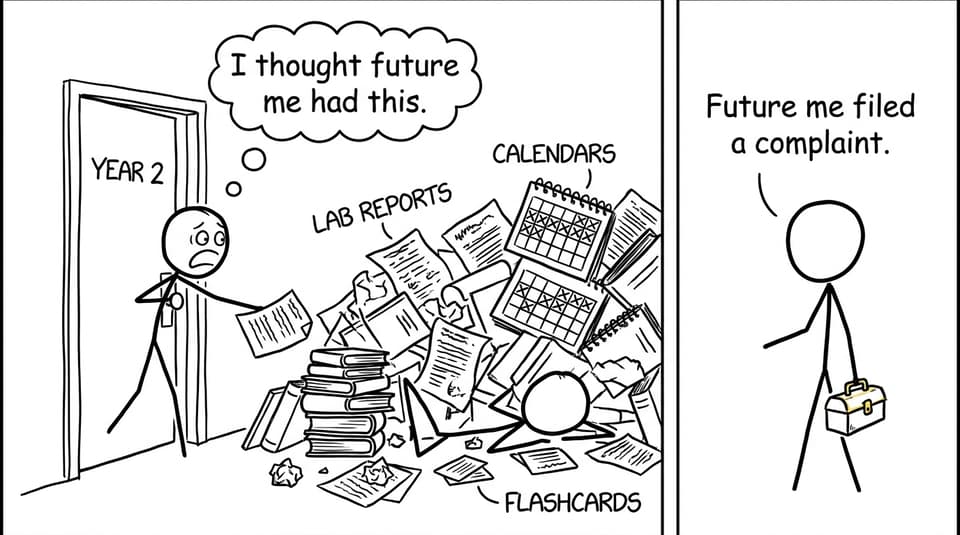
Year 1 knowledge does not remain perfectly preserved simply because you understood it in class. Without retrieval, details become harder to access. Formulas lose their context. Historical evidence becomes vague. Vocabulary that once felt automatic starts requiring effort.
Research on learning consistently supports distributed practice: revisiting material across separated sessions generally produces stronger long-term retention than concentrating the same work into one burst. Retrieval practice also matters. Trying to recall an idea before checking the answer strengthens memory more effectively than repeatedly looking at the information.
This makes summer valuable for a simple reason: it provides time between learning and review. That gap makes recall harder, but useful learning often feels slightly difficult.
A productive review cycle looks like this:
- Choose one narrow Year 1 topic.
- Write or say what you remember without opening your notes.
- Check concise Study Notes to identify omissions.
- Complete several relevant Questionbank problems.
- Turn recurring mistakes into Flashcards.
- Revisit the topic later rather than immediately repeating everything.
RevisionDojo's step-by-step guide to studying for IB exams explains how notes, recall, questions, and error review can work as one cycle. The important shift is from recognizing information to producing it independently.
Year 2 has less spare capacity than it appears
The Diploma Programme combines externally assessed work, examinations, and internal assessment components. Requirements vary by subject, but most students enter Year 2 balancing new content with investigations, oral work, essays, practical work, and the programme core.
The Extended Essay is an independent research project presented as formal academic writing of up to 4,000 words. Theory of Knowledge also includes assessed work, while Creativity, Activity, Service continues across the programme. Your exact deadlines are set by your school, so its calendar should always control your summer priorities.
The problem is not that any one task is impossible. The problem is concurrency. Several reasonable tasks can become unreasonable when they all require attention in the same week.
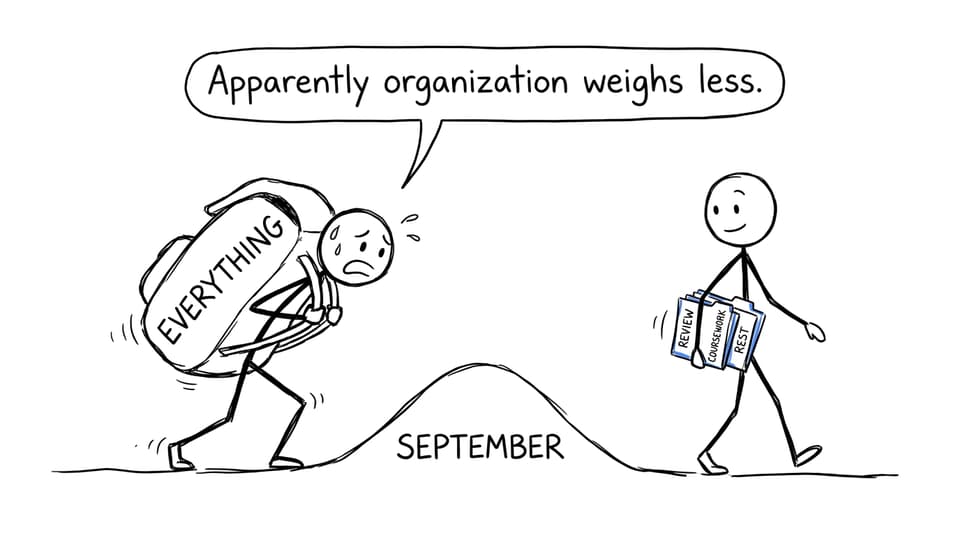
Summer study creates margin. Completing preliminary reading, organizing sources, cleaning data, refining an outline, or reviewing a weak chapter can reduce the number of decisions waiting for you in September. RevisionDojo's IB Coursework Guides can help you understand criteria and structure, while the Coursework Library provides examples for studying how successful work is organized.
Use those resources for analysis, not imitation. Follow your teacher's instructions, document sources carefully, and confirm what assistance is permitted. If you receive supervisor comments, the guide to using feedback on an IA or Extended Essay explains how to turn broad guidance into your own revisions.
Summer reveals weaknesses while they are still affordable
A weak foundation becomes expensive when later topics depend on it. A misunderstanding in algebra can slow progress in calculus. Uncertain experimental reasoning can make a scientific investigation harder to evaluate. Weak source analysis can follow a history student into longer responses.
The summer gives you a low-pressure diagnostic window. Select representative questions from each major Year 1 unit and answer them without notes. Then classify every error:
- Knowledge gap: you could not recall a fact, definition, or process.
- Method gap: you knew the concept but could not apply the procedure.
- Interpretation gap: you misunderstood the prompt or command term.
- Communication gap: your reasoning was correct but insufficiently explained.
- Accuracy gap: arithmetic, notation, evidence, or checking caused the loss.
This classification matters because different errors need different repairs. A knowledge gap may need Flashcards. A method gap needs worked examples followed by independent practice. A communication gap needs model analysis and rewriting.
The RevisionDojo guide to using IB question banks effectively can help turn broad concern into focused practice. Instead of deciding that you are simply “bad at chemistry” or “behind in economics,” you discover one specific skill that can be trained.
A realistic IB summer schedule
An effective plan should be small enough to survive travel, work, family plans, and low-energy days. Start with three study sessions per week, each lasting roughly 45 to 75 minutes. Adjust the frequency to your goals, school deadlines, and wellbeing rather than treating any template as a rule.
Session one: repair
Choose one weak Year 1 topic. Spend a short period using Study Notes, then close them and explain the idea from memory. Finish with targeted Questionbank practice and record no more than three recurring errors.
Session two: coursework
Complete one defined action: annotate two sources, check citations, revise a research question, organize results, or outline a section. “Work on my EE” is too vague. “Evaluate the usefulness of two sources for my current argument” gives the session an endpoint.
Session three: mixed recall
Review Flashcards across several subjects, then complete a short mixed set. Ask RevisionDojo's AI Chat for an explanation when a mark scheme or method remains unclear. If the problem requires deeper individual support, Tutors can help you work through the reasoning rather than merely showing an answer.
Every two or three weeks, replace a normal session with a timed section or short Mock Exam. Later in the summer, Predicted Papers can provide broader practice where they are available. Grading tools can then help identify patterns in written responses, although teacher guidance remains central for submitted coursework.
Students focusing heavily on mathematics can adapt the more detailed IB Math summer preparation strategies. Whatever the subject, the sequence remains stable: understand, retrieve, apply, review.
What not to do during the Year 1 summer
The first mistake is attempting to study every subject every day. It creates a schedule that looks impressive and feels oppressive. Prioritize subjects with foundational gaps, approaching coursework milestones, or skills that deteriorate without practice.
The second mistake is rewriting entire notebooks. Neat pages can create familiarity without proving recall. Condense only when the process forces you to make decisions about meaning, hierarchy, or connections.
The third mistake is starting with full Mock Exams before diagnosing individual topics. Long simulations have value, but targeted practice is usually more manageable early in the summer. Build accuracy first, then timing and stamina.
The fourth mistake is treating rest as evidence of poor discipline. A summer with no recovery can send you into Year 2 already depleted. RevisionDojo's guide to studying for IB exams without burning out emphasizes sustainable blocks, active methods, and protected sleep.
Measure progress by reduced uncertainty
Hours are easy to count but do not always reveal learning. Better evidence includes:
- recalling a concept without prompts;
- completing a previously difficult question independently;
- making fewer errors of the same type;
- producing a clear coursework outline;
- explaining why an answer earns marks;
- identifying the next specific task without hesitation.
Review your plan once a week. Keep what is producing evidence of improvement, reduce what is becoming performative, and change the workload when summer circumstances change.
RevisionDojo's all-in-one IB exam preparation guide connects this process through Study Notes, Flashcards, the Questionbank, AI Chat, Grading tools, Predicted Papers, Mock Exams, the Coursework Library, and Tutors. The value is not having more material. It is moving smoothly from uncertainty to explanation, then from explanation to practice and feedback.
Begin Year 2 with options, not panic
Studying during the Year 1 summer is crucial not because every free day must become productive, but because a small amount of deliberate work protects your future choices. Knowledge stays accessible. Coursework becomes less mysterious. Weaknesses become visible while there is still time to address them calmly.
Choose three priorities today: one topic to repair, one coursework milestone to clarify, and one routine you can sustain. Then stop planning and complete the smallest useful action.
Year 2 will still be demanding. The difference is that you will not meet it from a standing start. With RevisionDojo as your central IB resource, each summer session can lead somewhere specific: from concise learning, to active recall, to realistic practice, to feedback that determines what comes next.