

The question every stressed IB student asks
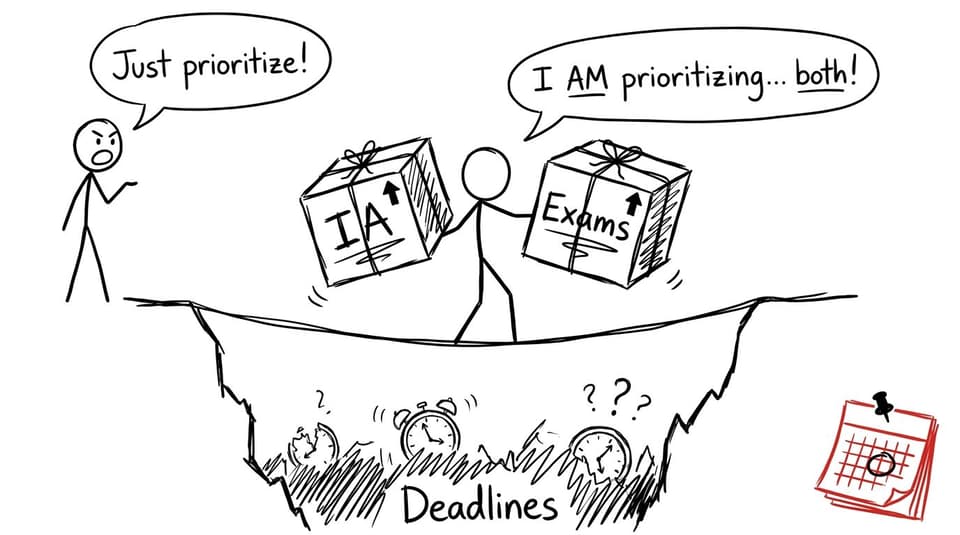
There's a particular moment in the IB year when your brain starts doing financial math.
Not compound interest math. More like: "If I spend four more hours polishing my IA, how many marks does that buy me compared with two hours of exam revision?"
That's why the question Which IA is worth the most marks? never really means "Tell me a number." It means: where should I put my limited effort so my final grade moves the most?
In other words: you're asking about IA impact.
This article breaks down how to think about IA value in a way that actually helps you plan. We'll separate raw marks from grade weighting, show you the quick calculation that matters, and give you a practical strategy for using your IA to reduce exam pressure (not add to it). Along the way, I'll point you to RevisionDojo tools that make the IA process calmer: Grading tools, AI Chat, Coursework Library, Study Notes, Flashcards, Questionbank, Mock Exams, Predicted Papers, and Tutors.
Quick checklist: how to tell if an IA is "worth the most marks"
Before we talk about any specific subject, use this checklist. It's the fastest way to judge how much your IA matters.
- Check the IA weighting for your subject and level (SL/HL). This is the percentage of your final grade.
- Check the IA total marks (often 20, 24, 30, etc.). This tells you how "granular" improvement can be.
- Estimate your realistic improvement (e.g., +3 marks, +6 marks). Be honest.
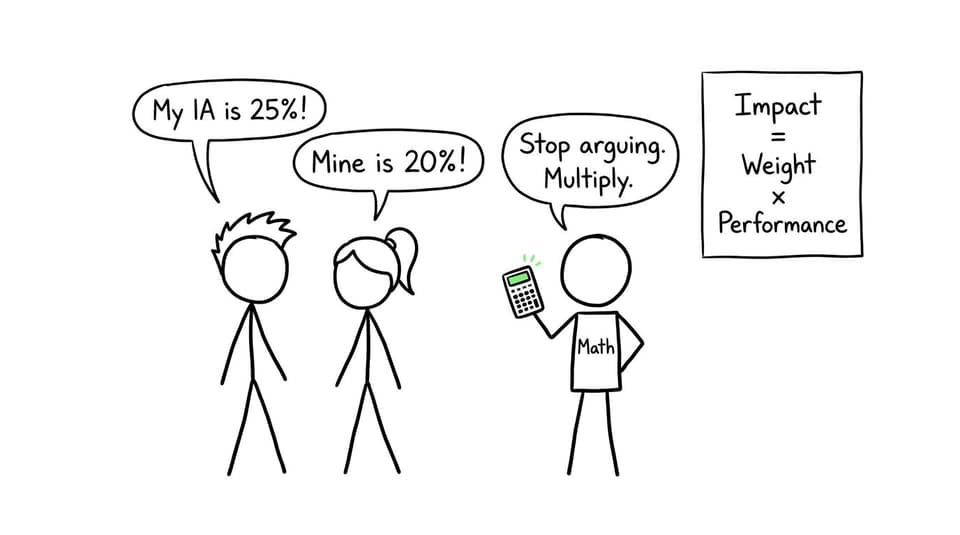
- Calculate impact:
weighting % x (mark improvement / total IA marks). - Compare that to exam impact: same idea, but with paper weightings.
That's the whole game. Everything else is details.
IA marks vs IA weighting: the mistake that causes panic
A lot of confusion comes from mixing up two different things:
IA total marks (raw marks)
This is the rubric total: for example, an IA out of 30. Raw marks tell you how many "steps" exist between okay and excellent.
IA weighting (percentage of final grade)
This is how much the IA contributes to your final subject grade.
An IA can be out of 30 marks and still have a smaller effect on your final grade than an IA out of 20 marks, depending on weighting.
So when someone asks, "Which IA is worth the most marks?", what they usually want is:
-
the highest weighting, and/or
-
the biggest realistic grade swing for the time invested.
That second one is the more useful question.
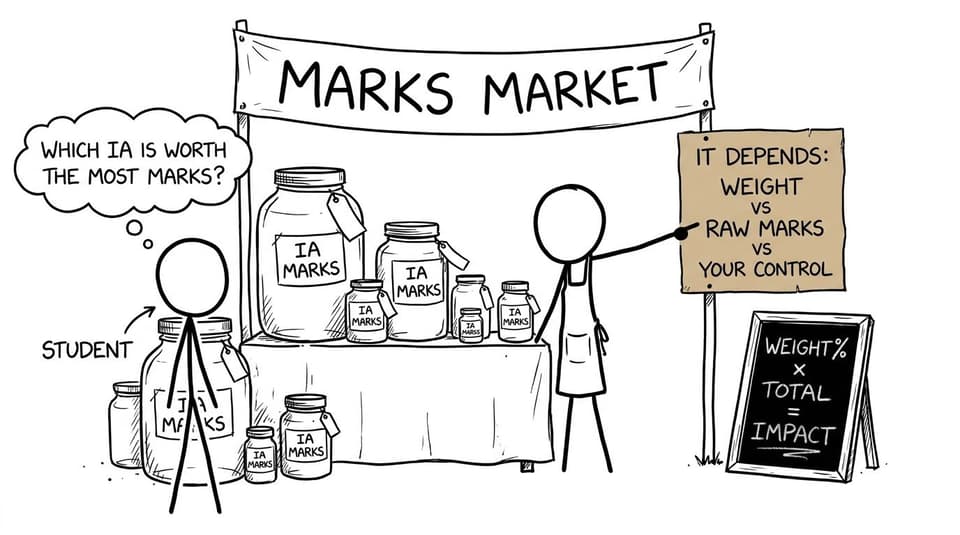
So which IA is worth the most marks?
In pure "final grade weighting" terms, the IAs that feel most valuable are often the ones with 20% to 30% weighting in many programs.
But you don't need a universal ranking to make a smart decision. You need a personal ranking based on your subjects.
Here's the clean way to answer it:
The IA worth the most marks is the one where you can still improve the most
That's not motivational. It's mathematical.
- If your IA is already near the ceiling, adding 10 more hours might only gain +1 or +2 marks.
- If your IA is underdeveloped but fixable (weak analysis, unclear structure, missing evaluation), the same 10 hours can gain +6 to +10 marks.
Impact comes from change, not from the rubric total.
A real example (use this template)
Let's say:
- Subject A: IA weighting 20%, IA out of 30
- You can improve by +6 marks
Impact on final grade proportion: 0.20 x (6/30) = 0.04 (a 4% swing in the overall subject outcome).
Now compare:
- Subject B: IA weighting 25%, IA out of 20
- You can improve by +2 marks
Impact: 0.25 x (2/20) = 0.025 (2.5% swing).
Even though Subject B has higher weighting, Subject A is currently the better investment.
That's what "worth the most marks" means in practice.
One subject we can verify: ESS IA weighting (and why it matters)
Some subjects publish clear rubric totals and weightings in accessible tools. For instance, RevisionDojo's ESS rubric grader states the ESS IA is marked out of 30 and contributes 25% at SL and 20% at HL.
If you take ESS, that makes your IA a serious lever.
If you want a fast, criterion-by-criterion sense of where your ESS draft stands, use the IB ESS (new) IA Grader. It's built to mirror rubric language so your edits are aimed at marks, not vibes.
The best way to "rank" your IAs: the 3-factor model
If you're juggling multiple IAs (which you are), rank them using three factors:
Weighting
Higher weighting means each improvement matters more.
Controllability
Some IAs are more controllable because feedback loops are faster. If you can test changes against a rubric quickly, you can climb marks predictably.
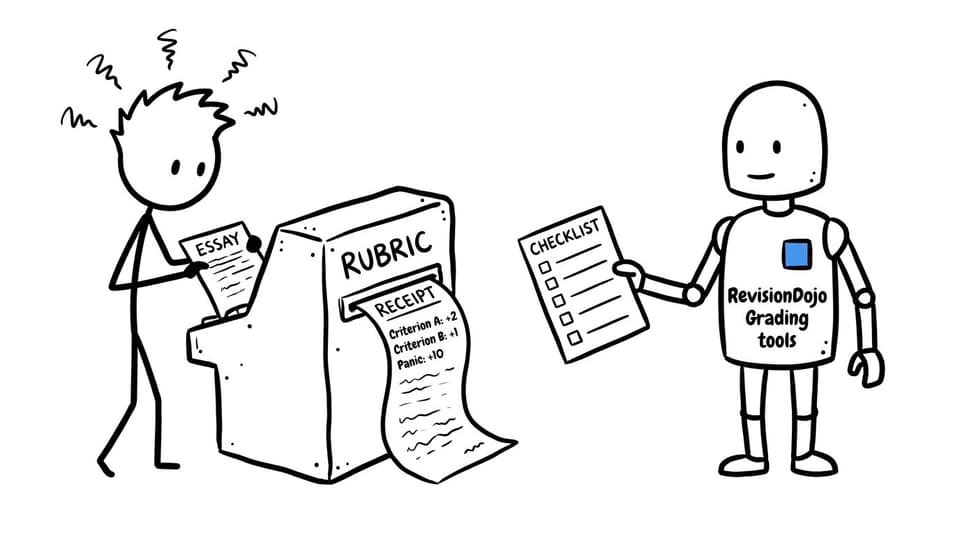
This is where RevisionDojo's Grading tools change the experience. When you upload a draft to a rubric-aware grader, you stop guessing. You start iterating.
Try this with:
Headroom
Headroom is the gap between where you are and where you could be.
The fastest headroom wins tend to be:
- missing evaluation/reflection
- unclear research question/aim
- messy data processing/communication
- weak criterion alignment (writing good work… for the wrong criterion)
A calm strategy: treat your IA like an "exam you can edit"
Exams are brutal because the clock is final.
Your IA is different. It's an exam where you get to:
- re-read the question (the rubric)
- rewrite the answer
- submit only when it's shaped like marks
This mindset shift matters because it stops you from treating the IA as a creative project and starts treating it as a scoring opportunity.
RevisionDojo is built around that scoring mindset. You can use the Coursework Library to see what strong work looks like, then use Grading tools to map your own draft to the rubric, then use AI Chat to fix the exact sentence-level issues you keep repeating.
If you want the broader system for exam season too, the loop is described well here: RevisionDojo App: The Smarter Way to Prep for IB Exams.
Overview: how to maximize IA marks in the final month (without losing exam time)
Here's a simple approach many top students use when deadlines collide.
Do a 60-minute rubric audit first
Open the rubric and do this:
- Highlight every descriptor that sounds like evidence (not effort).
- For each criterion, write one sentence: "To gain the next mark, I need to add…"
- Make a checklist of only those additions.
If you want to see how rubric-driven improvement is supposed to feel, browse All IA posts and pick one guide for your subject.
Use a feedback loop, not a motivation loop
Motivation fades. Feedback compounds.
On RevisionDojo, your feedback loop can look like:
- Use a grader for criterion-level notes (your IA becomes measurable)
- Ask Jojo AI Chat to rewrite one paragraph to meet a criterion better
- Turn recurring mistakes into Flashcards so you stop repeating them
- Return to exams with less cognitive load
To anchor the rest of your study time, build exam skill with Notes + Flashcards + Question Bank (Free).
Protect two weekly exam sessions no matter what
This is the trap: a heavy IA week can silently erase exams.
Schedule two non-negotiable sessions using:
- Questionbank practice for weak topics
- a timed Mock Exams block when possible
If you need a structure for timed practice, use How to Run Timed IB Mock Exams in RevisionDojo.
Where RevisionDojo fits: making the IA less mysterious
The hardest part of an IA isn't writing. It's not knowing what matters.
RevisionDojo reduces that uncertainty by connecting the things you already do into a single loop:
- Study Notes clarify the content and the language IB expects
- Flashcards keep definitions, methods, and evaluation points alive
- Questionbank trains you to answer like the mark scheme wants
- AI Chat helps you get unstuck quickly without spiraling
- Grading tools turn your IA into criterion-by-criterion steps
- Coursework Library shows models so you can stop guessing quality
- Tutors add a human layer when you need strategic feedback
- Mock Exams and Predicted Papers keep exam readiness real
If you want a good "systems" read for the final stretch, this pairs well with the mindset above: Top Students Don't Study Like You Think (IB Edition).
Closing: the IA worth the most marks is the one you can still move
The honest answer to "Which IA is worth the most marks?" is that it depends on subject weightings.
The useful answer is simpler: the IA worth the most marks is the one where your next 5 hours can still buy the biggest mark increase.
So do the calculation. Find the headroom. Use the rubric. Build a feedback loop.
Then keep your exams alive with a steady routine: quick Flashcards daily, targeted Questionbank blocks, and a weekly timed session with Mock Exams or Predicted Papers.
If you want the whole system in one place, RevisionDojo is designed for exactly this moment in the IB: coursework stress on one side, exams on the other, and you in the middle trying to make smart choices. Start by using an IA grader, check your criteria, and turn your next draft into marks.