Home / Blog / Top Students Don’t Study Like You Think (IB Edition) Top Students Don’t Study Like You Think (IB Edition) RevisionDojo Team • Last updated: 19 Jul 2026 • 10 min read
© 2022 - 2026 RevisionDojo (MyDojo Inc)
RevisionDojo was developed independently of the IBO and as such is not endorsed by it in any way.
Related Articles IB en España · Oct 20, 2026 · 14 min read
Cómo estudiar Catalán A IB: guía completa Aprende cómo estudiar Catalán A del IB en NM y NS: organización, análisis literario, lectura, escritura y preparación de cada evaluación paso a paso.
IB en España · Oct 20, 2026 · 11 min read
Cómo usar exámenes anteriores de Inglés A del IB Aprende a usar exámenes anteriores de Inglés A del IB: cuándo empezar, cómo cronometrarte, corregir con criterios y registrar tus errores.
IB en España · Oct 20, 2026 · 10
Cómo practicar Lengua ab initio IB fuera de clase Aprende cómo practicar Lengua ab initio IB fuera de clase con rutinas eficaces para mejorar vocabulario, escucha, conversación, lectura y escritura.
IB World Religions · Oct 20, 2026 · 11
Non-Violence in Indian Religions: Three Views Non-violence Indian religions compared: explore Jain, Buddhist and Hindu teachings on ahimsa, with examples and IB World Religions SL exam advice.
IB World Religions · Oct 20, 2026 · 12
Vaisakhi and Gurpurbs: Sikh Festivals for IB Vaisakhi and Gurpurbs explained for IB students, including Khalsa identity, Sikh beliefs, sacred texts, practices, interpretations and exam links.
IB World Religions · Oct 20, 2026 · 11
Pesach, Shavuot and Sukkot: An IB Student Guide Pesach Shavuot Sukkot explained for IB World Religions SL, with rituals, texts, interpretations, key concepts and an exam-ready revision comparison.
In the IB , most students imagine top scorers studying like monks: color-coded schedules, 8-hour marathons, and notes so neat they look framed.
But the first time you watch a genuinely high-performing student revise up close, it can feel almost disappointing.
They don't look intense.
They look… repetitive.
They do a small set of exam-style questions, mark ruthlessly, fix one mistake, and leave.
That's the twist: in the IB , the most effective study often looks boring from the outside. It's quieter than motivation. It's closer to training.
And if you're preparing for exams right now, that's good news. Because you don't need a new personality. You need a better system.
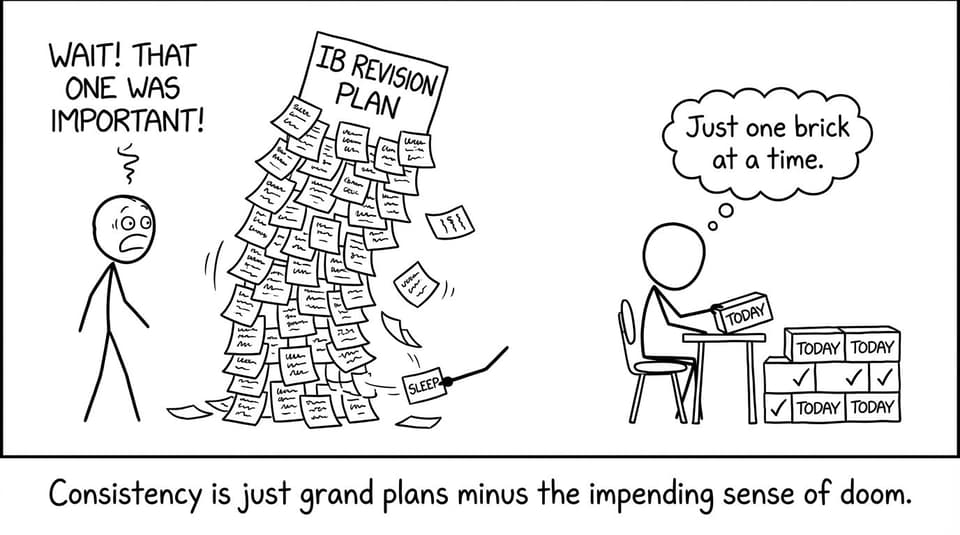
A tall revision plan collapses while a small checklist survives The IB difference: the exam doesn't reward effort, it rewards outputs
Here's a hard truth that ends up being strangely calming:
The IB doesn't grade your intentions.
It grades what you can produce under constraints.
That means top students optimize for three things:
Recall speed (can you retrieve it quickly?)Exam technique (can you package it the way marks are awarded?)
min read
min read
min read
min read
Consistency (can you do it again tomorrow?)This is why their study habits can look "smaller" than yours. They're building outputs, not vibes.
If you want to see what a full IB workflow looks like in one place, the easiest starting point is the RevisionDojo for IB hub .
A quick checklist: how top students actually study for IB exams Borrow this as a default template:
Pick one IB paper you're training for (not the whole subject)
Learn one subtopic quickly using Study Notes
Test immediately with Questionbank practice
Turn mistakes into Flashcards (spaced repetition)
Do timed practice weekly (Mock Exams or Predicted Papers)
Use AI Chat to get unstuck fast (then re-test)
Use Grading tools + the Coursework Library to stop coursework stress from leaking into exam season
Ask Tutors for targeted help when you're plateauing
Top students don't "revise"; they run feedback loops A lot of IB study time disappears into activities that feel productive but don't create feedback.
Rereading notes can be comforting.
Rewriting notes can be satisfying.
Watching videos can feel like momentum.
But none of those automatically tell you what you can't do yet .
Top students hunt for that information.
They want the awkward moment where the question exposes a gap.
Because a gap has a location.
And a location can be fixed.
The small secret: they study in "paper language," not "topic language" Many students plan like this:
Top students plan like this:
"Train IB Biology Paper X, Topic Y, Question type Z."
That shift matters because the IB is a format as much as it is content. You can know a chapter and still lose marks if you answer the wrong command term or structure.
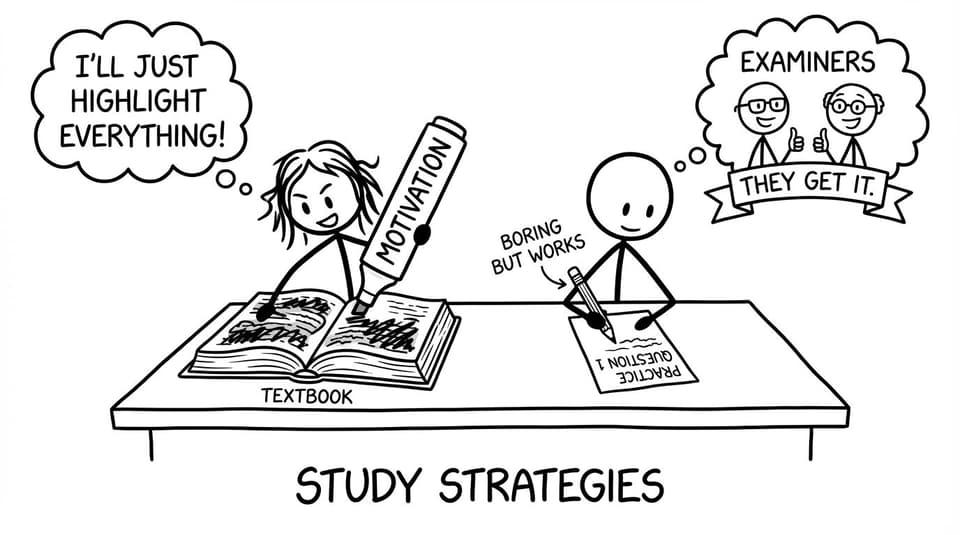
One student highlights everything while another does one question
Top students use notes differently (and spend less time with them) Top scorers aren't "anti-notes."
They're anti-notes-as-a-hiding-place.
In IB revision, notes should do one job: make the next question easier.
If your notes session doesn't end in a question attempt, it's not revision yet.
That's why students who move faster often rely on clean, syllabus-aligned notes that skip the fluff. Two useful references:
The "question mode" method (15 minutes that beats an hour of rereading) Try this for any IB topic:
Read one short section of Study Notes
Close it
Write 3 questions the examiner could ask
Answer from memory
Then prove it using the Questionbank
This turns notes into a launchpad instead of a hammock.
Top students don't avoid boredom; they weaponize it There's a strange pattern in the IB :
The study methods that feel the most "motivating" are often the least effective.
And the methods that feel a little dull are often the ones that raise grades.
That's because boredom is frequently a sign of repetition.
And repetition is how you build speed.
Flashcards are a perfect example. They aren't exciting. They're reliable. They keep recall warm across six subjects when life is busy.
Top students use AI like a pit crew, not a chauffeur A common trap for stressed IB students is using AI as a way to avoid the hard part: producing an answer.
Top students do the opposite.
They attempt first, then use AI to speed up correction.
That's why tools like AI Chat and Grading tools are most powerful when they keep you moving:
Explain one misconception quickly
Generate a mini-quiz
Show how your answer missed the mark-scheme shape
Give you one next step
Then you go back to questions.
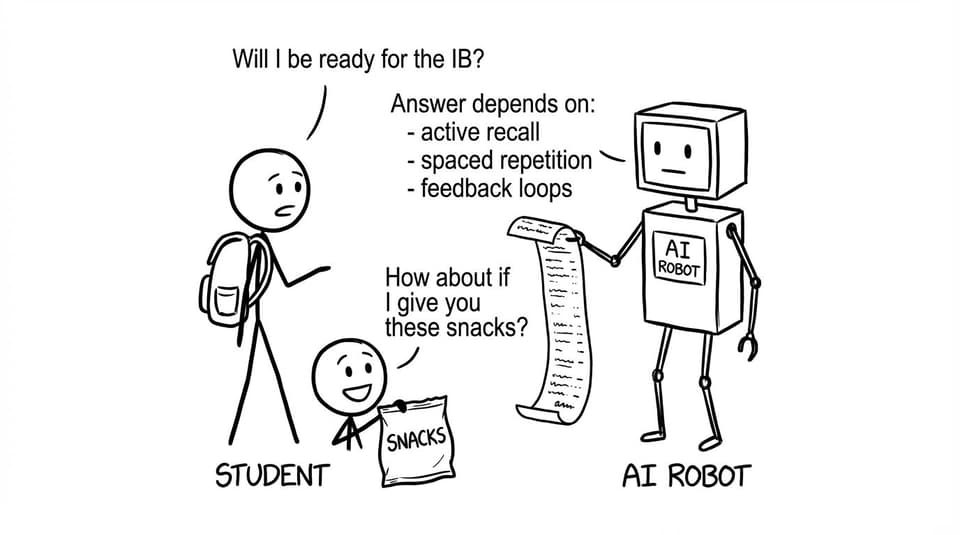
An AI robot prints a receipt listing active recall and feedback loops
Top students train timing earlier than you think Many IB students delay timed work because it feels stressful.
But that delay makes exam day more stressful.
Top scorers treat timing like a skill, not a personality trait.
They build it the same way you build anything else: exposure.
Timed sets (15-25 minutes)
Timed sections (30-60 minutes)
Full Mock Exams (paper-length)
Top students protect sleep like it's an IB subject This is the least glamorous advantage.
In the IB , fatigue doesn't just reduce memory.
misreading command terms
over-writing low-mark questions
blanking on easy definitions
panicking when you could have banked marks elsewhere
Top students don't always sleep perfectly, but they treat sleep as a performance input, not a reward.
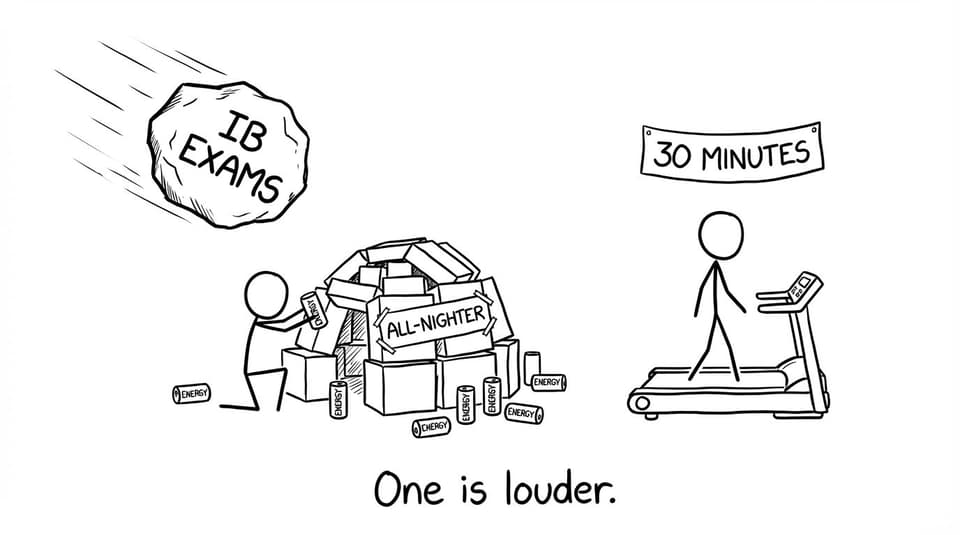
An IB exam calendar meteor approaches; two students respond differently
A practical 7-day IB micro-plan (steal this) If you want to feel different in a week, do this. Keep it small enough that you'll actually repeat it.
Daily (10-20 minutes)
Flashcards (spaced repetition)
One "error rule" review (the mistake you keep repeating)
4 days this week (45-75 minutes)
10 minutes: Study Notes for one subtopic
30-45 minutes: Questionbank practice on that exact subtopic
10-15 minutes: log mistakes, convert two into flashcards
1 day this week (60-120 minutes)
Timed practice (Mock Exam section or full paper depending on time)
Review for patterns: knowledge vs technique vs time
1 day this week
Coursework maintenance window: use Grading tools + Coursework Library to reduce uncertainty
This is the kind of plan that compounds in the IB because it is repeatable.
Closing: the IB top-student advantage is quieter than you think The difference isn't that top scorers have more willpower.
In the IB , the edge is usually a system that creates feedback, protects consistency, and trains the exact outputs the exam rewards.
If you want to build that system without stitching together five different resources, use RevisionDojo as your control panel: Questionbank for exam practice, Study Notes for fast clarity, Flashcards for daily recall, AI Chat for quick unblocking, Mock Exams and Predicted Papers for realism, plus Grading tools , a Coursework Library , and Tutors when you need feedback that's faster than waiting.
Start simple, stay consistent, and let the loop do the heavy lifting for your IB exams.
Continue studying with RevisionDojo
Frequently Asked Questions Do top IB students really study less, or do they just hide it?
What should I do if I keep revising but my IB grades aren't improving?
How do I balance six IB subjects without feeling like I'm failing all of them?