

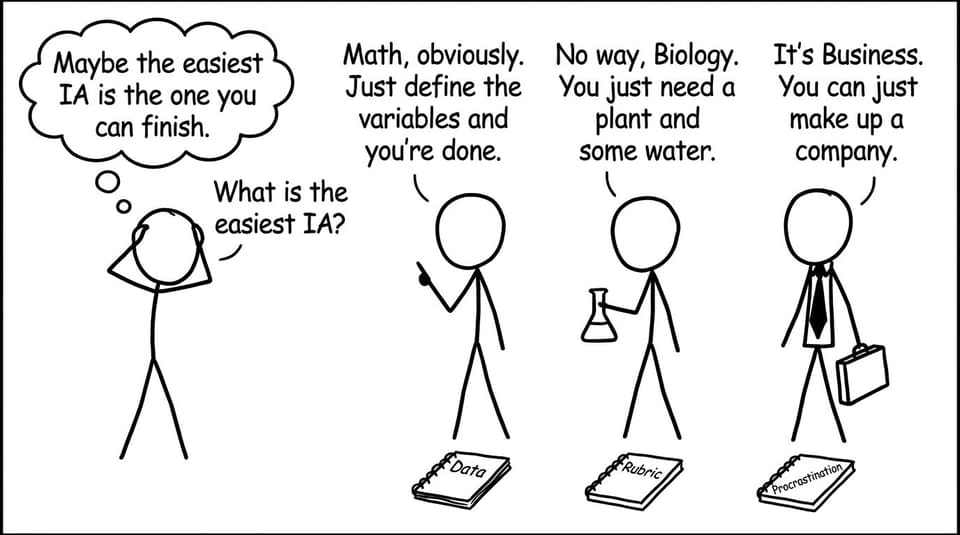
When someone asks, "What is the easiest IA?", they're rarely asking about intelligence.
They're asking about pain.
They want the version of the IA that doesn't quietly expand to fill every evening. The one that doesn't depend on a lab booking that never happens, a survey nobody answers, or an idea that sounded brilliant until it met the rubric.
The truth is simple, and slightly annoying: the easiest IA is the one you can finish well.
Not the one with the simplest topic. Not the one your friend did. Not the one that looks "impressive" on a title page. The easiest IA is the one with clear criteria, reliable data, manageable scope, and a topic you can explain without forcing enthusiasm.
If you want a quick refresher on what an IB IA is (and why it matters so much), start with IB Internal Assessment: A Complete Guide.
The "easiest IA" checklist (print this mentally)
Before you commit to any IA idea, run this checklist. If you can tick most boxes, you're looking at an easy IA (meaning: straightforward to execute and score well).
- Data is accessible within 48 hours (primary or secondary)
- Method is repeatable and doesn't rely on perfect conditions
- Variables are controllable (or at least discussable)
- Rubric feels clear: you can see how marks are earned
- Scope is small enough to finish a solid draft in 2 weeks
- You can evaluate limitations without destroying your own conclusion
- Teacher feedback cycle exists (you can submit drafts and iterate)
If you want your IA process to feel less like guessing, RevisionDojo's ecosystem is built around clarity and iteration: Study Notes, Flashcards, and the Questionbank for understanding, plus AI Chat, Grading tools, exemplars in the Coursework Library, and Tutors when you need a human to pressure-test your plan.
What "easy" really means in an IA
Easy doesn't mean "low effort." It means low friction.
Low friction is when you can take the next step without needing permission, special equipment, or perfect timing. It's when your IA is designed so progress happens on normal days, not ideal ones.
A low-friction IA usually has:
- A question that can be answered with available evidence
- A method that produces usable results even if one part goes wrong
- A rubric pathway you can see clearly (what earns marks, what loses them)
That's why the "easiest IA" differs by student. A confident writer might find a Business Management IA easier than a Chemistry lab. A data-minded student might find a Math IA easier than a Psychology experiment.
The goal isn't to find the objectively easiest IA. It's to find the easiest IA for you.
The easiest IA by subject type (patterns that keep showing up)
Different IB subjects have different IA formats. But the same "easy" patterns show up again and again.
Sciences: the easiest IA is usually the one with boring reliability
For Biology, Chemistry, and Physics, the easiest IA tends to be:
- Based on simple apparatus and a familiar method
- Designed around clean variables
- Run with enough trials to support analysis
Not because boring is better, but because boring is controllable.
A classic mistake is choosing a "cool" experiment that depends on fragile conditions. When it fails, you lose weeks. When it works, the data is often too messy to analyze well.
If you're doing Biology, use RevisionDojo's subject-specific support to reduce uncertainty: the IB Biology IA Guide and the IB Biology IA Grader help you align drafts with the rubric quickly.
And if you need to see what high-quality looks like, the Biology IA exemplars in the Coursework Library can save you from reinventing structure.
Math: the easiest IA is usually the one with a small question and real data
Math IAs become hard for two reasons:
-
The topic is too broad.
-
The math is performed but not explained.
The easiest IA in Math is often a small exploration with a dataset you can actually work with. The writing becomes easier because your results give you something to talk about.
If you're unsure about structure and expectations, this is worth keeping open while you plan: Math IA Essentials.
If you're in Applications and Interpretation, use targeted examples: Math AI IA Examples and the workflow guidance from A Step-by-Step Guide to IB Math AI IA.
And when your draft starts to feel like disconnected calculations, this piece is a calm reset: Maintain Mathematical Flow and Coherence in the IB Math IA.
Business Management: the easiest IA is often the one with access
Business Management IAs get easier when you have access to:
- A cooperative organization (even a small local one)
- Basic documents or interview insights
- A defined problem you can analyze with course tools
The hardest Business IAs aren't "difficult." They're vague.
Start with a guide that makes the criteria feel less mysterious: IB Business Management IA Guide.
ESS: the easiest IA often uses strong secondary data and clear justification
ESS is one of those subjects where "easy" often means you build a smart investigation around data you can justify and evaluate.
If you're in the new syllabus, ground yourself in the official-feeling expectations with ESS IA Essentials and then validate your work against the rubric using the ESS (new) IA Grader.
Psychology: the easiest IA is the one that reduces logistics
Psychology IAs become painful when the logistics multiply: participant recruitment, ethics, materials, time, and analysis.
The easiest IA here often comes from choosing a design that:
- Is straightforward to run with classmates
- Produces results you can actually analyze
- Leaves you enough room to evaluate limitations properly
Then use the IB Psychology IA Grader to quickly see what each criterion is still missing.
The enemy of the easiest IA: scope creep
You'll know scope creep has started when your IA begins collecting extra tasks like a magnet collects paperclips.
You add a second variable "just in case." You expand the sample size beyond what you can manage. You chase a more advanced model because it looks impressive. You start reading articles that make you feel behind.
Then your IA becomes hard, not because you can't do it, but because you can't finish it.
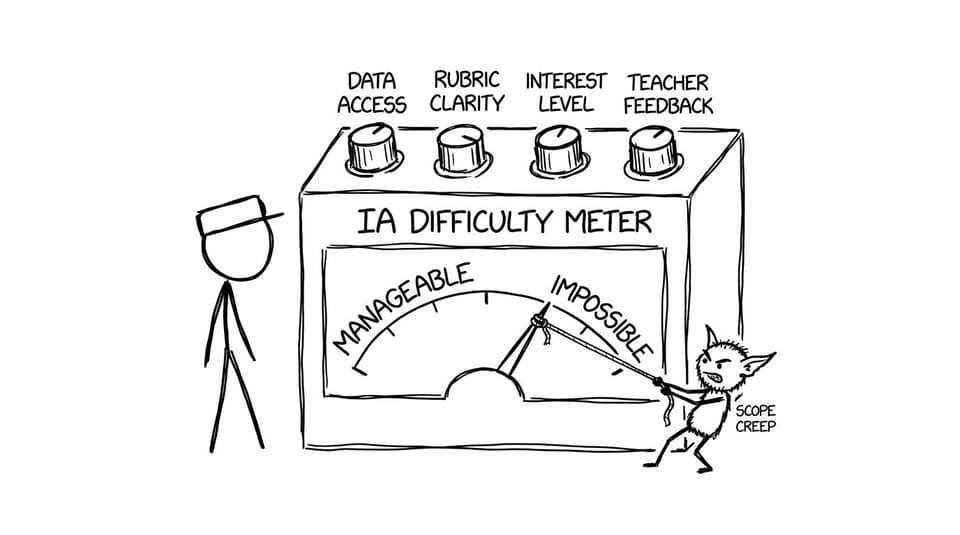
A practical rule: Your IA should get narrower over time, not wider.
If you need help keeping it controlled, RevisionDojo's AI Chat can act like a calm supervisor: you tell it your aim, method, and variables, and ask, "Where is this too broad?" Then you verify against the rubric with the relevant Grading tools.
A simple "easy IA" planning workflow (that actually finishes)
Here's a workflow you can run without heroics:
Pick a question you can answer with available evidence
Within one day, you should know:
- what data you'll use
- how you'll collect or source it
- what analysis you'll perform
If that's unclear, the IA is not easy yet.
Build a one-page method before you do anything else
A one-page method forces honesty. It reveals hidden dependencies early.
Include:
- aim and variables
- materials/data sources
- step-by-step method
- planned analysis
- limitations you already anticipate
Do a "tiny pilot" immediately
Before committing, run the smallest version of the investigation:
- one trial
- five data points
- one graph
- one paragraph of reflection
If you can't pilot, you can't finish.
Draft early, then iterate with feedback
The easiest IA is the one that becomes clearer through drafts.
RevisionDojo supports that iteration loop directly: build understanding with Study Notes, reinforce with Flashcards, stress-test your concepts with the Questionbank, and then use subject-specific rubric graders to tighten the IA.
If you're trying to integrate IA work into exam revision without losing your mind, this article helps: The Role of IAs and Revision.
Should you use primary data or secondary data for an easier IA?
Secondary data is often the quiet shortcut to an easier IA, provided your subject allows it and you evaluate source reliability properly.
Primary data can be great, but it introduces risk: equipment issues, participant drop-off, inconsistent conditions, and time.
Secondary data tends to be easier because:
- it's already collected
- it's often larger and cleaner
- you can start analysis immediately
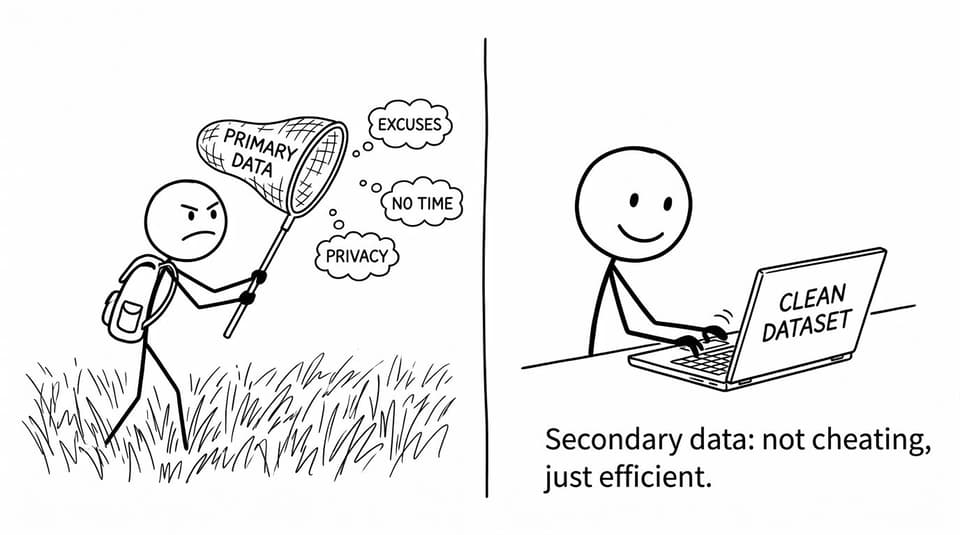
The key is not pretending secondary data is magically perfect. You still need to discuss limitations, bias, measurement issues, and context. That evaluation is often where marks live.
For a practical guide to what "good analysis" looks like, read How to Use Data Effectively in Your IA Analysis.
Closing: the easiest IA is the one you can finish twice
A strange secret about the easiest IA is that it's often the one you can rewrite.
Not because you enjoy rewriting, but because the first draft is where you discover what the IA really is. The second draft is where you earn the marks.
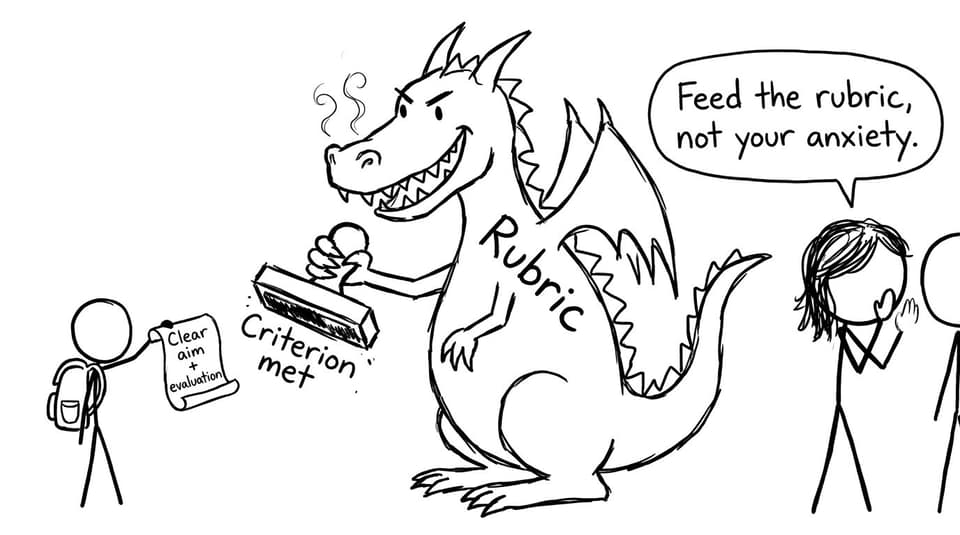
So choose the IA that lets you start quickly, collect data reliably, and iterate with feedback. Feed the rubric. Starve the scope creep.
If you want that process to feel calm and controlled, use RevisionDojo as your IA and exam control panel: build understanding with Study Notes, lock it in with Flashcards, prove it with the Questionbank, ask AI Chat the questions you're avoiding, validate drafts with Grading tools, learn structure from the Coursework Library, and bring in Tutors when you need momentum.
Because the easiest IA is not the one with the simplest title.
It's the one you can finish well.