
You can write a brilliant EE and still lose sleep over one small thing: paperwork.
It usually happens late. You’ve finally found momentum, your arguments are starting to sound like you, and then someone says, “By the way, did your university mentor sign the external mentor form?”
Your brain does a quick scan of everything you’ve done for your EE. Research question revisions. Citations. Reflection notes. Draft feedback. And then it lands on a blank spot: external mentor form.
This post is here to remove the fog. If you worked with an external mentor, there are clear expectations. If you didn’t, you can stop worrying. Either way, understanding the rule protects your EE from an avoidable authentication issue.
EE external mentor form: the short answer
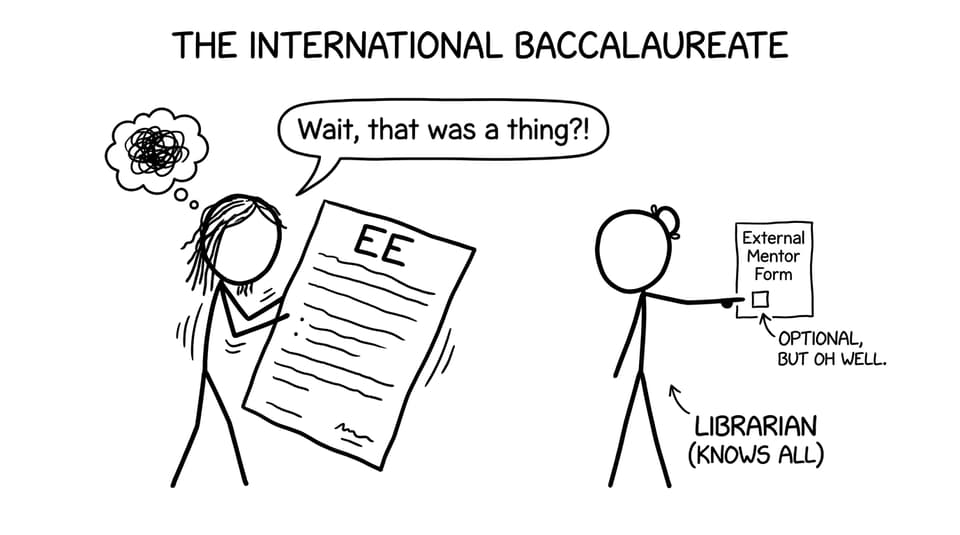
If you used an external mentor for your EE (for example, a university researcher, lab supervisor, industry expert, or specialist outside your school), you need an external mentor form.
And two details matter more than students expect:
- The external mentor must sign the external mentor form.
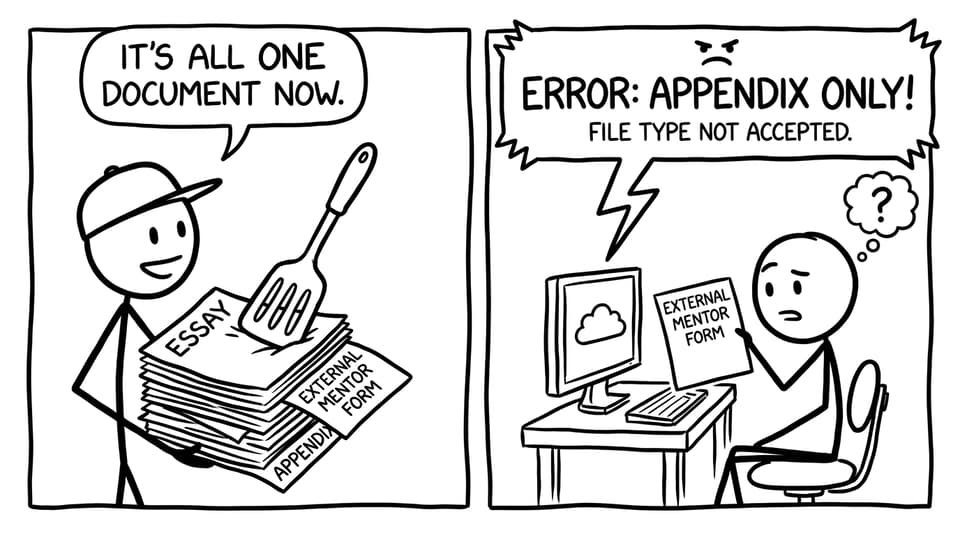
- The form must be inserted into the appendix of the EE in the same document file (not uploaded separately).
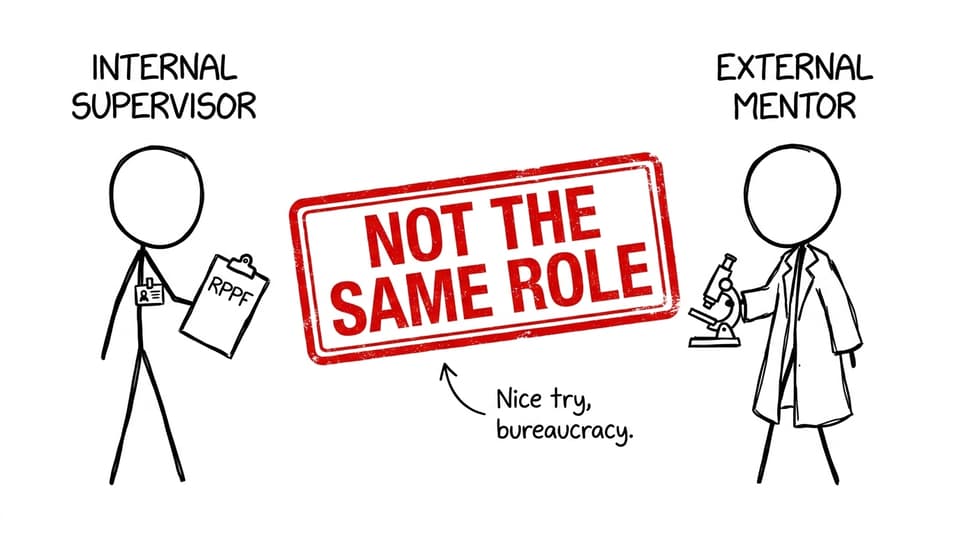
Even with an external mentor, you must still have an internal supervisor at your school. The internal supervisor conducts all three reflection sessions and signs the RPPF. The external mentor cannot fulfil the internal supervisor role.
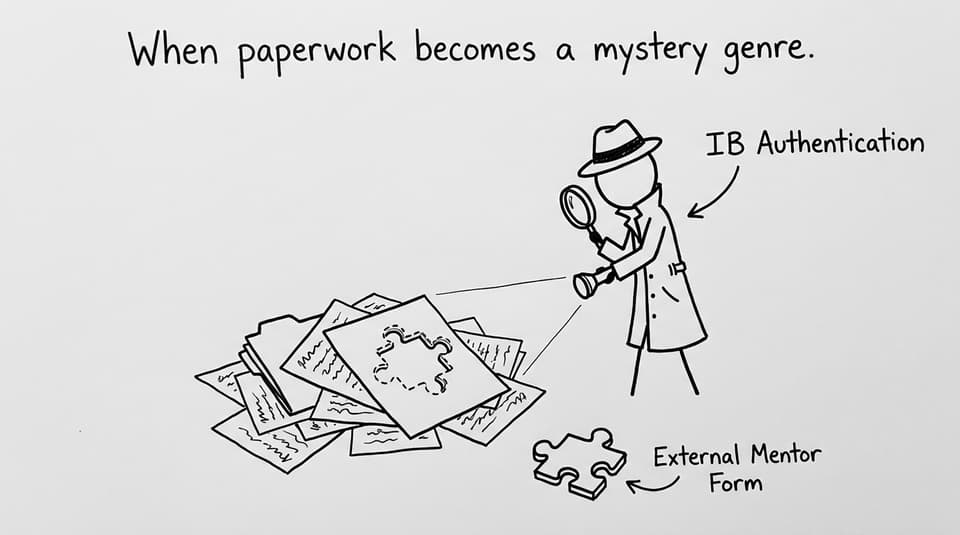
If the external mentor form is missing when an external mentor was used, it creates an authentication gap. That gap can trigger questions about academic honesty and may lead to an academic misconduct investigation.
Quick checklist: do you need an external mentor form for your EE?
Use this quick checklist before you panic-edit your EE at 1 a.m.
- Did anyone outside your school guide your research methods, data collection, interviews, lab work, or specialist analysis for your EE?
- Did you meet, email, or collaborate with a non-school expert who influenced how the investigation was conducted?
- Did you access a university lab, research group, clinic, company, or archive with an assigned person supporting your work?
If yes, treat that person as an external mentor and make sure the EE external mentor form is completed, signed, and placed inside your appendix.
If no, you typically do not need the external mentor form. Your EE remains supervised internally through your school process.
For broader EE planning and structure, keep the main hub open while you work: IB Extended Essay Guide.
What counts as an “external mentor” in an EE?
An external mentor is not just “someone who answered one quick question.” In practice, an external mentor is someone outside your school who provides ongoing or substantive support that shapes the research process of your EE.
Common examples include:
- A university researcher helping you design methodology or interpret results.
- A lab technician showing you procedures or enabling you to collect data.
- A professional (economist, engineer, psychologist, lawyer, journalist) advising on tools, frameworks, or access to specialist sources.
- An archive curator guiding you to primary materials.
A helpful way to think about it: if their involvement becomes part of how your EE was possible, not just a source you cited, you’re in external mentor territory.
If you want more support on building a clean research process (so your final EE feels defensible and transparent), this guide helps: What Are the Best Sources for IB Extended Essay Research?
Where the external mentor form goes (this is the detail people miss)
This requirement is specific and easy to get wrong:
If you used an external mentor, the external mentor form must be inserted into the appendix of your EE as part of the same document file.
Not a separate upload. Not an email attachment “on the side.” Not a form your coordinator keeps somewhere else.
Your EE document should contain:
- Main essay content
- Works cited / bibliography
- Appendix
- External mentor form placed in that appendix
This is one of those rules that feels administrative until you realize what it protects: the authenticity chain of your EE.
Internal supervisor vs external mentor: not the same job
Students sometimes assume, “My external mentor basically supervised the EE.” That assumption can create real risk.
In the EE process, the internal supervisor is the school-appointed teacher who:
- Conducts the three mandatory reflection sessions
- Oversees the official school-side process
- Signs the RPPF
- Confirms authenticity expectations
The external mentor cannot replace that. The external mentor’s role is supportive, specialist, and limited. Your internal supervisor remains the official supervisor for the EE.
If you want to understand what schools expect supervisors to do (and what they are not allowed to do), this is useful context: 10 Key Responsibilities of the Extended Essay Supervisor in IB.
Why a missing external mentor form can become a serious EE problem
An EE is assessed partly on trust: trust that the work is yours, that your process is legitimate, and that your support was appropriate.
When an external mentor is involved, the form acts like a simple bridge between two worlds:
- the world outside school (specialist access, labs, experts)
- the world inside school (supervision, reflection sessions, authentication)
If the form is missing, you create an authentication gap. That gap can lead people to ask:
- Who exactly helped you?
- What did they do?
- Did the help cross the line into editing or authorship?
- Was this disclosed properly?
And yes, that can escalate into an academic misconduct investigation, even if your intentions were completely honest.
To understand the IB’s expectations around authenticity and honesty for the EE, read: What Are IB's Expectations for Academic Honesty in the Extended Essay (EE).
How to work with an external mentor without risking your EE
External mentors can be amazing. The goal is not to avoid them. The goal is to keep your EE clean.
Set expectations early
Before your mentor reads anything, clarify:
- You will write all text yourself.
- They can advise on methods, feasibility, safety, and general direction.
- They should avoid rewriting your sentences, building your argument for you, or editing your draft like a university supervisor would.
This aligns with how strong feedback is supposed to work in IB coursework: guiding, not ghostwriting. Helpful read: How to Use Feedback to Improve Your IB IA and EE.
Keep a simple “support log”
Even a short note after each meeting helps:
- date
- what was discussed
- what decision you made afterward
It strengthens your reflection quality and protects you if questions come up.
Tell your internal supervisor everything
Your internal supervisor is the person who needs the full picture of your EE process. That includes external support.
Reflection is part of how the EE is authenticated and assessed. This article explains why it matters: How Reflection Strengthens Your IB Extended Essay.
Place the form correctly
Again, the form should be inserted into the appendix of the EE document file. Treat it like part of the final submission package.
A practical “EE submission pack” so you do not forget anything
If your school allows an appendix, here is a practical way to assemble your EE pack (always follow your coordinator’s final instructions):
- Title page (if required by your school)
- Main EE
- Bibliography / works cited
- Appendix (if used)
- raw data or extra materials referenced in the essay
- external mentor form (if applicable)
Then do one last integrity sweep:
- All external help disclosed appropriately
- Citations complete and consistent
- Reflections and RPPF completed with your internal supervisor
If you want to see what high-quality coursework looks like across subjects (to calibrate your standard without copying), RevisionDojo’s library is built for that: IB Coursework Examples: IA, EE and TOK Exemplars.
How RevisionDojo helps you protect your EE (and still study for exams)
The hard part of the EE is rarely the writing. It’s staying organized while everything else in the Diploma Programme keeps moving.
RevisionDojo is designed to keep your EE strong without letting it consume your exam preparation:
- Use the Coursework Library to understand what top-band structure and voice look like in a real EE.
- Use the Grading tools for rubric-aligned feedback that highlights where your argument is descriptive vs analytical: IB Coursework Grader.
- Use AI Chat to clarify concepts, tighten your research question, and check whether your draft still answers it (without rewriting your work for you).
- Use Study Notes and Flashcards to keep subject content separate from your EE writing, so you don’t accidentally turn revision notes into assessed text.
- Use the Questionbank, Mock Exams, and Predicted Papers to protect your exam technique time even while the EE is underway.
- Use Tutors when you need a human to help you make a plan that is realistic.
If you want a clear overview of common pitfalls that quietly lower scores, this is worth reading: Mistakes to Avoid in IB Extended Essays.
Closing: protect your EE with one boring, powerful habit
The EE teaches you how to think like a researcher, but it also teaches something quieter: good work needs a clean paper trail.
If you worked with an external mentor, the external mentor form is not optional decoration. It is the small document that keeps your EE whole, academically and administratively. Signed by the mentor, inserted into the appendix, and backed by an internal supervisor who runs your three reflections and signs the RPPF.
If you want the simplest next step, do this today: open your EE document, scroll to your appendix, and make sure the external mentor form is there if you used one. Then get back to the work that actually earns marks.
When you’re ready to strengthen the writing, tighten the reflection, and still keep your exam prep on track, RevisionDojo is built for the whole IB journey, from the EE to timed practice with Questionbank, Flashcards, Study Notes, AI Chat, Grading tools, Predicted Papers, Mock Exams, Coursework Library, and Tutors.