
The EE appendix myth you probably believe
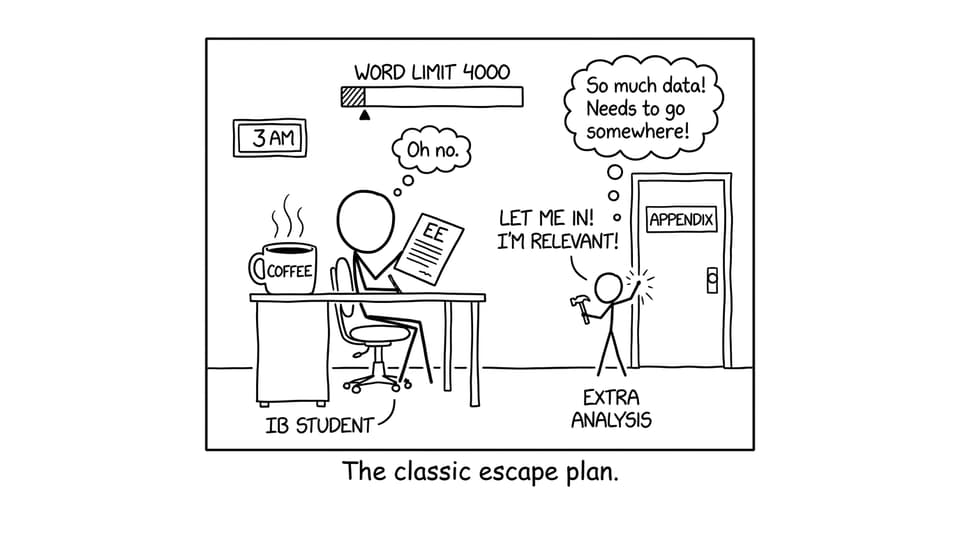
The night before you submit your EE, you discover an uncomfortable truth: your argument finally makes sense… at word 4,237.
So you start bargaining.
Maybe you can move “extra but important” reasoning into an appendix. Maybe you can tuck a few key lines into footnotes. Maybe the examiner will be curious and read them anyway.
That instinct is normal. It’s also dangerous.
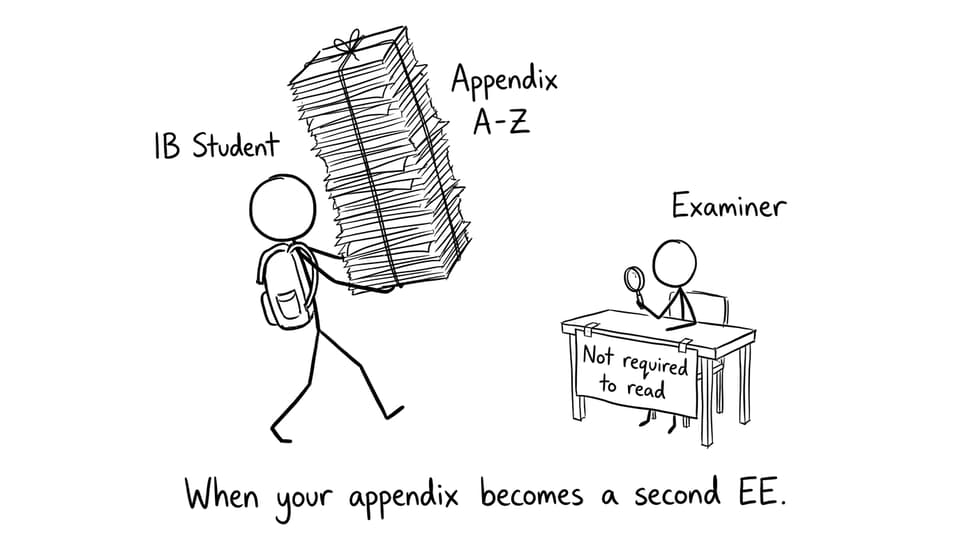
In an EE, examiners are not required to read appendices, footnotes, or endnotes. They may glance at them, but they are not obliged to. Anything crucial to your line of argument must live in the body of the essay. If you hide analysis outside the main text to evade the word limit, you’re not being clever; you’re making your own work unmarkable.
This post is your calm reset: what EE appendices are for, what examiners will and won’t read, and how to use supplementary material without sacrificing marks.
EE appendices: a quick checklist (keep this beside your draft)
Use this checklist before you attach a single page to your EE.
- If it contains analysis, evaluation, interpretation, or your conclusion: it belongs in the body (not the appendix).
- If removing it would make your argument unclear: it belongs in the body.
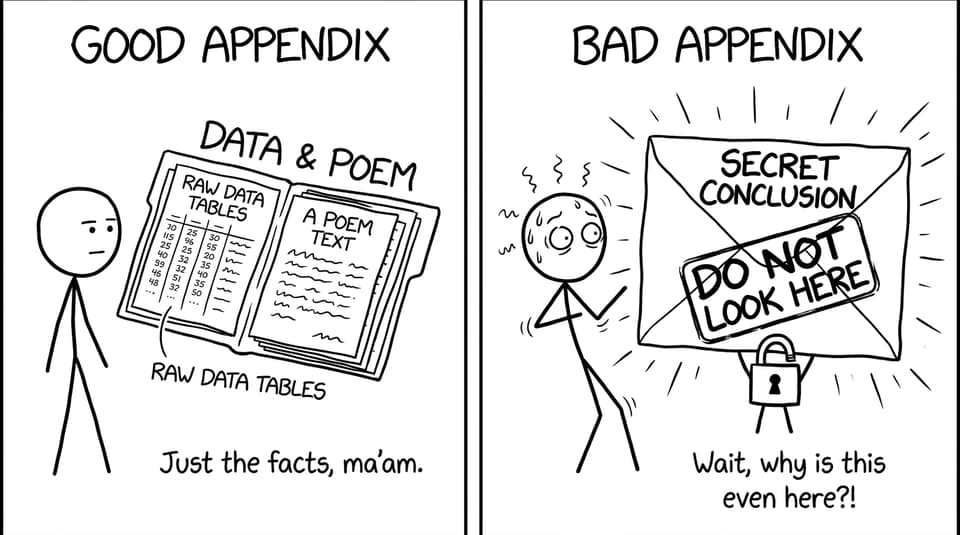
- If it’s raw evidence that would clutter the flow (large datasets, full transcripts, full poem/lyrics text, long tables): it can go in the appendix.
- If it’s there to “prove you did work” but you don’t reference it directly: delete it.
- If you’re using footnotes to smuggle paragraphs: move the content into the body and rewrite more tightly.
If you need a grounding overview of format and section order, see How to Format Your EE According to IB Guidelines.
What examiners will and won’t read in an EE
There’s a simple mental model that keeps you safe:
The examiner is paid to assess your EE, not to explore your attachments
Your EE is marked against criteria that reward clear focus, methods, critical thinking, and presentation. Those qualities must be visible in the main body. Appendices are supporting documents, not an overflow room.
This is why the most practical rule is the one you were already given (and should trust): any information that is important to your line of argument must not be placed in appendices, footnotes, or endnotes.
What examiners will definitely read
- Your introduction, main body sections, and conclusion
- Your in-text citations and quotations (as they appear in the body)
- Your references/bibliography (to check academic integrity and sourcing)
If you want a word-count-oriented view of what’s included and excluded, use Mastering the IB Extended Essay Word Count and IB word count rules explained: IAs and Extended Essay.
What examiners are not required to read
- Appendices
- Footnotes/endnotes used for anything beyond brief clarification or referencing conventions
- “Extra” sections that are not part of the standard essay flow
So if your best explanation is sitting in Appendix D, you’ve essentially written it into a place the examiner can ignore with a clean conscience.
The real purpose of EE appendices (and why they still matter)
A good EE appendix is like the storage room of a well-run kitchen.
You don’t cook in there. You don’t serve guests in there. But it holds the bulk ingredients so the cooking space stays clean.
Appendices exist to keep your EE readable while still letting you demonstrate that your evidence base is legitimate.
Appropriate appendix content includes:
- Large datasets (raw measurements, survey outputs, extended data tables)
- Supplementary tables that are too long for the body
- Full interview transcript(s), especially if you quote only short segments in the body
- Full text of a poem, speech, song, or document you are analyzing (when relevant)
- Additional images or documents used as sources, if including them in the body would break the flow
Notice what’s missing: interpretation. The appendix can hold the “what.” The body must contain the “so what.”
If you’ve also written IAs, the logic is similar: appendices support, they don’t replace. The IA version is explained well in How to Use Appendices Correctly in Your IA. The same discipline applies to an EE.
The footnote trap: why hiding analysis backfires
Footnotes feel tempting because they look small. But marks don’t care about typography.
If you place key analysis in footnotes, two things happen:
- You risk the examiner not reading it at all.
- You weaken multiple criteria at once: your argument looks thinner, your critical thinking appears less developed, and your presentation feels evasive.
This matters because the EE is evaluated holistically: you don’t just lose the sentence you hid; you lose the clarity and persuasive force it would have created.
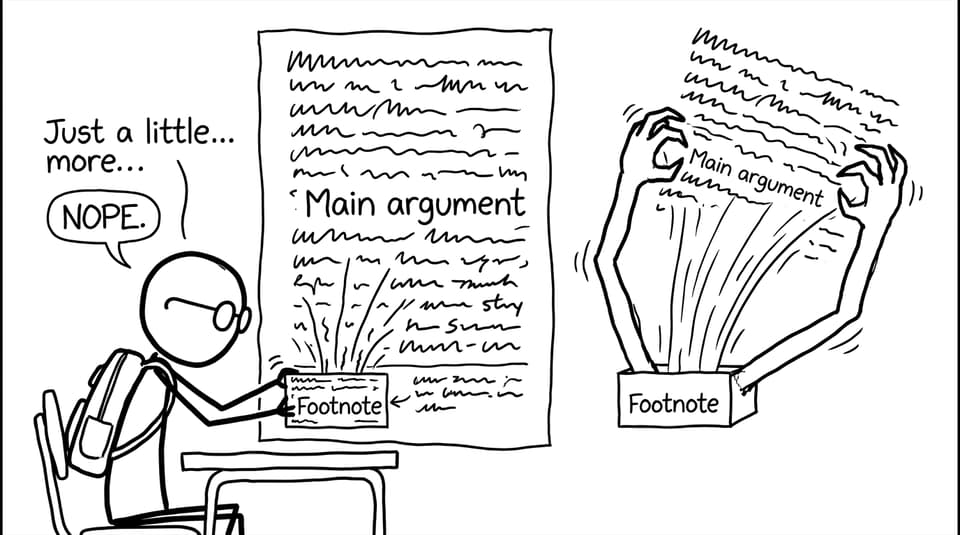
If you’re unsure whether your footnotes are “safe,” the safest rule is blunt: if it reads like argument, it belongs in the body.
For more on what counts and what doesn’t in word limits (and why trying to game it is risky), see Is the Bibliography Part of the Word Count in IB? and again Mastering the IB Extended Essay Word Count.
Where students accidentally put “key argument” in the appendix
Most students don’t try to cheat. They just mislabel analysis as “support.” Here are the most common danger zones.
Extra discussion of results
In a science or economics EE, you might place “further interpretation” after your final graph in the appendix.
If that interpretation changes what the data means, it’s not supplementary. It’s your argument.
Fix: put the interpretation in the body, and move only the raw data table or extended calculations to the appendix.
Method limitations and evaluation
Students sometimes move limitations into the appendix because it feels like “extra honesty.” But evaluation is part of critical thinking.
Fix: keep limitations and evaluation in the body. If you have long instrument specifications or full survey forms, those can be appended.
“Full justification” of the research question
If your rationale for the research question is only fully written in the appendix, the EE’s focus looks weak.
Fix: bring the justification into the introduction (tight, direct), and append only extra background documents if truly necessary.
If your EE still feels wobbly at the start, use 7 Key Steps to Write a Strong Extended Essay Introduction.
What a high-scoring EE appendix looks like
A strong EE appendix is boring in the best way.
It is:
- Clearly labeled (Appendix A, Appendix B…)
- Referenced in the body only when needed (“See Appendix B for the full dataset.”)
- Short enough that it doesn’t feel like a second essay
- Purely supportive: it proves your evidence exists, but it doesn’t do your thinking for you
Here’s a simple split:
- Body: your selected evidence + your interpretation + your evaluation + your conclusion
- Appendix: the full evidence base that would overwhelm the reader if placed inline
A practical rewrite strategy when you’re over the word limit
Most appendix mistakes are born from the same problem: the EE is too long.
So here’s a strategy that keeps your best thinking inside the essay without panic.
Compress from the outside in
- Cut repeated background first. Your reader doesn’t need a textbook chapter.
- Replace “plot summary” with “analysis + micro-evidence.” Especially in literature and language EEs.
- Remove duplicated explanations of method. Explain it once, clearly.
- Turn long quotations into short quotations + your commentary. Quote what you analyze.
- Make every paragraph earn a mark. If it doesn’t help focus, method, critical thinking, or clarity, it’s expensive.
Then, and only then:
- Move bulky supporting material into appendices (raw data, full transcripts, full poem text).
If your entire EE plan feels chaotic, it helps to revisit process guidance like How to Survive the IB Extended Essay Research Process or a full structure refresher via How to Structure an Extended Essay.
How RevisionDojo helps you keep the argument in the EE (where it belongs)
Appendix problems are rarely appendix problems. They’re clarity problems.
RevisionDojo is built for that kind of clarity.
- Use the IB Extended Essay Guides to align your structure and evidence with examiner expectations from the start.
- If you want criterion-specific direction, the IB EE Feedback Tool helps you see which parts of your EE are underdeveloped (so you stop trying to “hide” them).
- The IB Coursework Grader and subject-specific Grading tools (for example, IB Economics EE Grader) help you pressure-test whether your analysis is actually landing in the body.
- When you’re revising across subjects, RevisionDojo’s Study Notes, Flashcards, and Questionbank keep exam prep moving while your EE gets polished.
- If you’re stuck rewriting a section without losing meaning, RevisionDojo’s AI Chat can help you tighten paragraphs so the main argument fits inside the EE word limit.
The bottom line: write the whole EE where it can be marked
When you’re deep in the EE process, it’s easy to treat the appendix like a spare room: a place to store “just one more point” without paying the word count.
But examiners mark what they are required to read.
So keep your analysis, evaluation, and conclusions in the main body. Use EE appendices only for large datasets, supplementary tables, or full texts that would otherwise clutter your argument. And if you’re over the limit, don’t hide your best thinkingcompress until the core fits.
If you want to tighten your draft with examiner-style clarity, start with the IB Extended Essay Guides, then run a criterion check using the IB Coursework Grader or an EE rubric tool. Your EE should feel complete even if every appendix page vanished.