
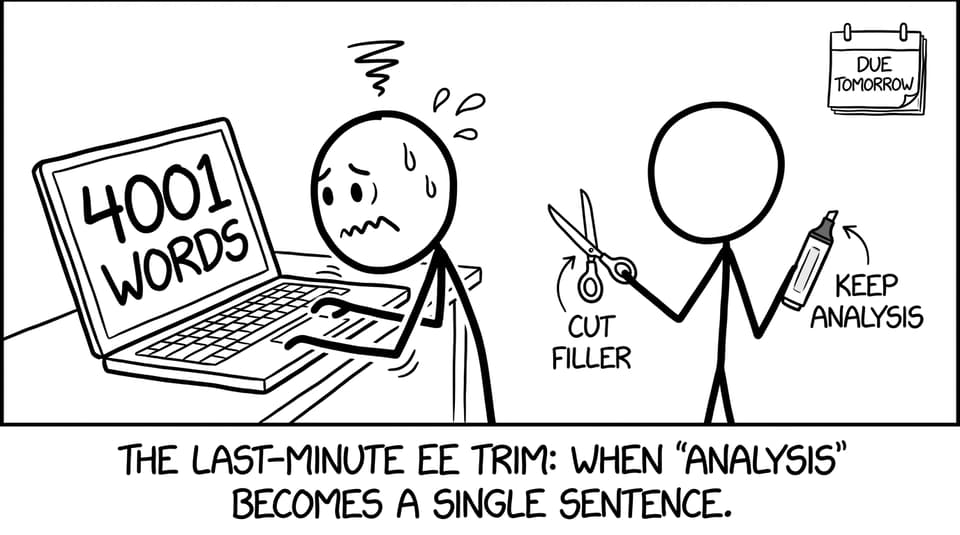
There’s a specific kind of panic that only arrives at 3,997 words.
You’re not thinking about your argument anymore. You’re thinking about physics: how to compress meaning into fewer syllables, how to turn “in order to” into “to,” how to delete one sentence without deleting your logic.
That panic is why the EE word limit matters. Not because the IB enjoys rules, but because the limit shapes what gets read, what gets assessed, and what counts.
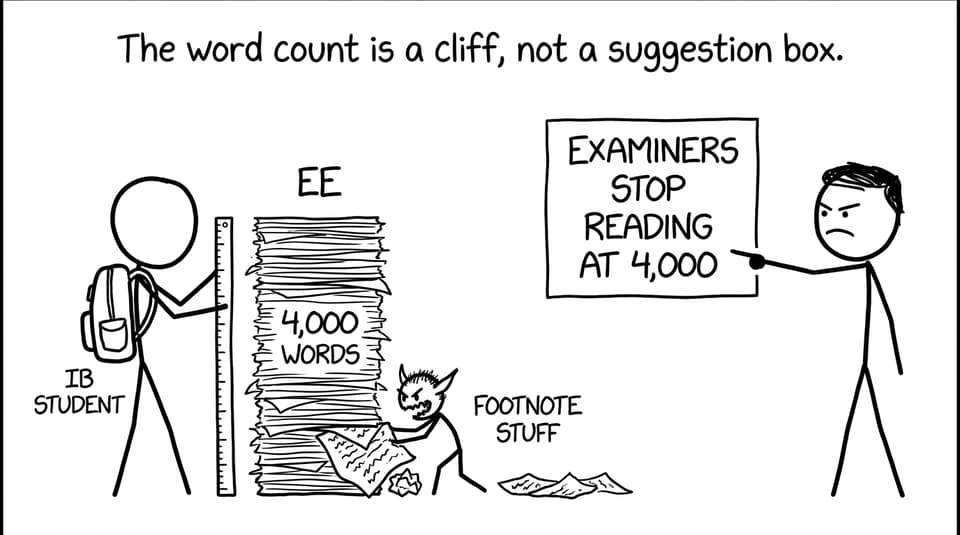
The line is blunt: examiners are instructed not to read or assess any material beyond 4,000 words. If your best evaluation is sitting at word 4,120, it might as well be written in invisible ink.
This guide gives you a full, practical breakdown of what counts toward the EE 4,000-word limit (and what doesn’t), plus a 2027-friendly glossary of key EE terms you’ll see in checklists, rubrics, and supervisor meetings.
EE 4,000-word limit checklist (save this)
If you want the fastest answer before we go deep, use this EE checklist.
Included in the EE word count
- Introduction, body, and conclusion
- Headings and subheadings (if they’re words on the page)
- In-text citations that appear in your sentences (author-date or numeric citations)
- Direct quotations
- Footnotes or endnotes if they contain substantive argument
- Any explanatory text inside diagrams/figures if it is part of your main argument (rare, but it happens)
Not included in the EE word count
- Title page
- Table of contents
- Page headers (running headers) and page numbers
- Bibliography/works cited/references list
- Citations/references (whether parenthetical, numbered, or footnotes) as references themselves
- The RPPF (Reflections on Planning and Progress Form)
- Maps, charts, diagrams, annotated illustrations, tables
- Equations, formulas, calculations
To sanity-check your structure alongside the limit, compare your plan with RevisionDojo’s EE resources: IB Extended Essay Guides and the All IB Extended Essay Posts.
What counts toward the EE 4,000 words (full breakdown)
The simplest rule for the EE is also the most ignored: if it’s part of what the examiner reads as your argument, it counts.
The introduction counts toward the EE limit
Everything in your introduction is inside the EE word count: background, context, definitions, your research question, and your thesis. This is why overly broad introductions quietly destroy good EEs. They spend 400 words “arriving” instead of arguing.
If your research question still feels too wide, tighten it using this: How to Craft the Perfect IB Extended Essay Research Question.
The body counts toward the EE limit (including most “extra explanation”)
Your body paragraphs are obviously included, but here’s what surprises students:
- Topic sentences count.
- Transitions count.
- Definitions you repeat because you’re anxious the reader forgot them count.
- Mini-summaries that restate sources without analysis count.
In a high-scoring EE, the body is mostly analysis and evaluation. If you want to measure whether you’re drifting into description, run a quick self-test: highlight every sentence that is your thinking vs. someone else’s information. If the second color wins, your EE is paying word-count rent for sentences that don’t earn marks.
The conclusion counts toward the EE limit
Yes, your conclusion counts. That means the “real ending” of your EE cannot be something you plan to “write later” after you exceed 4,000. Your final evaluation should be protected space.
A practical workflow is to draft your conclusion earlier than feels comfortable, then revise it as your analysis improves. RevisionDojo’s graders make this easier because you can check whether your ending is doing what the criteria reward: What Are the Assessment Criteria for the IB Extended Essay? (Full Breakdown).
Quotations count toward the EE limit
Every word inside quotation marks counts toward your EE word count.
This matters because quotes often feel like “free authority.” They are not free. They’re expensive. A quote must either:
- provide language you genuinely need to analyze (tone, phrasing, rhetoric), or
- supply a precise definition or claim you then evaluate.
If you’re quoting because you’re unsure how to paraphrase, that’s not an EE strategy. That’s a drafting habit.
In-text citations count toward the EE limit
If your EE uses in-text citations like “(Smith, 2021)”, those are words/characters embedded in the text and count toward the word count.
But your reference list does not count. This is why it’s smart to keep citations correct but minimal in the body: cite when you must, not as decorative confetti.
Footnotes and endnotes: the EE trapdoor
Students love footnotes because they feel like a loophole. The IB has seen that movie.
Here’s the principle you should follow for your EE:
- If a footnote is a reference, it’s not part of the word count.
- If a footnote is your argument (analysis, interpretation, evaluation), it effectively becomes part of what you’re asking the examiner to value.
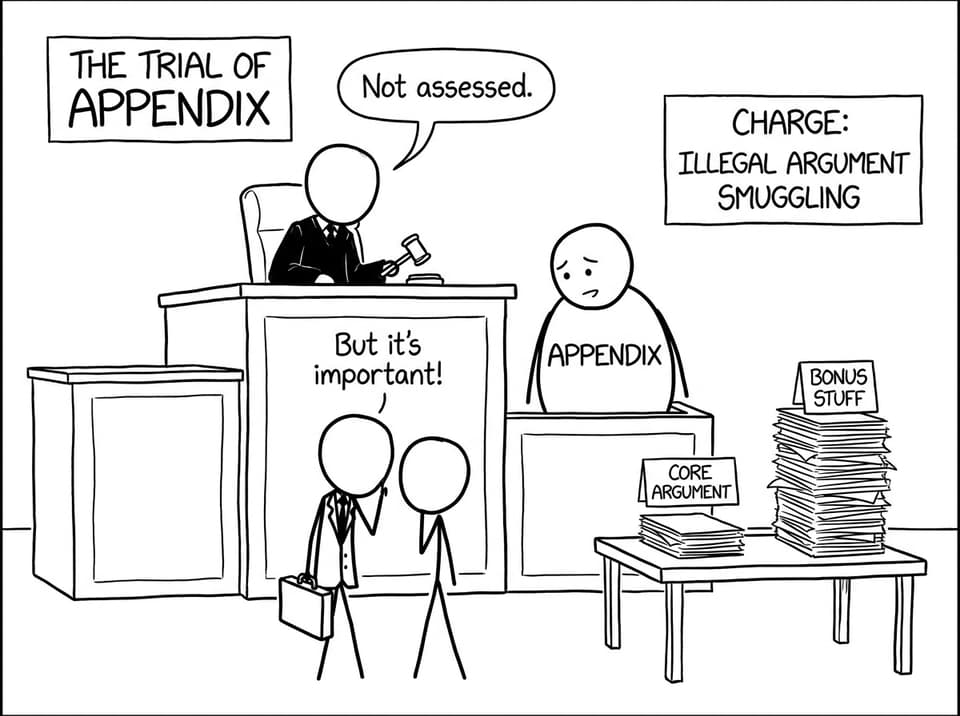
And the larger warning is even more important: hiding important argument material in footnotes or appendices to dodge the limit will hurt your score, because examiners are not required to read it.
If you’re tempted, it’s usually a sign your EE is carrying too much background and not enough focus.
What does NOT count toward the EE 4,000-word limit (and how to use it ethically)
The “excluded” list is where smart students gain breathing room without playing games.
Title page and contents page don’t count
Use them for clarity, not decoration. A clean contents page helps your supervisor and examiner navigate your EE, but it won’t save a weak argument.
Formatting help here: How to Format Your EE According to IB Guidelines: Tips + FAQ.
Bibliography/references don’t count
This is where you can be thorough. In the EE, accurate referencing is part of academic honesty and presentation quality, even if the bibliography isn’t in the word count.
The RPPF doesn’t count (but it still matters)
Your reflections are assessed separately from the essay text. They do not reduce your 4,000 words, which is good news.
But they’re not optional in spirit. The strongest students treat reflection as a record of decision-making, not a diary.
If you want to strengthen engagement and reflection, use: How Reflection Strengthens Your IB Extended Essay.
Tables, charts, diagrams, annotated illustrations don’t count
These are excluded from the EE word count, and they can be powerful when used properly.
Use them to:
- present raw data efficiently,
- show patterns clearly,
- avoid bloated prose that repeats what a table already shows.
Do not use them to hide analysis. If the meaning of your results is only explained in a caption-sized paragraph inside a figure, you’re gambling with what gets read.
How to cut your EE down to 4,000 words without cutting marks
Most word trimming fails because it treats all words as equal. In a high-scoring EE, words have jobs.
Cut “travel sentences,” not “thinking sentences”
Travel sentences move the reader but add no evaluation:
- “This essay will now discuss…”
- “It is important to note that…”
Thinking sentences do criterion work:
- evaluating evidence,
- acknowledging limitations,
- comparing interpretations.
Protect thinking sentences.
Replace repeated context with one strong definition
Students often define a key term three times in an EE because each chapter was drafted at a different time. Keep the best definition once, then use it consistently.
Convert long quotes into short quoted phrases
If you only need five words from a 40-word quote, quote the five and paraphrase the rest. Your EE becomes yours again.
Use RevisionDojo to cut strategically
When you’re stuck, the fastest path is feedback that mirrors the rubric.
- Use the Grading tools to find where paragraphs are descriptive, not analytical: IB Coursework Grader
- Use AI Chat to test whether a paragraph is necessary, or whether it repeats an earlier claim.
- Use the Coursework Library to compare how top students stay concise.
- Protect exam prep time with Study Notes, Flashcards, Questionbank, Predicted Papers, and Mock Exams so the EE doesn’t swallow your whole diploma.
If you want an aggressive timeline approach (not recommended, but sometimes reality wins), see: How to Write an EE in One Day.
IB Extended Essay glossary (2027): every key EE term you’ll actually use
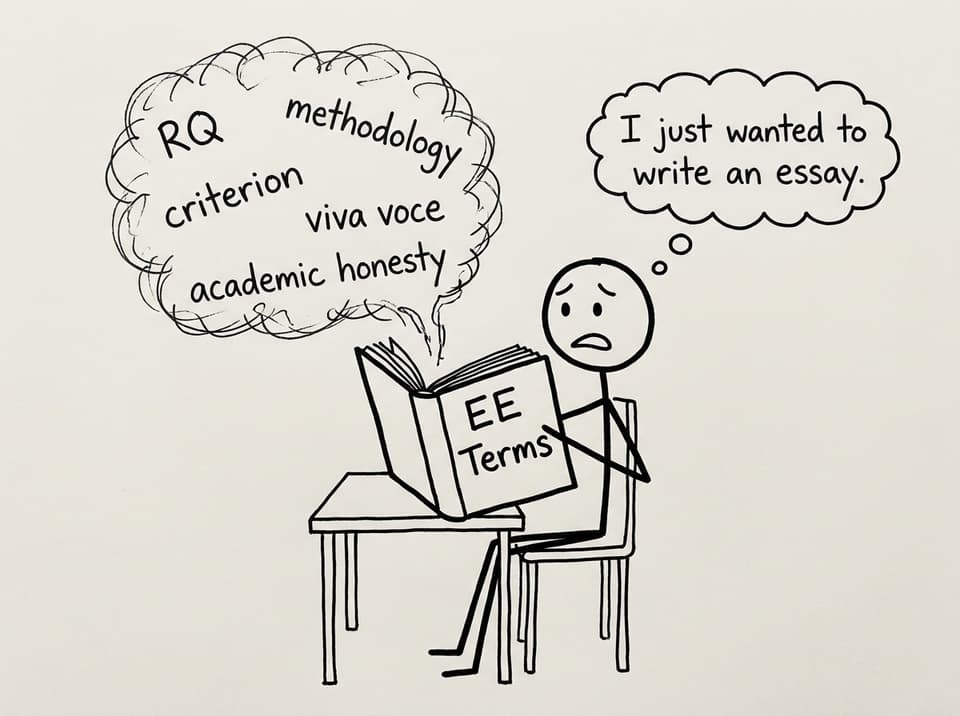
This isn’t a dictionary. It’s a translation layer between student language and examiner language, tailored to how your EE is marked.
Research question (RQ)
The exact question your EE answers. It must be focused enough to be answered with depth inside 4,000 words. A strong RQ prevents “interesting research” from turning into “unassessable sprawl.”
Line of argument
The logical path connecting your evidence to your conclusion. In the EE, a line of argument is not just your topic. It’s your reasoning, step by step.
Methodology
How you gathered and analyzed evidence. In Sciences it may be experimental design; in Humanities it may be a framework for source selection and analysis; in Literature it may be a lens for textual interpretation.
Primary source / secondary source
Primary sources are your direct evidence (data you collected, a novel, an interview transcript, a historical document). Secondary sources interpret or analyze primary evidence (journal articles, critiques, textbooks). Most strong EE projects use both, but the balance depends on subject.
Literature review
A structured discussion of what relevant scholars have said, and how your EE fits into that conversation. It’s not a list of summaries. It’s a map of debate.
Analysis vs. description
Description tells what happened or what a source says. Analysis explains why it matters, how it supports your claim, and what its limitations are. Your EE is graded on analysis.
Evaluation
Judging the quality of evidence and reasoning. Evaluation is where you acknowledge limitations, weigh competing interpretations, and justify your final conclusion.
Engagement (Criterion E)
How thoughtfully you reflect on your research decisions and growth, captured in the RPPF. Engagement is not enthusiasm. It’s awareness.
Academic honesty
Proper citation, original writing, and ethical research practice. In an EE, academic honesty is not just “don’t plagiarize.” It also includes not recycling large chunks of your own assessed work.
Appendix
Extra material not assessed, used only for supporting evidence like raw data or transcripts. If your argument depends on the appendix, your EE is at risk.
Examiner
The person who assesses your EE against IB criteria. They are trained to follow the limit. They are not allowed to reward what they do not read.
Closing: treat the EE word limit like a design constraint, not a punishment
The best EE writers don’t “fit” ideas into 4,000 words. They choose an argument that belongs in 4,000 words.
When you understand what counts toward the EE limit, you stop negotiating with the word count and start using it. You write fewer travel sentences. You quote with purpose. You put your best thinking where it will actually be read.
If you want a calmer, more controlled drafting process, build your EE with RevisionDojo beside you: use the IB Extended Essay Guides for subject-specific expectations, the IB Coursework Grader for criterion-aligned feedback, and the wider toolkit: Study Notes, Flashcards, AI Chat, Questionbank, Predicted Papers, Mock Exams, Coursework Library, Tutors, and Grading toolsto keep your coursework strong without sacrificing exam performance.
Keep your EE under 4,000 words. Keep your argument above the line. And make every word earn its place.