
Molarity is the amount of solute, measured in moles, divided by the total volume of solution in cubic decimetres. In IB Chemistry, it is usually called molar concentration, represented by c or square brackets, and calculated using c = n/V, with units of mol dm⁻³.
A concentration question can look almost too simple. Three values, one equation, a calculator. Yet the arithmetic is rarely the real challenge. Most lost marks come from deciding what the volume represents, converting units correctly, or overlooking the mole ratio hidden in a balanced equation.
Molarity at a glance
- Definition: amount of solute per unit volume of solution
- Equation:
c = n/V - Rearrangement:
n = cV - IB unit:
mol dm⁻³ - Equivalent unit:
mol L⁻¹ - Volume conversion:
1000 cm³ = 1 dm³ - Concentration notation:
[NaCl]means the molar concentration of NaCl - Important distinction: use the final volume of the solution, not the volume of solvent added
The current IB DP Chemistry course places this idea within Structure 1.4. Students are expected to solve problems involving amount, solution volume and molar concentration, use square brackets for concentration, and convert between g dm⁻³ and mol dm⁻³. The relationship n = cV is provided in the data booklet, but recognizing when and how to use it remains your responsibility.
For the surrounding foundations, review the mole in IB Chemistry and RevisionDojo's detailed Structure 1.4 study notes.
What is molarity measuring?
The equation is:
c = n/V
where:
cis molar concentration inmol dm⁻³nis the amount of solute inmolVis the volume of the complete solution indm³
Suppose 0.20 mol of sodium chloride is present in 0.50 dm³ of solution:
c = 0.20 mol ÷ 0.50 dm³ = 0.40 mol dm⁻³
This means each cubic decimetre of that solution would contain 0.40 mol of sodium chloride if the concentration were uniform. It does not mean the sample physically has a volume of 1 dm³; concentration is a ratio that describes its composition.
Molarity is also not the same as molality. Molar concentration divides by the volume of solution, while molality divides by the mass of solvent. For IB solution-stoichiometry questions, let the stated units guide you rather than relying on the similar names.
The unit conversion that controls the calculation
IB questions commonly provide volume in cm³, but c = n/V requires volume in dm³ when concentration is in mol dm⁻³.
V in dm³ = V in cm³ ÷ 1000
Therefore:
25.0 cm³ = 0.0250 dm³250 cm³ = 0.250 dm³5.00 cm³ = 0.00500 dm³
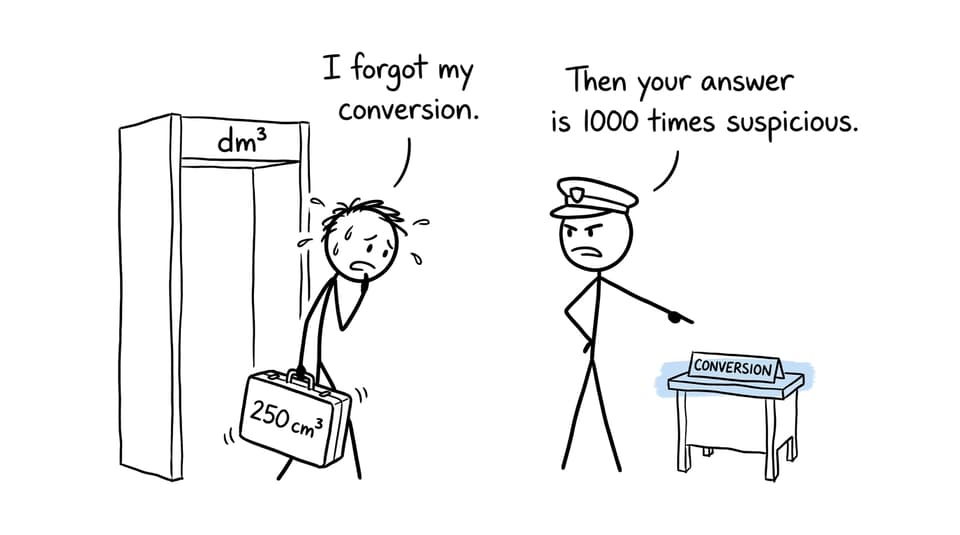
A reliable exam habit is to convert the volume before substituting anything. Writing the conversion as a separate line makes your reasoning visible and reduces the chance of an answer that is incorrect by a factor of 1000. RevisionDojo's guide to concentration units in IB Chemistry is useful if unit choices still feel uncertain.
Worked example: finding concentration from mass
Question: A solution is prepared by dissolving 5.85 g of NaCl and making the total solution volume up to 500 cm³. Calculate its molar concentration. Use M(NaCl) = 58.5 g mol⁻¹.
First convert mass to amount:
n = m/M
n = 5.85 g ÷ 58.5 g mol⁻¹ = 0.100 mol
Convert the solution volume:
500 cm³ ÷ 1000 = 0.500 dm³
Now calculate concentration:
c = n/V
c = 0.100 mol ÷ 0.500 dm³ = 0.200 mol dm⁻³
The calculation follows a reusable path:
mass → amount in moles → molar concentration
Notice that the question says the solution is made up to 500 cm³. You are not adding 500 cm³ of water to the solid. You are adding water until the combined solution reaches that final volume.
For more targeted practice, use the IB Chemistry stoichiometric relationships hub, where Study Notes, Questionbank exercises and Flashcards can reinforce each step.
Worked example: molarity inside a reaction
Question: 25.0 cm³ of 0.200 mol dm⁻³ sulfuric acid reacts completely with sodium hydroxide. Calculate the amount of NaOH required.
Start with the balanced equation:
H₂SO₄ + 2NaOH → Na₂SO₄ + 2H₂O
Convert the acid volume:
25.0 cm³ = 0.0250 dm³
Find the amount of sulfuric acid:
n(H₂SO₄) = cV
n(H₂SO₄) = 0.200 × 0.0250 = 0.00500 mol
The equation shows a 1:2 ratio between H₂SO₄ and NaOH:
n(NaOH) = 2 × 0.00500 = 0.0100 mol
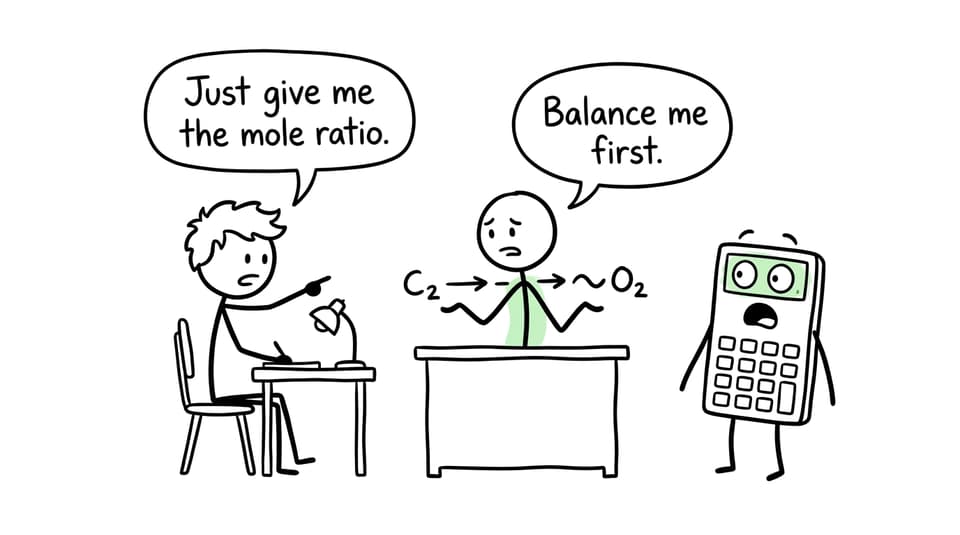
The concentration equation only completes the first bridge: solution data to moles. The balanced equation then carries those moles from one chemical species to another. This pattern underpins titration calculations and many broader stoichiometry problems.
See IB Chemistry stoichiometry explained for exams before moving into RevisionDojo's step-by-step titration guide.
Dilution questions
During dilution, solvent is added but the amount of the original solute transferred remains unchanged. This gives:
c₁V₁ = c₂V₂
If 20.0 cm³ of 1.50 mol dm⁻³ solution is diluted to 250 cm³:
c₂ = (1.50 × 20.0) ÷ 250 = 0.120 mol dm⁻³
The volumes can remain in cm³ here because the same unit appears on both sides and cancels. However, both values must describe corresponding initial and final volumes. The final volume is 250 cm³, not 270 cm³, because the solution was diluted to that mark.
Common IB Chemistry exam mistakes
Using solvent volume instead of solution volume
Molarity uses the final volume occupied by the entire solution. Do not automatically add the stated solvent volume to another volume unless the question explicitly supports that operation.
Leaving volume in cubic centimetres
When using c = n/V with mol dm⁻³, divide a cm³ value by 1000 first. A quick magnitude check helps: ordinary laboratory concentrations rarely become hundreds of moles per cubic decimetre without a clear reason.
Skipping the balanced equation
In reaction problems, equal volumes or equal concentrations do not guarantee equal reacting amounts. Calculate moles, then apply the coefficients from the balanced equation.
Confusing mass concentration with molar concentration
To convert from g dm⁻³ to mol dm⁻³, divide by molar mass:
molar concentration = mass concentration ÷ molar mass
The units confirm the logic: (g dm⁻³) ÷ (g mol⁻¹) = mol dm⁻³.
Reporting an incomplete answer
Carry sufficient figures during working, round at the end, and include the requested unit. A bare decimal does not communicate whether you calculated moles, volume or concentration.
Quick-reference checklist
| Question gives | First move | Then use |
|---|---|---|
| Moles and volume | Convert volume to dm³ | c = n/V |
| Concentration and volume | Convert volume to dm³ | n = cV |
| Mass and volume | Find n = m/M | c = n/V |
| Reacting solutions | Find moles of one reactant | Apply mole ratio |
| Stock and diluted solutions | Identify initial and final values | c₁V₁ = c₂V₂ |
Concentration in g dm⁻³ | Divide by molar mass | Report mol dm⁻³ |
Turn the formula into an exam skill
Knowing what is molarity gives you the definition. Earning marks requires a repeatable sequence: identify the solute, convert the volume, calculate moles, apply any reaction ratio, and finish with a unit and sensible precision.
RevisionDojo brings that sequence into one study system. Use IB Chemistry resources to move between Study Notes, Flashcards, AI Chat and Questionbank feedback, then test the skill under pressure with Chemistry Predicted Papers and Mock Exams. When a misconception persists, Grading tools and Tutors can expose the exact step causing it, while the Coursework Library helps connect concentration calculations with experimental work. The formula is short. Good revision makes the reasoning just as automatic.