In IB Chemistry, concentration is one of those “small” details that quietly decides grades. You can know the reaction, balance the equation, even pick the right formula… and still drop marks because you wrote the wrong unit, forgot a conversion, or mixed mass concentration with molar concentration. It’s frustrating because it’s avoidable. This guide keeps it simple: what the unit for concentration is in IB Chemistry, when to use the common alternatives, and the few conversions that save you on exam day.
The quick answer (exam checklist)
If you remember nothing else, remember this for IB Chemistry:
-
Standard concentration unit: mol dm⁻³
-
Also common: g dm⁻³, ppm, and % (mass or volume)
-
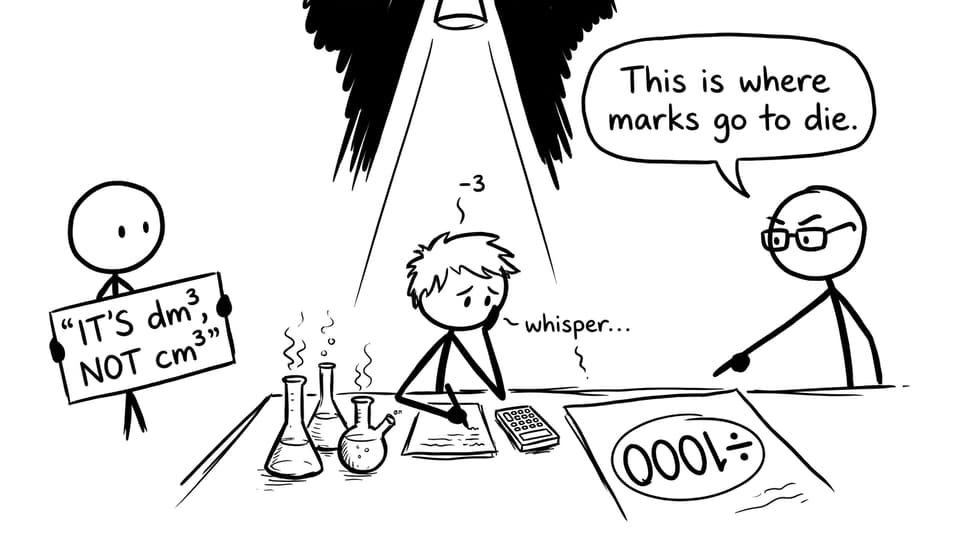
Key volume facts: 1 dm³ = 1 L = 1000 cm³
-
Most common lost-mark moment: not converting cm³ to dm³ before using c = n/V
If you want more confidence with calculations in context (not just units), pair this with How to Calculate Molarity in Chemistry.
What is the unit for concentration in IB Chemistry?
The main unit for concentration in IB Chemistry is mol dm⁻³ (moles per cubic decimeter). You’ll also hear it called molar concentration or “molarity” (even if the course often avoids the capital M shorthand).
Why does IB Chemistry lean so hard on mol dm⁻³? Because so much of the syllabus is built on moles. Once concentration is in moles per volume, the rest of the course becomes consistent: stoichiometry, titrations, equilibrium, kinetics, and acids and bases all start speaking the same language.
For formal definitions that the IB expects you to use accurately, keep IB Chemistry Key Definitions bookmarked.
Why mol dm⁻³ is the “default” in IB Chemistry
It plugs straight into the formulas you actually use
In IB Chemistry, the formula n = c × V shows up everywhere. Same story with equilibrium expressions like Kc, where the square brackets represent concentrations in mol dm⁻³. If your units match the model, your working looks cleaner and your answers are less error-prone.
If equilibrium is a weak spot, revise the logic behind the brackets with R2.3.2 The equilibrium law and constant Notes.
It matches how the lab works
Most school labs prepare solutions by moles and measure volumes in cm³ or dm³. That’s why IB Chemistry rewards students who treat units like part of method, not decoration.
To build that lab-to-exam consistency, read Tips to Improve Your Lab Skills for IB Chemistry.
The conversions that IB Chemistry expects you to do instantly
Converting cm³ to dm³ (the big one)
In IB Chemistry, volume in calculations should usually be in dm³.
-
1 dm³ = 1000 cm³
-
So: V(dm³) = V(cm³) ÷ 1000
That “÷ 1000” step is where easy marks disappear, especially in titration questions. If titration is coming up in your revision, Titration Explained Step-by-Step is worth a focused read.
Other concentration units you must recognize
mol dm⁻³ (molar concentration)
Use mol dm⁻³ for almost everything quantitative in IB Chemistry: stoichiometry in solution, titrations, equilibrium (Kc), pH work, and rate data tables.
For hydrogen ion concentration specifically (and the exact bracket meaning), see R3.1.4 pH and the hydrogen ion concentration Notes.
g dm⁻³ (mass concentration)
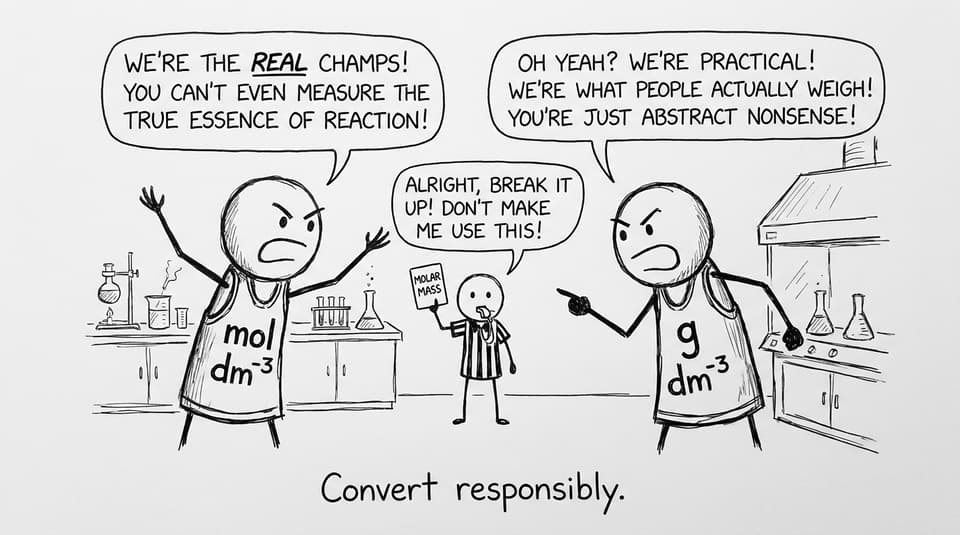
Sometimes the question gives mass per volume rather than moles per volume. That’s g dm⁻³.
To convert into the IB Chemistry “native unit”:
- c(mol dm⁻³) = c(g dm⁻³) ÷ molar mass
ppm (parts per million)
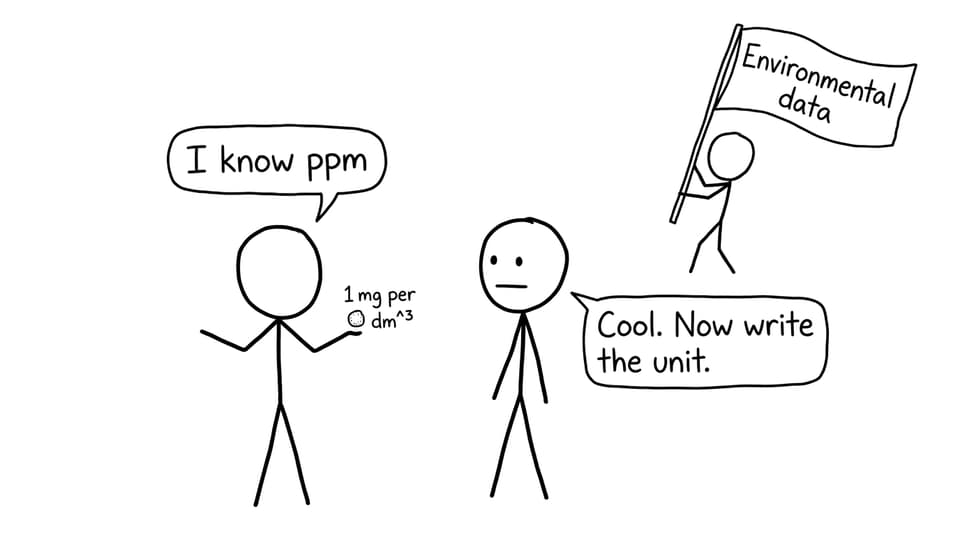
In environmental-style questions, ppm appears because it’s practical for tiny concentrations.
A useful approximation in IB Chemistry is:
- 1 ppm ≈ 1 mg dm⁻³ (for dilute aqueous solutions)
For a broader look at where those questions tend to show up, see IB ESS vs IB Chemistry: Which Is More Useful for Environmental Careers.
A fast IB-style example
Question: What is the concentration when 0.050 mol NaOH is dissolved to make 250 cm³ of solution?
-
Convert volume: 250 cm³ = 0.250 dm³
-
Use c = n ÷ V: c = 0.050 ÷ 0.250 = 0.200 mol dm⁻³
The structure matters in IB Chemistry: conversion, formula, substitution, unit.
To drill this with realistic exam-style practice, the IB Chemistry Questionbank is the quickest way to see the patterns and the marking expectations.
Final takeaway: write the unit like it’s part of the method
The standard unit for concentration in IB Chemistry is mol dm⁻³, and it’s standard for a reason: it connects directly to moles, to core formulas, and to the way exam questions are marked. Master the cm³ to dm³ conversion, recognize when a question is using g dm⁻³ or ppm, and you’ll stop donating marks to formatting.
When you’re ready to turn that understanding into consistent exam performance, RevisionDojo brings it all together with Study Notes, Flashcards, the Questionbank, AI Chat, Grading tools, Predicted Papers, Mock Exams, a Coursework Library, and expert Tutors to close the gaps fast. Start your next IB Chemistry practice set here: Questionbank.

