


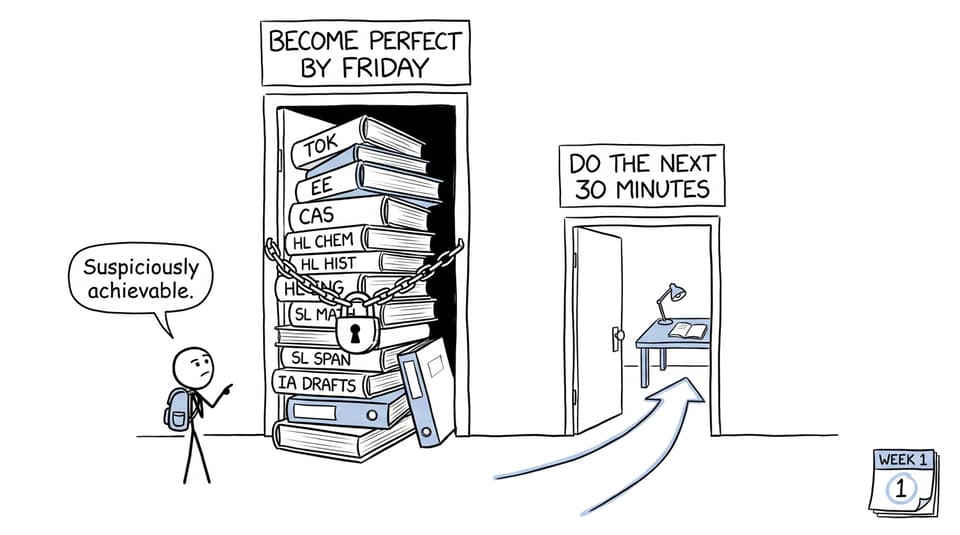
Starting the IB Diploma can make ordinary goals sound inadequate. “Keep up with every subject” becomes “earn a 7 in everything.” A useful routine becomes a colour-coded system that assumes you will never feel tired, get sick, or receive three assignments in the same week.
If you are setting realistic goals for your first IB term, begin more simply. Choose a few repeatable study behaviours, establish a baseline in each subject, meet school deadlines, and protect time for sleep, relationships, and activities. Your September-November goal is not to master the entire Diploma Programme. It is to build a system that can survive DP1.
The Diploma combines six subjects with Theory of Knowledge, the Extended Essay, and Creativity, Activity, Service. Because it is a two-year programme, the first term is a foundation rather than a final verdict. Early results provide information. They do not define your eventual result.
Your first-term goal checklist
By the end of November, aim to have:
- One calendar containing assessments, activities, and school-specific core deadlines
- A realistic performance baseline for each subject
- Two or three priorities rather than six simultaneous emergencies
- A repeatable weekly routine with buffer time
- A simple mistake log for assessed work and practice questions
- A sustainable CAS rhythm following your school’s guidance
- A weekly review habit for adjusting goals
- A clear understanding of when to ask for help
This list is deliberately modest. A strong beginning is usually a collection of small promises kept repeatedly.
Define success for the IB DP1 fall term
A goal such as “get 40 points” may feel ambitious, but it is difficult to act on in September. You still have limited evidence about assessment standards, subject difficulty, and your working pace.
Define first-term success across four areas:
- Academic understanding: Can you explain the concepts taught so far?
- Assessment technique: Can you respond to command terms and apply subject criteria?
- Organisation: Are deadlines visible before they become urgent?
- Sustainability: Can you follow your routine without sacrificing sleep each week?
This broader definition stops one disappointing quiz from becoming a crisis. DP1 requires you to learn how the programme works while learning its content. The IB Diploma preparation guide explains these moving parts in more detail.
Turn ambitious outcomes into controllable goals
An outcome goal describes where you hope to arrive. A process goal describes what you will do. An evidence goal shows whether that process is helping.
Suppose you want a 6 in Biology. Turn that direction into a weekly plan:
- Outcome: Move toward a 6 based on assessments and teacher feedback.
- Process: Complete two focused Biology sessions each week, combining retrieval with application.
- Evidence: Track errors by topic and reattempt selected questions after several days.
The structure also works in essay subjects. Your process could be one timed paragraph and one essay plan each week. Your evidence might be fewer repeated comments about description, structure, or evaluation.
Realistic goals depend mainly on actions you control. You cannot choose the test questions. You can arrive having practised the necessary thinking.
Use September to observe before optimising
September is an adjustment month. Teachers introduce routines, expectations become clearer, and the difference between HL and SL begins to feel real. Resist designing a perfect timetable from assumptions.
For the first two weeks, record:
- How long assigned work actually takes
- Which subjects leave you confused after class
- When your concentration is strongest
Then build around the evidence. Mathematics may benefit from shorter recurring problem-solving sessions instead of one exhausting Sunday block. A language may need brief daily exposure. An essay subject may require regular planning practice before more writing volume.
A balanced IB study schedule should reflect your timetable, commute, responsibilities, and energy. It should not imitate an online routine designed for somebody else’s life.
Make October the month of feedback
By October, you will probably have marked work from several subjects. This is when realistic goals become more precise.
Do not record only the score. Ask:
- Was the problem missing knowledge, weak application, or poor timing?
- Did I misunderstand a command term?
- Is the mistake isolated or recurring?
- What is the smallest task that would address it?
RevisionDojo can turn this review into a practical loop. Use Study Notes to clarify a topic, Flashcards to retrieve essential knowledge, and the Questionbank to apply it. Ask AI Chat a focused question when an explanation remains unclear. Use Grading tools to examine written responses, while treating teacher feedback and official subject guidance as essential.
The RevisionDojo guide for DP1 students shows how to connect these tools without using everything at once. Collecting resources can feel productive while quietly replacing study.
Set goals small enough for difficult weeks
A plan should be judged by what happens when Wednesday goes badly, not when Monday goes perfectly.
Create standard and minimum versions of your routine. A standard week might include four focused blocks, short retrieval sessions, and one core task. A minimum week could include two blocks, brief Flashcards, and the most urgent deadline. The minimum is not failure. It prevents one difficult week from becoming a lost month.
Use clear outputs instead of vague promises. “Study Chemistry” is difficult to verify. “Review bonding notes, answer eight questions, and record two errors” has a finish line.
These time management strategies for IB students can help you place tasks into bounded periods. Leave some capacity unscheduled because a calendar filled to 100% assumes life will behave perfectly.
Keep the core moving without rushing it
Students sometimes ignore TOK, the Extended Essay, and CAS because submission feels distant. Others try to make major decisions before understanding the requirements.
The better first-term goal is steady orientation. Follow your school’s timeline, learn what each component requires, and complete the next authorised step. For CAS, establish regular engagement and maintain evidence or reflections according to your coordinator’s instructions. For TOK, collect useful real-world examples and notice how claims are justified. For the Extended Essay, meet school milestones rather than forcing an early research question without enough subject knowledge.
RevisionDojo’s Coursework Library can help you understand the shape of strong work. Tutors can provide targeted human support when feedback is difficult to translate into action. Both should support your thinking, not replace your authorship or school process.
Review your goals at the end of November
A November review should ask more than, “Did I hit every target?” Examine what the term taught you about planning.
Use your calendar, assessment feedback, and mistake log. Keep goals that produced useful work. Reduce goals that required unrealistic energy. Replace routines measured only in hours with routines that produce questions answered, concepts retrieved, paragraphs drafted, or errors corrected.
You can also introduce carefully selected timed practice. Short sections are usually more useful for a new DP1 student than constant full simulations. Later, RevisionDojo’s Mock Exams and Predicted Papers can support broader rehearsal. For now, practice should match the material you have studied. The guide to proven IB study techniques can help you choose methods according to purpose rather than novelty.
Build a system you can still use in DP2
The first IB term matters because everything is new. Its greatest value, however, is the chance to discover how you learn before the workload becomes denser.
Set goals that produce evidence. Review that evidence without drama, then adjust before frustration becomes identity. RevisionDojo brings the process together through Study Notes, Flashcards, the Questionbank, AI Chat, Grading tools, Predicted Papers, Mock Exams, the Coursework Library, and Tutors. Used selectively, it becomes the ultimate IB resource for turning ambition into a calm, repeatable next step.
Your first term does not need to look extraordinary. It needs to become something you can build upon.