It’s the quiet click of a laptop closing at 1:17 a.m. after you re-read your Internal Assessment one more time and suddenly notice a sentence that doesn’t make sense. It’s the way your stomach drops when someone says, “Moderation can change marks,” like the word moderation is a weather system drifting toward your school.
And it’s the thought you don’t like saying out loud: What happens if I fail my IA?
If you’re an IB student preparing for exams, that question isn’t dramatic. It’s practical. The IA often carries meaningful weight in your final grade (commonly around 20-25% depending on the subject and level), so a weak IA can feel like you’ve started the race with one shoe missing.
The good news is that “failing” an IA is rarely the single, instant catastrophe IB Stress makes it out to be. The real situation is more nuanced: component marks, rubrics, moderation, and the fact that your exams still matter a lot.
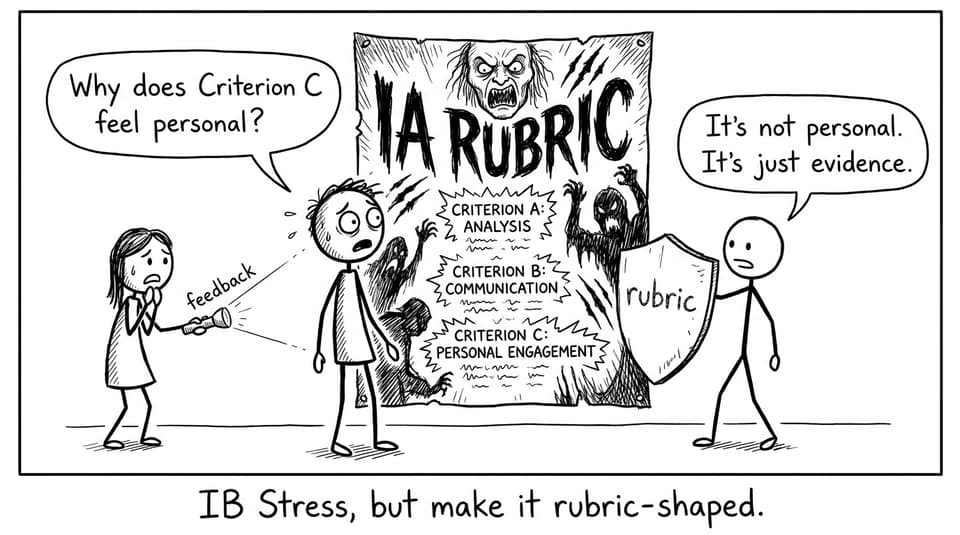
Student vs IA rubric horror poster
Quick overview: what “failing an IA” usually means
Before your brain writes a disaster movie, anchor to a few realities:
Your IA is one component, not your entire diploma.
A low IA mark can be offset partially by stronger exam performance (how much depends on the subject weighting).
, then the IB moderates a sample to check the school’s marking standard.
X
Share on WhatsApp
Share on LinkedIn
Share on Facebook
Your teacher marks the IA first
Most “IA emergencies” are actually fixable earlier with clearer rubric alignment, better evidence, and one more smart revision cycle.
If you want the clearest explanation of the marking process, read Who Marks the IA? The Truth Behind Your Final Score. Understanding the pathway from teacher marking to moderation reduces IB Stress because it replaces vague fear with a concrete system.
What happens if you fail an IA in IB?
“Fail” can mean different things in student language. In IB language, it usually means your IA earns a very low criterion score, which then reduces your overall subject grade.
Here’s what typically happens:
Your overall subject grade takes a hit
Because the IA contributes a chunk of the final grade, a weak IA means you’ll likely need stronger exam marks to reach the same final result. This is where IB Stress becomes mathematical: you start doing mental grade-boundary gymnastics instead of sleeping.
But remember: a low IA doesn’t automatically mean you fail the course. It means you have less margin for error elsewhere.
University plans can feel shakier, even if nothing “official” changed
Some universities care most about your final score. Others watch predicted grades, internal school reports, or consistency. A poor IA mark can influence teacher expectations, which can spill into confidence and performance.
This is the hidden cost: not just marks, but momentum.
Confidence drops, which can quietly affect exam revision
The most damaging part of “failing” an IA is often psychological. IB Stress convinces you a weak IA is proof you’re “bad at the subject.” Then revision becomes avoidance, and avoidance becomes more stress.
Your goal is to treat the IA result like a diagnostic test: information, not identity.
In some cases, you may need to redo work (school policy dependent)
Whether you can revise, resubmit, or complete an additional internal task depends on your school’s deadlines and internal policies. The IB has strict submission timelines, so late changes aren’t always possible.
That’s why the best strategy is to get rubric-aligned feedback early, when changes are still realistic.
Why IB Stress spikes around IAs (and how to calm it)
IAs are stressful for a specific reason: they feel subjective.
Exams feel like a known arena: you study content, practice questions, and perform on the day. An IA feels like you’re being judged on taste, writing style, or whether the teacher “gets” what you meant.
But rubrics reduce the subjectivity.
If you haven’t already, start with IB IA Guides: Internal Assessment Structure, Rubrics & More to see what your subject actually rewards. This is one of the fastest ways to reduce IB Stress: align your effort with the markbands, not with vibes.
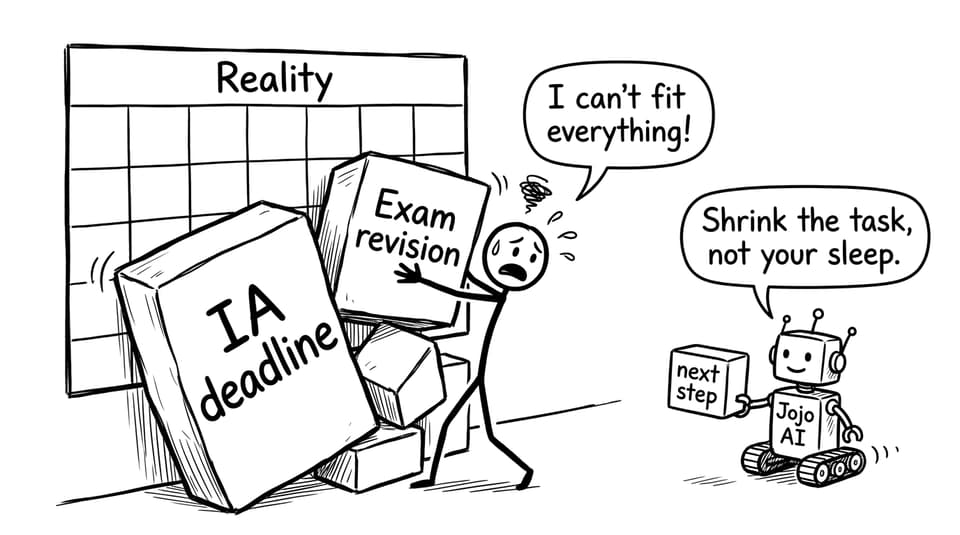
Tetris calendar of deadlines
What to do immediately if you think your IA will score low
Ask one focused question: “Which criterion is bleeding marks?”
Many students respond to IB Stress by making everything bigger: more words, more data, more sources, more graphs. That often backfires.
Instead, open the rubric and locate the bottleneck. Is it:
unclear research question?
weak methodology or poor justification?
analysis that describes rather than explains?
evaluation that’s generic?
structure and presentation making evidence hard to find?
Run a rubric check before you run another all-nighter
RevisionDojo’s grading tools are built for this exact moment: when you need a fast, criterion-by-criterion read on what’s missing.
Start with the IB Coursework Grader to get structured feedback aligned to IB rubrics. For specific subjects, you can also use a rubric grader like IB Biology IA Grader to see where your marks are realistically landing.
This reduces IB Stress because it turns “I think it’s bad” into “Criterion B is underdeveloped, so I’ll fix Criterion B.”
Use feedback like a system, not a sentence
Teacher comments can feel like riddles. The trick is translating them into rubric actions.
IB Stress often comes from uncertainty about performance under time pressure. A timed session creates proof.
Use IB Predicted Papers as a rehearsal tool. If your confidence is low, start with a section, not a full sitting. Consistency beats intensity.
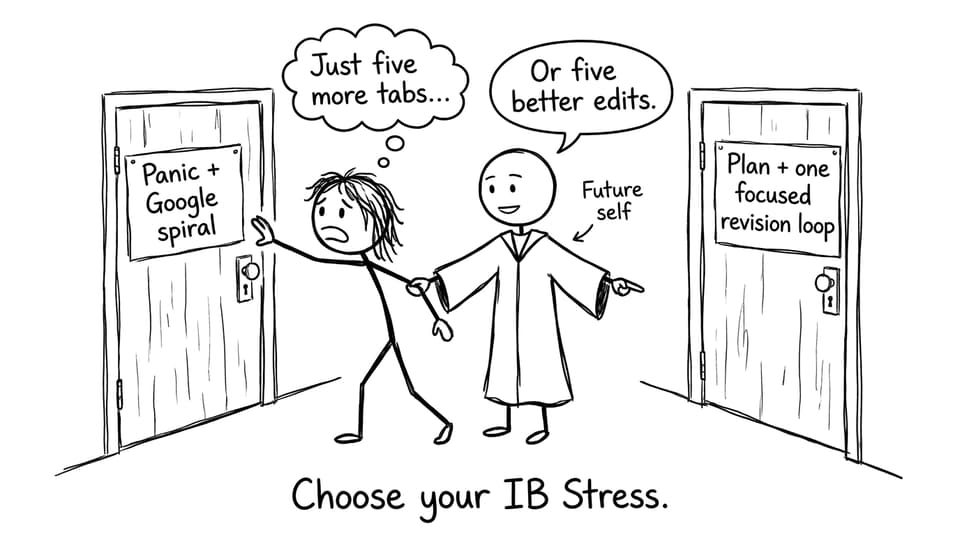
Two doors: panic vs plan
Closing: turning IB Stress into a plan
IB Stress tells you that a weak IA is the end of the story.
But the IB is rarely one moment. It’s a portfolio of moments: drafts, corrections, timed practice, and the quiet decision to keep going when one component doesn’t go your way.
If you’re worried you “failed” your IA, don’t treat that fear as a prophecy. Treat it as a prompt.
Use RevisionDojo to build the recovery loop: check your IA against the rubric with the IB Coursework Grader, keep daily recall with Flashcards, drill targeted weaknesses in the Questionbank, and rehearse performance using Predicted Papers and Mock Exam workflows.
That’s how you shrink IB Stress: not by pretending nothing happened, but by making the next step obvious.