




There's a moment every IB student has.
You submit your IA, you close your laptop, and your brain immediately opens a new tab: "Who marks the IA?"
Because deep down, you're not only asking about process. You're asking about fairness. About control. About whether the hours you spent tightening your analysis and fixing your citations will actually matter when the IA becomes a number.
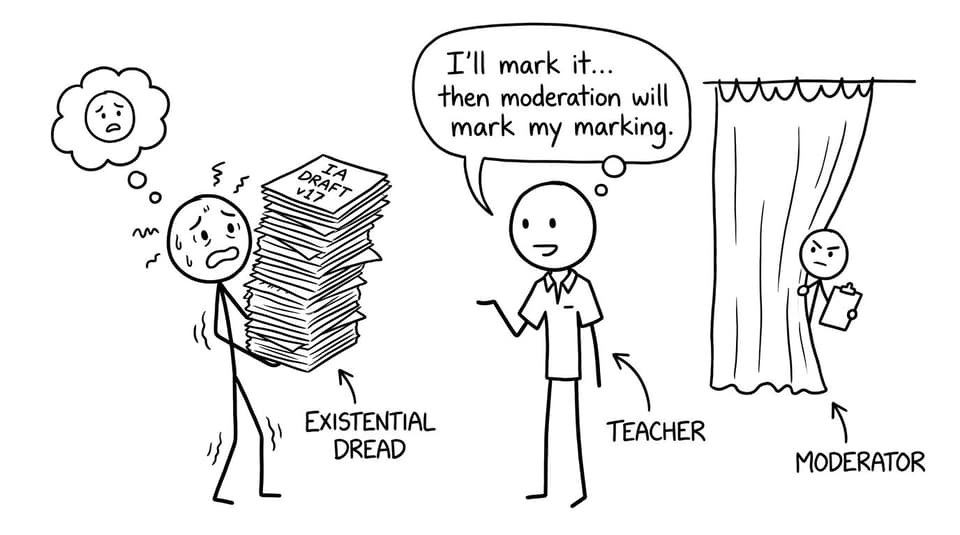
Here's the honest answer: your IA is usually marked by your teacher, then checked through moderation by the IB. And that one sentence contains most of what you need to understand, including the part that trips students up.
This guide will break down who marks the IA, how moderation works, what gets changed (and what doesn't), and how to make your IA more "moderation-proof" while you're also preparing for exams.
IA marking in one checklist (save this)
- Your teacher marks your IA using the official rubric (criterion-based, best-fit).
- Your school may internally standardize IA marks across classes.
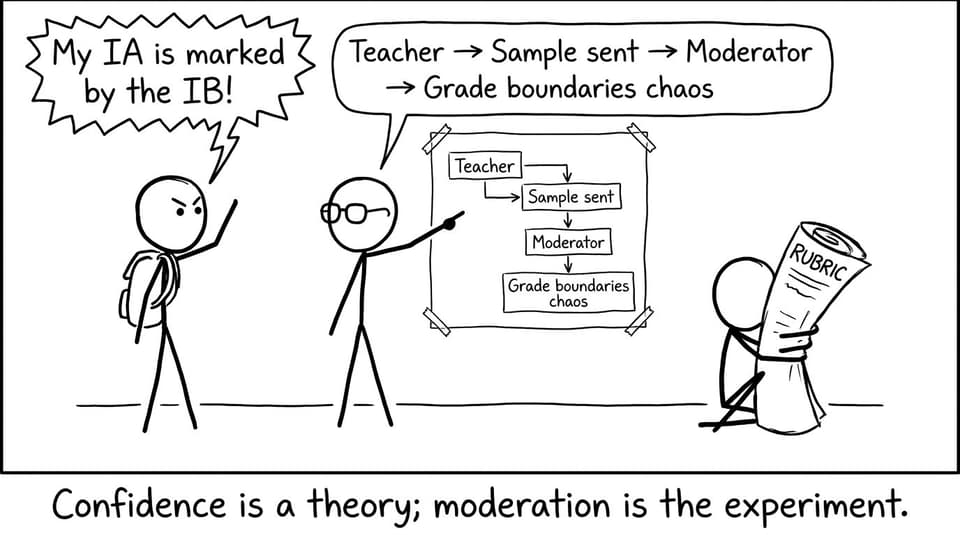
- The IB externally moderates a sample of IAs from your school.
- Moderation can adjust marks up or down for the whole cohort in that subject.
- The best strategy is to write an IA that clearly "shows evidence" for each criterion, not one that merely feels impressive.
- Fast way to de-risk: run an early draft through an IB-style rubric check and revise in iterations.
If you want a rubric-aligned feedback loop that feels like a second pair of examiner eyes, the IB Coursework Grader is built for exactly that: IA drafts, clear criterion feedback, and faster iteration.
Who marks the IA, really?
For most IB subjects, the first and primary marker of your IA is your classroom teacher. That's not a technicality. It's the core of the system.
Your teacher is responsible for:
- reading your IA,
- marking it against the official assessment criteria,
- annotating evidence (in the way your school requires), and
- submitting marks to the IB.
So if you're wondering whether an "IB examiner" individually grades every IA submitted worldwide: no. Your IA is not usually marked by an external examiner line-by-line in the way final exam scripts are.
But that doesn't mean the IB is uninvolved.
How IB moderation changes IA marks
After teachers submit marks, the IB applies external moderation. In plain English: the IB checks whether your school's marking is consistent with global standards.
Moderation typically works like this:
- The IB requests a sample of student work from your school for a given subject.
- The sample includes IAs across a range of marks (not only the top ones).
- An IB moderator reviews that sample and compares the teacher's marks to the rubric standard.
- If the school's marking is judged too lenient or too harsh, the IB can apply an adjustment to the cohort's marks in that subject.
That last line is the part most students don't notice until it matters: moderation often affects the group outcome, not a single student in isolation.
This is why "Who marks the IA?" is really two questions:
- Who gives the first mark? (Your teacher.)
- Who ensures the marking standard matches the IB? (The moderator, through sampling.)
For a deeper look at the coursework feedback + moderation workflow schools use, see How RevisionDojo Enhances IB Internal Assessment (IA) Feedback and Moderation.
What does "best-fit" marking mean for your IA?
A quiet detail in IB marking is that it's rarely about ticking every box perfectly. It's about best-fit.
Best-fit means your teacher (and later, the moderator) looks at the descriptors in each criterion and chooses the level that most closely matches the overall evidence. If one strand is strong and another is weaker, the mark reflects the balance.
In practice, best-fit rewards students who do one thing consistently well: make evidence easy to see.
A brilliant idea buried in messy structure is hard to reward. A solid idea with clean signposting and clear justification often scores higher.
If you're doing a science IA and you want to understand how markers are trained to think, the language in this guide is revealing: Chemistry IA Marking Toolkit.
Why some schools "standardize" IA marks internally
Before your marks ever reach the IB, many schools run internal standardization.
This is simply teachers comparing samples across classes to reduce randomness. It can help you, because it reduces the chance that one class is marked wildly differently from another.
But it also means your IA mark is not only about your individual teacher's opinion. It's about your school's shared interpretation of the rubric.
If you want to play this game well, you don't chase a vibe. You chase the criteria.
That's also why many students find it useful to compare their draft to top models. RevisionDojo's IB Coursework Exemplars Index (IA, EE, TOK) is designed for that: seeing what "evidence" looks like at higher bands.
The practical question: can moderation change your IA score?
Yes. But usually not in the way students imagine.
Moderation rarely "re-marks" every IA individually. It checks the school's marking standard using the sample, then adjusts if needed.
So the risk isn't that your IA gets secretly judged by a stranger who dislikes your topic. The risk is broader:
- If your school is generous, moderation can pull marks down.
- If your school is strict, moderation can push marks up.
Your goal is to write an IA that would survive either scenario: clear rubric alignment, strong justification, and visible evaluation.
How to make your IA more moderation-proof
Moderation-proof doesn't mean perfect. It means defensible.
Build your IA around "marker visibility"
Markers are human. They read fast. They juggle criteria. They look for evidence.
Simple wins:
- Use headings that map to the rubric (where appropriate).
- Make the research question explicit and repeat it in your conclusion.
- Label graphs and tables clearly.
- Add brief signposts: "This supports Criterion C because…" (sparingly, but strategically).
If your research question is still fuzzy, fix that first: How to Write a Strong IA Research Question.
Treat feedback like iterations, not verdicts
Most students wait too long to get feedback because they think feedback is a final judgment. That mindset creates panic.
A better approach is small, frequent loops:
- draft,
- check against criteria,
- revise one or two criteria at a time,
- repeat.
RevisionDojo's IB IA Grading Service: Professional Assessment in Minutes explains how rubric-aligned draft feedback can work as a fast checkpoint, especially when your teacher can't read version 9 on a Tuesday night.
Use the right tool for the right stage
When exams are close, your brain wants certainty. Tools can help, as long as you use them correctly.
A practical workflow:
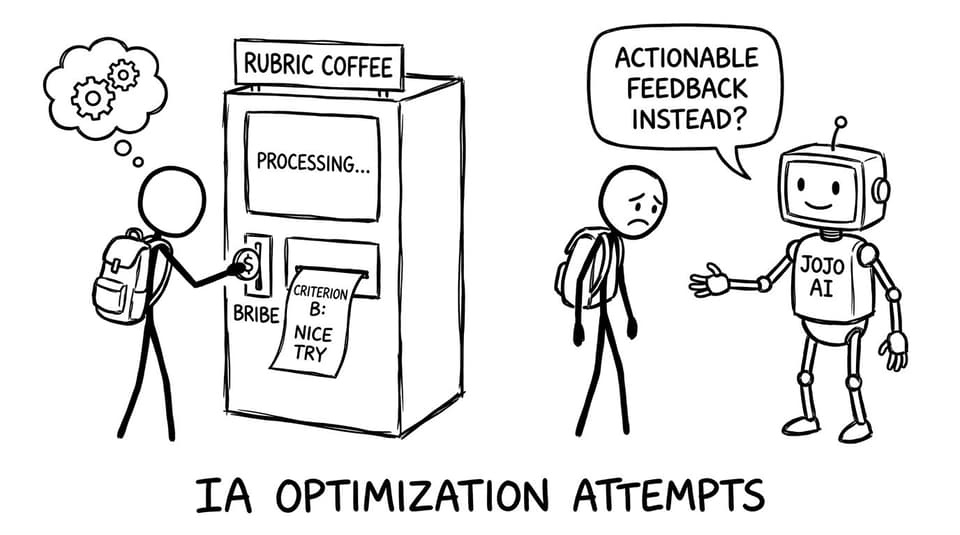
- Use IB Coursework Grader for criterion-by-criterion feedback on your IA draft.
- Use Jojo AI Chat to ask targeted questions like "What would stronger evaluation look like here?" or "Is my methodology replicable?"
- Use the Questionbank to keep exam technique moving while coursework is in progress.
- Use Study Notes and Flashcards to prevent the classic IA trap: finishing coursework and forgetting content.
That full-stack loop, including Questionbank, Study Notes, Flashcards, AI Chat, Grading tools, Predicted Papers, Mock Exams, plus the Coursework Library and Tutors, is what makes RevisionDojo feel like a home base instead of another tab.
How IA marking connects to exam preparation (without stealing your time)
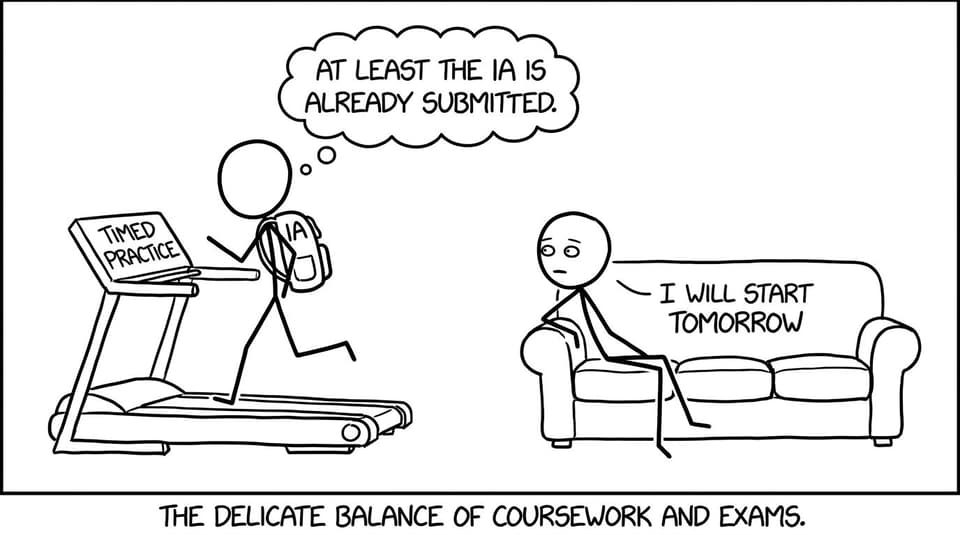
It's tempting to treat the IA as separate from exams. But the best students quietly do the opposite: they use the IA to sharpen the skills exams reward.
- Your IA trains explanation and justification.
- Your IA trains data commentary and evaluation.
- Your IA trains academic clarity.
Then you reinforce those same skills with exam-style practice.
If you need a simple routine that integrates both, this article lays out a sustainable rhythm: RevisionDojo App: The Smarter Way to Prep for IB Exams.
And if you're in a science subject, don't ignore the analysis layer: Using Statistical Analysis Effectively in an IB Science IA shows what markers often reward when they see statistics used with purpose.
Closing: the calm way to think about IA marking
If you remember only one thing, make it this: your IA is marked by your teacher, but it's judged in a system that cares about consistency.
That's why the smartest strategy isn't trying to predict the moderator. It's making your IA easy to mark well: clear criteria alignment, visible evidence, and revision cycles that tighten weak spots before they become permanent.
When you're balancing coursework and exams, RevisionDojo gives you the full loop in one place: the Coursework Library for models, the Grading tools for rubric feedback, Jojo AI Chat for targeted fixes, Study Notes and Flashcards for content retention, and the Questionbank, Predicted Papers, and Mock Exams to keep exam performance rising while your IA gets finished.
If you want the fastest next step, upload a draft to the IB Coursework Grader and turn "Who marks the IA?" into a better question: "What would earn the next band, and how quickly can I build that evidence?"