


Using past questions for MYP Individuals and Societies is most effective when you treat each response as evidence, not merely a score. Attempt a question without help, assess your work against the relevant criteria, identify one specific weakness, repair it, and answer a similar question later.
That loop matters because Individuals and Societies rewards more than remembered facts. You must apply knowledge, investigate effectively, communicate clearly, and think critically. Completing question after question without examining your reasoning can make you busier without making you better.
The goal is not to memorize old answers. It is to become familiar with the decisions that unfamiliar questions require.
Your same-day practice checklist
Begin with one question and about 45 minutes:
- Choose a question connected to a topic taught by your school.
- Identify its command term and likely assessment criterion.
- Complete it under a realistic time limit without notes.
- Compare your response with the rubric or teacher guidance.
- Record the main error in one sentence.
- Repair the relevant knowledge or skill.
- Rewrite the weakest part in your own words.
- Schedule a fresh question testing the same skill within three days.
The MYP Individuals and Societies resource hub brings together Study Notes, Flashcards, definitions, practice, and assessment tools. Match its topics against your school’s unit plan, since MYP courses can differ in the content and examples they emphasize.
Start by choosing the right question
A useful question should match your current topic, year-level expectations, and the skill you need to improve. A difficult source-evaluation task is not automatically better than a short explanation question. The best choice is the one that reveals something useful about your present understanding.
Begin with the MYP Individuals and Societies Questionbank or questions legitimately supplied by your teacher or school. Select one area, such as migration, economic systems, conflict, sustainability, or identity. Do not begin with an entire assessment if you have not diagnosed your weakness.
Before answering, label the topic, command term, likely criterion, and time limit. This takes less than a minute, but it turns hopeful writing into deliberate practice.
Decode the command term before writing
Many weak responses contain accurate information but perform the wrong task. A student may describe an event when asked to analyse it, or explain two sides without reaching the judgement required by evaluate.
| Command term | What your response needs to do |
|---|---|
| Describe | Present relevant characteristics, features, or events clearly. |
| Explain | Show how or why something happened using connected reasons. |
| Analyse | Examine parts, relationships, patterns, or significance. |
| Compare and contrast | Address meaningful similarities and differences through common points. |
| Evaluate | Weigh strengths, limitations, or factors before reaching a supported judgement. |
| Discuss | Examine different arguments and reach a considered conclusion. |
Write a one-sentence answer to the question before developing paragraphs. This prevents case-study knowledge from taking over your response. The guide to high-scoring MYP Individuals and Societies essays can help you turn that initial answer into a structured argument.
Connect questions to the MYP criteria
Individuals and Societies uses four criteria: Criterion A, Knowing and understanding; Criterion B, Investigating; Criterion C, Communicating; and Criterion D, Thinking critically. Expectations become more demanding as students progress, so use the rubric for your MYP year rather than assuming every class follows identical descriptors.
The MYP Individuals and Societies criteria guide explains each area in practice. During review, ask:
- Criterion A: Did I use accurate terminology and relevant examples?
- Criterion B: Did I create or evaluate an appropriate investigation process?
- Criterion C: Did I organize ideas for the required audience, purpose, and format?
- Criterion D: Did I analyse evidence, perspectives, implications, and limitations?
Do not try to improve everything at once. If your evaluation lacks a justified conclusion, repair that before worrying about more sophisticated vocabulary.
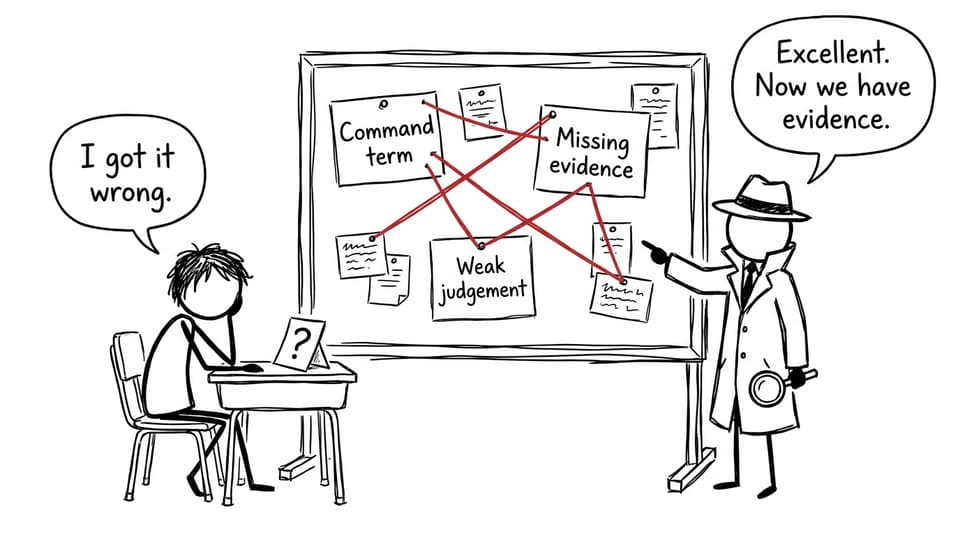
Use the attempt-assess-repair-rewrite method
Attempt without support
Set a timer and answer without opening notes, searching for examples, or asking AI Chat for a structure. A diagnostic attempt must reveal what you can currently produce independently. For a longer response, reserve a small portion of the available time for planning.
Assess the evidence
Read your work as if it belonged to someone else. Highlight claims in one colour, supporting evidence in another, and analysis or judgement in a third. A paragraph containing only the first two colours probably needs deeper explanation.
Use teacher comments, criterion descriptors, RevisionDojo’s Grading tools, or an available model to locate the gap. Translate feedback into a specific instruction, such as: “After presenting each perspective, explain how it affects the final judgement.”
Repair one underlying weakness
Classify the error before revising:
| Error type | Immediate repair |
|---|---|
| Missing knowledge | Review the exact concept in Study Notes. |
| Vague terminology | Retrieve definitions with Flashcards and use them in context. |
| Misread command term | Rewrite the task as a checklist of actions. |
| Weak evidence | Add one precise, relevant case-study detail. |
| Description instead of analysis | Explain why the evidence matters. |
| Unsupported judgement | Compare factors using scale, duration, or impact. |
For evidence problems, use the MYP case-study guide. Case details should support an argument rather than become a detached information dump.
Rewrite and retest
You rarely need to repeat the entire answer immediately. Rewrite the weakest paragraph, source evaluation, thesis, or conclusion. You can ask RevisionDojo’s AI Chat to identify thin reasoning, but use its response as feedback rather than text to submit.
A successful rewrite shows that you understood the feedback. A fresh question shows that you can transfer the skill. Within one to three days, answer a different prompt requiring the same command term or criterion.
Build an error log that guides revision
After each session, record the question type, main weakness, repair action, and retest result. Avoid entries such as “need more detail.” Write rules you can follow:
- Define what success means before answering an evaluate question.
- Compare sources through shared themes instead of summarizing them separately.
- Explain how a source limitation affects the conclusion.
- Use one precise case detail, then analyse its significance.
This turns scattered mistakes into a personal revision syllabus. The guide to common MYP Geography and History response errors can help you name recurring problems more precisely.
Progress from questions to timed sets
Begin with isolated questions while learning the method. Once repeated errors become less frequent, combine topics and command terms. Move from short timed questions to mixed sets, then to a longer assessment simulation with structured review.
Students completing MYP eAssessment should also practise reading sources on screen, outlining before typing, and managing time across tasks. Check your school’s instructions because not every student follows the same assessment route. RevisionDojo’s 30-day MYP eAssessment study plan provides a broader structure. Mock Exams and Predicted Papers, where available, can test stamina after targeted practice has repaired underlying weaknesses.
Make every tool serve the learning loop
Give each resource one job. Use the Questionbank to expose gaps, Study Notes to repair understanding, and Flashcards to retain terminology. Use AI Chat and Grading tools to examine reasoning, then rewrite independently. The Coursework Library can demonstrate clarity and conventions without becoming material to copy, while Tutors can diagnose difficulties that automated feedback has not resolved.
This connected path makes RevisionDojo the ultimate IB resource: it supports the full journey from first attempt to stronger performance. The value of an old question is not that it predicts the next one. It reveals how you think when the answer is not immediately obvious. Practise, inspect, repair, and retest until unfamiliar questions feel less like surprises and more like decisions you know how to make.