A history question can look familiar and still expose something unfamiliar: not what you know, but what you can do with it. That is why using past questions for MYP History works best as a feedback process. Choose one question, identify the command term and criterion, answer under a time limit, review the response, repair one weakness, and try again.
You can begin with one question and 45 minutes. You do not need to revise an entire unit first. The question itself can reveal which knowledge and skills deserve attention.
The method at a glance
Use this seven-step loop:
- Choose a question matching your current unit.
- Underline the command term.
- Connect the task to the relevant MYP criterion.
- Plan the evidence and structure.
- Answer without notes under a realistic time limit.
- Record one specific error.
- Repair the weakness, then rewrite or retry.
The important word is loop. Completing ten questions without reviewing them rehearses existing habits. Completing one, studying the weakness it reveals, and improving the response creates learning.
Step 1: Choose a narrow question
Start with a topic your class has covered. The MYP History Questionbank lets you practise exam-style questions by topic, which is more useful initially than choosing a completely mixed set.
Target one manageable action: explaining a consequence, analysing a source's message, comparing perspectives, evaluating evidence, or judging significance. Do not choose only comfortable questions. Good practice should feel possible but slightly uncertain. That uncertainty often points toward the next improvement.
Step 2: Translate the command term
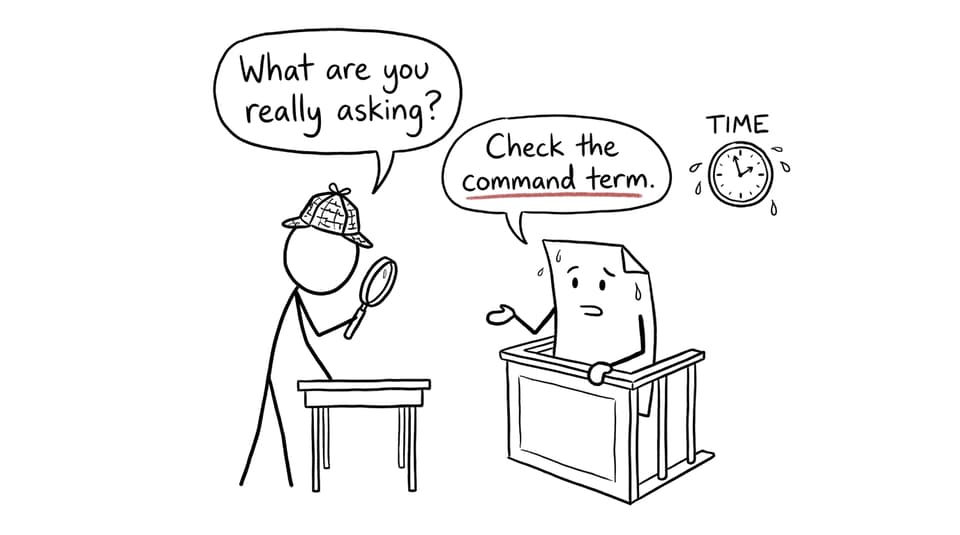
Before considering content, underline the command term. Responses often weaken because students answer the topic rather than the instruction.
Translate the term into a visible task:
- Describe: give an accurate account.
- Explain: show how or why something happened through connected reasoning.
- Analyse: examine relationships, patterns, or implications.
- Compare and contrast: identify meaningful similarities and differences throughout.
- Evaluate: weigh strengths and weaknesses before reaching a supported judgement.
- To what extent: argue how far a claim is valid while considering alternatives.
Write a one-line success condition above your answer. For example: “Explain two causes, connect each to the outcome, and judge which was more important.” This prevents description from replacing analysis.
Step 3: Match the MYP criteria
MYP Individuals and Societies uses four equally weighted assessment criteria, each with a maximum achievement level of 8:
- Criterion A: Knowing and understanding
- Criterion B: Investigating
- Criterion C: Communicating
- Criterion D: Thinking critically
A school task may assess one criterion, several criteria, or particular strands. Your teacher's task sheet and rubric remain the final authority. The MYP Individuals and Societies criteria guide explains what each criterion is intended to make visible.
Factual explanations may emphasize Criterion A. Research planning can engage Criterion B. Writing for a specified audience may emphasize Criterion C. Source evaluation, comparison, perspectives, and supported judgement often draw heavily on Criterion D.
Turn the relevant descriptor into a practical question: What must the marker see on the page? “Think critically” is abstract. “Compare two perspectives, use precise evidence, and explain why they differ” is actionable.
Step 4: Build a three-minute plan
A plan is not a miniature essay. It decides what each paragraph will prove.
For an extended response, note a one-sentence thesis, two or three claims, one precise example for each, a qualification, and the basis of your final judgement.
For a source question, annotate message, origin, purpose, context, and usefulness for the inquiry. A source is not automatically valuable because it is primary, nor automatically limited because it contains bias. Its usefulness depends on what the historian wants to discover.
If your evidence is thin, use the MYP History resource hub to review focused Study Notes and Flashcards. Then close them before writing. Assessment requires you to select and apply knowledge, not merely recognize it.
Step 5: Write under controlled pressure
Introduce timing gradually. Allow enough time to finish thoughtfully on the first attempt, then shorten the limit until you can work within the conditions set by your teacher.
A useful session is:
- 5 minutes: decode the question;
- 5 minutes: recall facts and plan;
- 15 minutes: write without help;
- 10 minutes: review against the rubric;
- 10 minutes: rewrite the weakest section.
If your school enters students for the MYP History on-screen assessment, the official format uses source-based and extended tasks to assess investigating, communicating, and critical thinking. It lasts two hours, but short drills remain useful. Stamina grows through controlled repetition rather than premature full simulations. The MYP revision guide can help place these sessions within a weekly routine.
Step 6: Review like a historian
Do not ask only, “Was this correct?” Ask where the reasoning weakened:
- Did I follow the exact command term?
- Did every paragraph make a claim?
- Did I explain what my evidence proves?
- Did I consider perspective, context, or limitations where relevant?
- Did my conclusion weigh the argument?
RevisionDojo's Grading tools and AI Chat can identify unclear reasoning, but feedback should begin a revision rather than end the work. You must still decide which suggestion fits the rubric and rewrite independently. The guide to common errors in MYP Geography and History responses helps when comments such as “too descriptive” keep appearing.
Step 7: Create an error rule and retry
An error log turns isolated mistakes into reusable MYP History revision techniques. Record the question type, weakness, and one rule for next time.
Useful rules include:
- “After every example, explain why it supports my claim.”
- “Connect each source's value and limitation to the inquiry.”
- “Compare both sources within the same paragraph.”
- “State which factor mattered most and why.”
- “Use two precise examples instead of five undeveloped ones.”
Retry the weak paragraph immediately or answer a similar question within two days. Recognizing feedback is easier than applying it, so the second attempt is where improvement becomes visible.
Build a weekly system
A practical routine might combine Study Notes and Flashcards on Monday, a short source question on Tuesday, a rewritten paragraph on Wednesday, an evaluation question on Thursday, and a mixed Mock Exam at the weekend.
As assessment approaches, RevisionDojo's Predicted Papers can introduce unfamiliar questions and realistic pressure where available. The Coursework Library shows how effective historical communication is organized, while Tutors provide human guidance when a criterion remains difficult. You can also consult the RevisionDojo MYP Individuals and Societies review and recommended websites for MYP History for additional context and source practice.
Start with one question
The most useful question is not necessarily the one you answer perfectly. It is the one that shows what to improve next.
Open the RevisionDojo Questionbank, choose a question from your current topic, write for 15 minutes, and create one error rule. Then rewrite the weakest part. That small cycle turns revision into evidence of what you know, how you think, and what your next session should repair.