



A university application can make a perfectly sensible parent wonder whether their child chose the wrong alphabet.
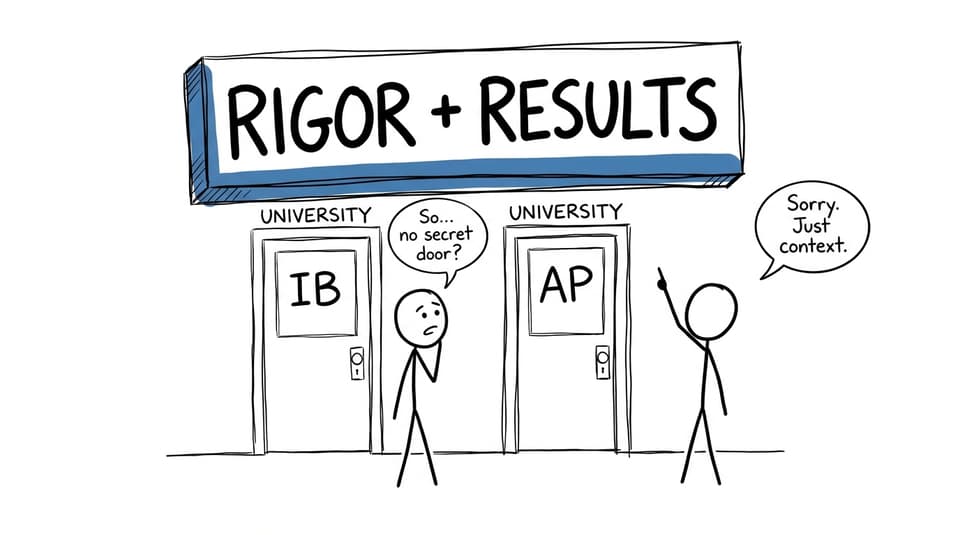
IB or AP? One is a coordinated diploma built around breadth, depth, research, and reflection. The other offers individual college-level courses familiar across the United States. When families ask whether US universities prefer IB or AP, the reassuring answer is usually neither.
American universities generally evaluate the rigor of a student's education in the context of what their school offers. A student taking the full IB Diploma is not expected to add AP courses simply because AP is more common in the US. Likewise, a student at an AP-focused school is not disadvantaged because the IB Diploma was unavailable.
The more important questions are whether the student selected appropriately demanding courses, performed well, maintained a balanced academic program, and met any subject-specific expectations for their intended degree.
The short answer for IB parents
Here is the practical overview:
- US universities recognize both IB and AP as rigorous academic options.
- Admissions officers consider which courses were available at the student's school.
- The full IB Diploma provides a clear, cohesive signal of academic challenge.
- Strong performance matters more than choosing one program label over another.
- Relevant Higher Level subjects can matter for preparation in areas such as engineering, science, economics, or mathematics.
- Admission, college credit, and advanced placement are separate decisions.
- Testing policies vary by university and application year.
- An IB student ordinarily does not need to take AP courses merely to look competitive.
Parents wanting a broader view can read this guide to applying to top US universities with the IB.
Why universities rarely make a simple IB versus AP choice
Universities do not review curricula in isolation. They review students within schools, communities, and educational systems.
This principle matters because opportunity is uneven. One school might offer the complete IB Diploma Programme. Another might provide 20 AP subjects. A smaller school may offer only a few advanced courses. Treating the number or type of advanced classes as a universal measurement would reward access rather than achievement.
Official admissions guidance reflects this contextual approach. Yale says that it is familiar with both AP and IB and does not prefer one over the other. Stanford states that it does not prefer a particular curriculum, including IB, AP, A Levels, or national systems. Both institutions emphasize rigorous preparation and achievement within the opportunities available.
That does not mean curriculum is unimportant. It means the label is not the decisive factor. Admissions readers are more likely to consider:
- How demanding the student's program was relative to school offerings
- Whether grades remained strong as difficulty increased
- Whether the schedule covered core academic areas
- Whether subject choices supported the proposed field of study
- Whether the student sustained effort through the final school year
For a detailed explanation of how the qualification is perceived, see what universities think of the IB Diploma.
How IB and AP communicate rigor differently
IB and AP can both demonstrate advanced preparation, but they do so through different structures.
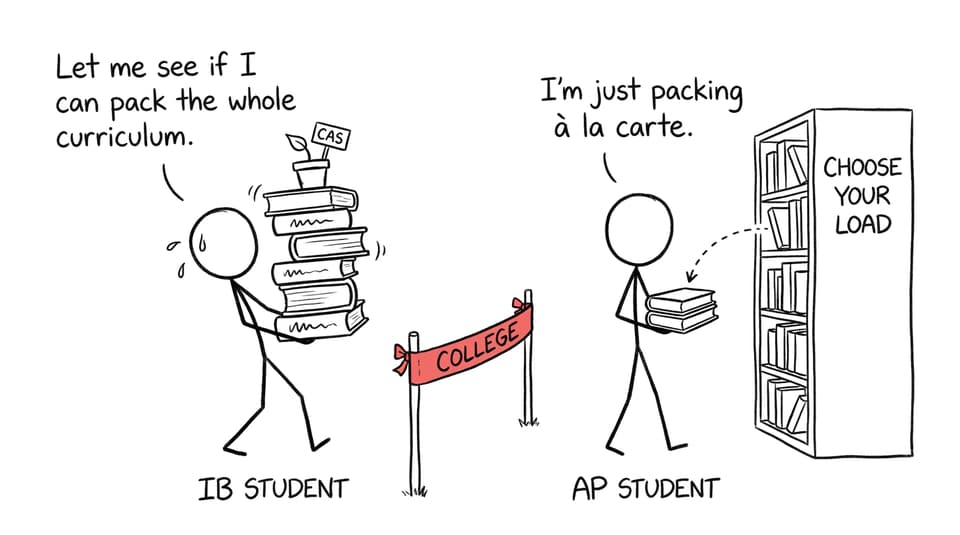
The IB Diploma is a two-year program built around six subjects and a required core. Students normally combine Higher Level and Standard Level study while completing Theory of Knowledge, the Extended Essay, and Creativity, Activity, Service. This creates a broad and interconnected academic record.
AP is more modular. Students select individual college-level courses and examinations, usually according to the subjects offered by their school, their interests, and their readiness. There is no universal number of AP classes that every competitive applicant must complete. College Board itself advises students to choose a balanced course load rather than pursue a fixed total.
| Question | IB Diploma | AP courses |
|---|---|---|
| Overall structure | Coordinated two-year program | Individual subject courses |
| Breadth | Built into diploma requirements | Determined by course selection |
| Advanced study | Higher Level subjects | Separate AP subjects |
| Research component | Extended Essay required | Depends on chosen courses and school |
| Interdisciplinary core | TOK, Extended Essay, and CAS | No equivalent program-wide core |
| Flexibility | Structured, with some subject choice | Highly flexible and modular |
Neither structure is inherently better for admission. The IB can show that a student managed a demanding program across several disciplines. AP can show advanced achievement through a carefully selected combination of subjects. The meaningful issue is how well the student used the pathway available.
Families comparing workload rather than admissions value may also find this IB and AP difficulty comparison useful.
What US admissions officers may notice about an IB student
The full IB Diploma can make academic rigor easy to understand. Its structure tells an admissions reader that the student has continued studying across languages, mathematics, science, and other academic areas while completing substantial independent and reflective work.
Still, enrollment in the program is only the beginning of the evaluation. Universities will examine the student's actual record. They may look at school-awarded grades, predicted results where available, completed examination results, the choice of HL and SL subjects, recommendations, essays, activities, and the school profile.
For an intended engineering applicant, rigorous mathematics and physics may be more relevant than simply possessing the diploma label. For a prospective literature student, sustained strength in writing-intensive subjects may carry more meaning. Exact expectations differ, so families should check the admissions pages for each university and, where applicable, the intended school or major.
It is also important not to manufacture an unofficial GPA conversion. There is no single national conversion between IB scores and the American 4.0 scale. Students should report grades exactly as the application requests and allow the school counselor to provide context. The guide to presenting IB in US college applications explains this reporting process in more detail.
Does an IB student need AP courses as well?
Usually, no.
A student completing the full IB Diploma is already following a demanding curriculum. Adding AP courses solely to prove rigor can create more strain without adding meaningful information to the application. It may even weaken the record if the extra commitment damages grades, coursework, sleep, or preparation for required assessments.
There are limited situations in which an additional AP course could make sense. A student might have a strong academic interest not available within the school's IB selection, or a specific university might accept a relevant AP result for placement. That should be a purposeful decision, not a response to the fear that American admissions officers will misunderstand IB.
The safer principle is simple: do the available curriculum well. A coherent program with strong achievement is more persuasive than a crowded transcript assembled to collect labels. Students can apply successfully using the IB alone, as explained in this guide to applying to US universities with only the IB Diploma.
Admission preference is not the same as college credit
Much confusion comes from combining two separate questions:
- Which curriculum does a university value during admission?
- Which examination results receive credit or advanced placement after enrollment?
A university can regard IB and AP as equally rigorous for admission while maintaining different credit rules for each. Policies may vary by subject, examination level, score, degree program, and campus.
The University of California, for example, currently awards credit for designated AP examinations with qualifying scores. It also awards credit for designated IB Higher Level examinations with scores of 5, 6, or 7, plus additional units for completing the diploma with at least 30 points. Other universities may grant placement without degree credit, restrict awards to certain subjects, or grant no pre-enrollment credit at all. Harvard, for instance, uses IB and AP credentials as possible placement tools but does not grant degree credit for them.
Therefore, a generous AP policy does not prove that AP applicants are preferred. Nor does substantial IB credit indicate that IB applicants receive an admissions advantage. Families should compare official credit charts separately for every institution. This overview of IB equivalency credit at Ivy League universities illustrates why policies require individual checking.
What about university requirements and standardized testing?
There is no universal set of IB university requirements across the United States. Each institution determines its own application documents, recommended secondary-school preparation, testing policy, English-language requirements, and credit rules.
Testing policies are especially changeable. Some universities require the SAT or ACT, some allow alternative forms of testing, some remain test-optional, and others do not consider those scores. The IB Diploma does not automatically replace a stated SAT or ACT requirement unless the university explicitly says that it can.
Parents should check requirements for the student's exact entry year rather than relying on an older list. A useful research sheet should include:
- Application deadline
- Required school documents
- Predicted-result procedure
- SAT or ACT policy
- English-language requirement and possible waivers
- Recommended secondary-school subjects
- Major-specific preparation
- IB credit and placement policy
- Final-result submission instructions
The current guide to SAT decisions for IB students provides a framework for sorting test-required, test-flexible, test-optional, and test-free policies.
What IB diploma parents should focus on now
The comparison between IB and alternatives can become a distraction precisely when students need calm, specific support.
For a student already enrolled in IB, the highest-value priorities are usually straightforward: protect performance in current subjects, complete required coursework carefully, prepare consistently for examinations, and build a balanced university list. Parents can also help confirm that HL choices align with any likely course prerequisites.
The next step is not to ask whether AP would have looked better. It is to examine each target university in context. Read its official first-year admissions page, review requirements for the intended major, check current testing rules, and separate admission policy from credit policy. The step-by-step IB university application guide can help organize that process.
The reassuring conclusion is also the most useful one: an IB student is not carrying the wrong qualification into US admissions. The diploma is a recognized, demanding pathway. What matters now is how thoughtfully the student completes it and how accurately the family matches that record to universities where the student can thrive.