

The truth about getting into a top U.S. university with IB
At some point in every IB student’s year, the doubt shows up quietly. Usually at 1:13 a.m. while you’re rewriting an IA conclusion for the third time and wondering whether your friends doing APs (or test prep) know something you don’t.
Here’s the truth: yes, you can get into a top U.S. university with just the IB Diploma. Many students do. Not because the IB is a magic ticket, but because it sends a clear signal: you can handle sustained rigor across subjects, deadlines, writing, and exams.
The part that surprises people is what comes next: top U.S. admissions is rarely about “did you take enough extra stuff?” It’s more often about “did you do the hard thing you had access to, and did you turn it into a story of impact?” The IB can do that exceptionally well--if you use it on purpose.
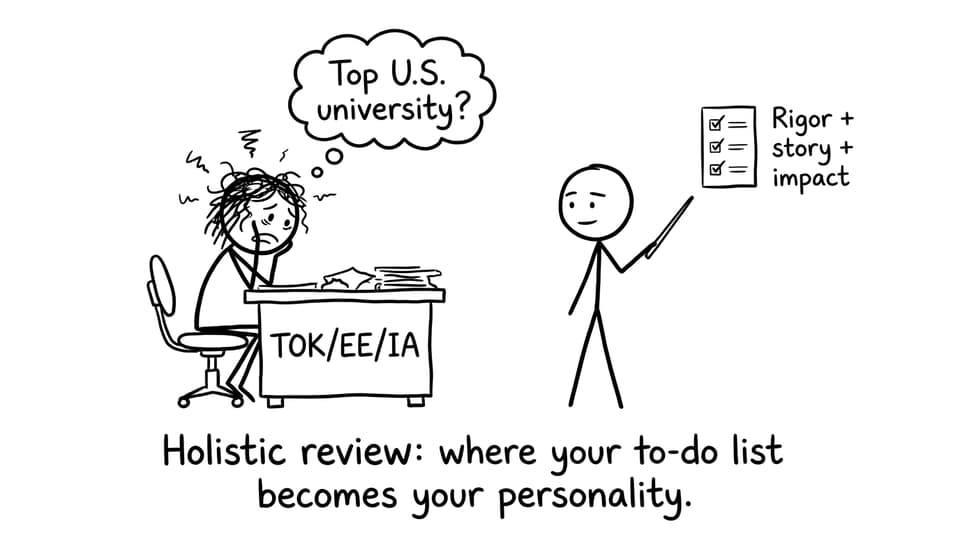
Quick checklist: what top U.S. schools want to see from IB students
Use this as your north star while you revise for IB exams and build your application:
-
Rigor in context: a full IB Diploma, plus HL choices that make sense for your direction.
-
Strong predicted/actual scores: not perfect, but consistently excellent.
-
A coherent academic narrative: EE, IAs, and activities that connect.
-
Writing that sounds like you: personal essay + supplements that show reflection.
-
Impact outside class: depth over quantity.
-
Proof you can finish what you start: the IB already trains this muscle.
If you want one place to organize the academic side of that checklist, RevisionDojo’s RevisionDojo for IB hub is built around the exact cycle U.S.-bound students need: learn, practice, get feedback, and improve.
Why the IB Diploma is already “enough” academically
The IB Diploma isn’t just six subjects. It’s a system that forces you to juggle breadth and depth while producing serious writing.
TOK teaches you how to argue without sounding like a Wikipedia page. The EE proves you can stick with a long project. IAs show you can execute a method, analyze results, and communicate them under constraints. Put together, the IB is a portfolio of academic behavior.
In other words: for U.S. universities that use holistic review, IB is not a disadvantage. It’s evidence.
To strengthen that evidence during exam season, build your fundamentals fast using Study Notes and then pressure-test your understanding with the Questionbank. That learn-then-apply rhythm mirrors what admissions readers call “preparedness.”
What “holistic review” actually means for IB applicants
Holistic review sounds fuzzy until you picture the actual problem admissions teams are solving: they’re assembling a class, not awarding trophies.
So yes, your IB predicted score matters. But it sits beside your writing, recommendations, course rigor, school context, and the pattern of your extracurricular impact.
That’s why the best IB strategy is rarely “collect more credentials.” It’s “make the credentials you already have speak clearly.”
A practical way to do that is to turn your IB work into application language:
-
Your EE becomes proof of intellectual curiosity (and self-management).
-
Your TOK moments become a voice for nuance and perspective.
-
Your IAs become examples of initiative, precision, and resilience.
When you’re revising, you can also use RevisionDojo’s IB Coursework Grader to tighten criterion-level writing. Even if your coursework is already submitted, the feedback style trains you to write clearer, more defensible arguments--a skill that carries into essays and interviews.
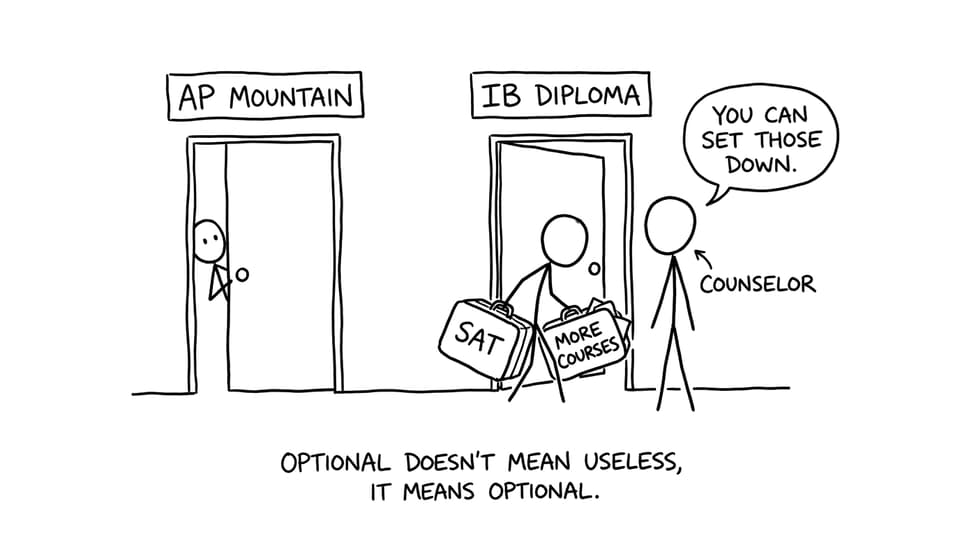
Do you need SAT/ACT or extra courses alongside IB?
For many students, no. A full IB Diploma is widely recognized as rigorous, and many U.S. universities are test-optional.
But “not required” isn’t the same as “never helpful.” Submitting strong test scores can sometimes strengthen an application, especially if:
-
your school’s grading is unusually strict,
-
your transcript has a dip you can offset,
-
you’re applying to highly quantitative majors and want another data point.
Still, the highest-return move for most IB students preparing for exams is simpler: raise your IB score. Because that improvement shows up in predicted grades, final results, and teacher recommendations.
If you’re trying to raise scores efficiently, use short daily recall with IB Flashcards and then run timed practice with IB Predicted Papers to build exam judgment (what to attempt, when to move on, how to structure answers).
What IB scores are competitive for top U.S. universities?
There’s no universal cutoff. Admissions varies by institution, major, and applicant pool.
But as a realistic rule of thumb, a predicted score in the high 30s to 40s is often competitive at very selective schools, and many admitted students sit even higher. If you’re aiming for the most selective STEM programs, strong performance in relevant HL subjects matters as much as the total.
Here’s the IB nuance students miss: a “good” score looks different depending on your context and choices.
-
HL Math AA + HL Physics is a different signal than lighter combinations.
-
A consistent transcript plus strong predicted grades can matter more than one perfect exam.
-
Your writing and recommendations can amplify academic strength.
RevisionDojo helps you convert effort into marks with fast feedback loops: drill weaknesses in the Questionbank, clarify gaps with Study Notes, and keep memory alive with Flashcards.
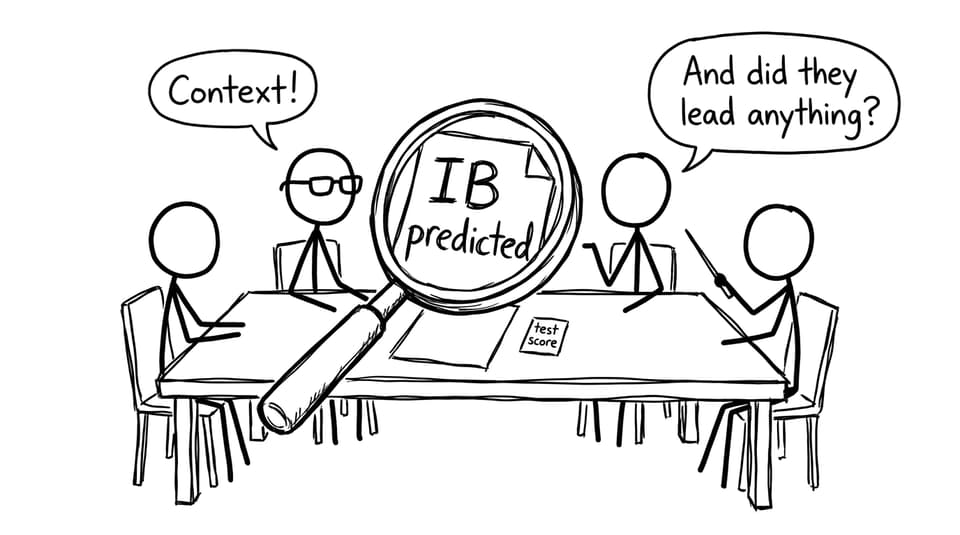
How to stand out using what you already do in IB
The students who get the most leverage from IB aren’t necessarily the ones with the heaviest schedule. They’re the ones whose application feels inevitable.
That usually comes from alignment:
-
HL choices that match your intended direction.
-
An EE topic that hints at genuine curiosity.
-
A few extracurricular commitments where you can show measurable contribution.
-
Essays that connect the dots without forcing them.
If you’re deep in exam prep, this alignment can still happen. Keep a running note of “proof moments” from your IB life: a lab that failed, a feedback cycle you survived, a TOK claim you changed your mind about. Those become application stories later.
To keep exam prep from swallowing everything, follow a repeatable loop: notes, flashcards, practice questions, then full timed papers. RevisionDojo’s RevisionDojo App guide lays out that workflow clearly, and the platform’s AI Chat can unblock you when a concept stalls your revision momentum.
Closing: the IB is already a compelling signal--if you finish it well
You don’t need a secret curriculum to reach a top U.S. university. If you’re doing the IB Diploma, you’re already in a program that rewards the exact traits selective admissions claims to value: rigor, reflection, and follow-through.
The honest play is to make your IB performance undeniable. Then make your story human.
If you want a calmer, more controlled path to higher IB scores, start with RevisionDojo: drill with the Questionbank, tighten understanding with Study Notes, and rehearse exam pressure with IB Predicted Papers.