

Understanding Change in IB Digital Society (and why it feels personal)
The first time a platform updates, you barely notice. The tenth time, you realize your habits moved without your permission. One day you’re scrolling “for five minutes.” The next, your attention has quietly reorganized itself around notifications, streaks, and a feed that seems to know you better than you do.
That uneasy feeling is exactly why IB Digital Society treats change as a core concept. In IB Digital Society, change is not a side effect of technology. It’s the story: how digital systems reshape people, communities, and institutions over time, often faster than culture or law can react.
If you want a course overview first, start at the IB Digital Society resources hub. It maps the syllabus and the RevisionDojo tools you’ll use to practise under exam conditions.
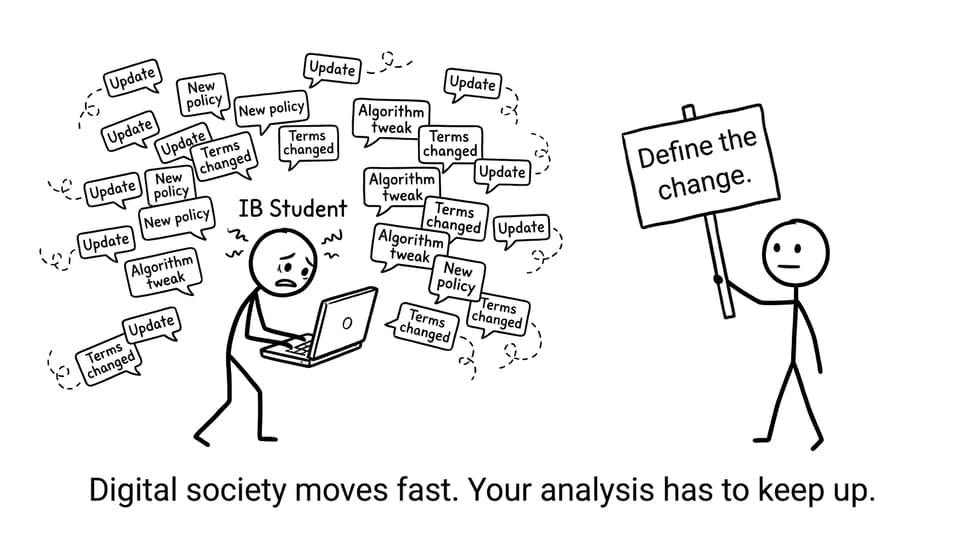
The change checklist (use this before you write)
When an exam question asks you to discuss change in IB Digital Society, run this quick checklist:
-
Name the digital system (a platform, feature, algorithm, policy, or device).
-
Define the “before” (what behaviours, norms, or structures existed previously?).
-
Explain the mechanism (how does the system produce the change?).
-
Track who is affected (individuals vs communities; winners vs losers).
-
Evaluate trade-offs (benefits, harms, unintended consequences).
-
Zoom out in time (short-term vs long-term impacts).
To drill this as a habit, pair Digital Society Topic 2: Concepts with targeted practice from the RevisionDojo Questionbank. That combination forces your explanations to become mark-earning analysis.
What “change” means in IB Digital Society
In IB Digital Society, change refers to how digital systems transform behaviours, relationships, opportunities, and power structures over time. It can be:
-
Fast or slow (a sudden policy shift vs gradual behaviour change)
-
Intentional or accidental (a designed feature vs an unexpected side effect)
-
Positive, negative, or mixed (efficiency gains alongside new inequalities)
The key is this: change is not “new tech exists.” Change is how society adapts, who gains influence, and what norms get rewritten.
If you’re revising content-heavy areas, anchor your examples to the syllabus coverage in Topic 3: Content and reinforce recall using the Topic 3 learning lessons.
Why change is central to IB Digital Society exam answers
Examiners reward students who can show that digital systems are not neutral. A small technical adjustment can create a large social ripple. In IB Digital Society, change helps you explain those ripples with structure.
Three reasons change matters so much:
Digital systems evolve faster than regulation
Laws and school policies often move at “committee speed.” Platforms move at “deployment speed.” That mismatch creates gaps where harms can scale before anyone agrees what the rules should be.
Minor updates can cause major consequences
An “algorithm tweak” can shift what news people see, which creators earn income, or which groups get amplified or silenced. In IB Digital Society, this is where change becomes a tool for evaluating responsibility and accountability.
Change is uneven
The same system can empower one group and exclude another. A feature that feels like convenience to a well-connected user can become a barrier for someone with limited access, low digital literacy, or higher surveillance risk.
For a broader lens, connect change to themes from IB Digital Society: Key Themes Explained.
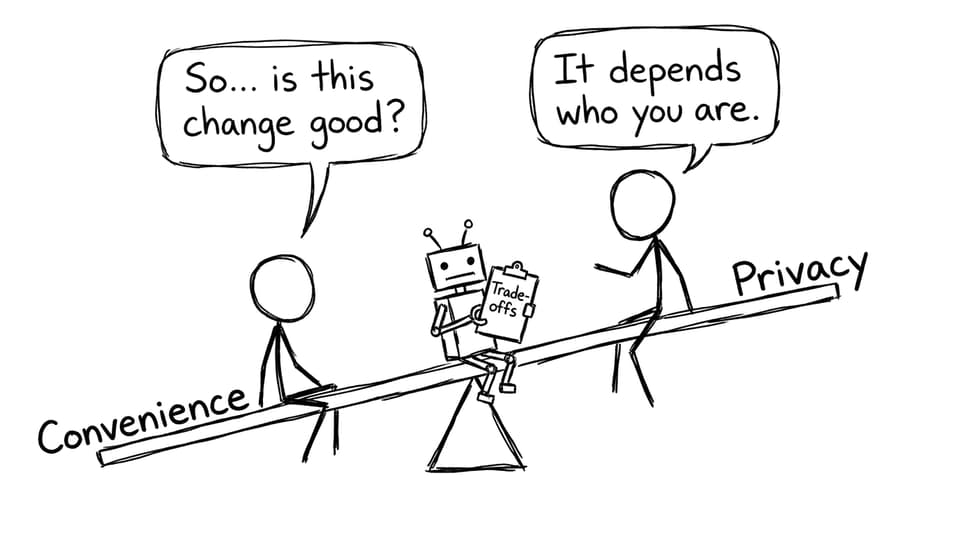
Types of change you can analyse (so your writing stays specific)
High-scoring IB Digital Society responses avoid vague statements like “technology changes society.” Instead, they specify what kind of change is happening.
Social change
How people communicate, form relationships, and build communities shifts with platform design. Think attention patterns, norms for responding, or how identity is performed in public.
Political change
Digital systems can reshape participation, persuasion, and control. The change might look like stronger civic engagement, but it can also involve manipulation, targeted messaging, or surveillance.
Cultural change
Language, trends, and shared meaning evolve quickly online. Cultural change can include hybrid identities, new forms of creativity, and also the erosion of local practices.
Economic change
Automation, platform labour, and data-driven advertising can reorganize work and value. Economic change often produces efficiency, but also new insecurities and inequalities.
When you’re stuck connecting ideas, RevisionDojo’s guide to applying Digital Society concepts effectively is a strong reset.
How to apply change to real examples without becoming descriptive
A reliable IB Digital Society paragraph about change has a simple backbone:
-
System: Identify the platform/feature/policy.
-
Mechanism: Explain what it does that causes outcomes.
-
Impact: Show change for individuals and communities.
-
Evaluation: Weigh trade-offs and justify a judgment.
If you want to level up, link change to at least one other concept (power, identity, ethics, systems). RevisionDojo breaks this down in Connecting Multiple Concepts in IB Digital Society Inquiries and the bigger-picture map in How all the core concepts fit together.
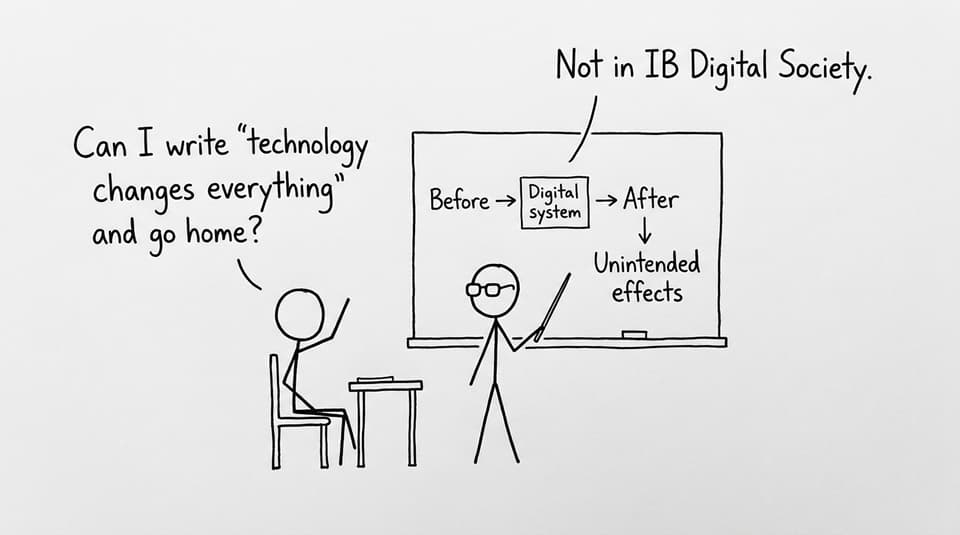
Change at different scales: people vs communities
In IB Digital Society, scale is where strong evaluation often lives.
-
Individuals might gain convenience, personalization, or connection.
-
Communities might lose shared public spaces, trust, or local control.
-
Institutions might gain efficiency while accountability becomes harder to trace.
A useful sentence starter for exam writing is: “While individuals experience X, communities experience Y, because…” It forces you to show uneven change rather than assuming one universal outcome.
Using the change concept in exams and the IA
In exam responses, change is often used to:
-
Explain how a digital system reshapes behaviour or power
-
Compare “before vs after” conditions
-
Evaluate long-term implications and unintended effects
For the Internal Assessment, change becomes even more practical because you can track developments over time and evaluate whether an intervention creates meaningful improvement. If you’re planning your IA, use How to write a strong IB Digital Society IA research question to keep scope manageable.
RevisionDojo supports the full workflow: Study Notes and Flashcards for coverage, Questionbank for exam-style practice, AI Chat when you get stuck, Grading tools for rubric-aligned feedback, plus Predicted Papers and Mock Exams to rehearse performance. If coursework pressure overlaps with exam season, the Coursework Library and Tutors help you keep momentum without guessing.
Closing: make change do work for you
Change is the concept that turns everyday digital life into exam-grade analysis. In IB Digital Society, your job is to show how a system produces change, who experiences it, and why the trade-offs matter over time.
If you want the fastest path from “I get it” to “I can write it,” build a simple routine: revise one concept, practise one set of questions, review one mistake pattern. Start with the IB Digital Society resources hub, then keep your momentum with RevisionDojo’s Questionbank, Flashcards, AI Chat, and Grading tools until change becomes a lens you can use on command.