
Your IA rarely fails because you “picked a bad topic.” It fails because the question quietly collapses under its own weight.
In IB Digital Society, your research question is the steering wheel. If it’s vague, you drift into description. If it’s too ambitious, you spin between ideas. But when it’s precise, analytical, and evaluative, it becomes the simplest way to earn marks because it forces you to do what IB Digital Society actually rewards: concept-driven analysis of a digital system and its impacts on people and communities.
If you want a fast subject refresher before you choose a system, start with the IB Digital Society resources hub.

A quick checklist for an IB Digital Society IA question
Use this before you commit. A strong IB Digital Society IA research question should:
-
Name one specific digital system (platform, feature, algorithm, policy, tool)
-
Target impacts on individuals and communities (not just “how it works”)
-
Invite conceptual analysis (power, identity, ethics, change, systems, inequality)
-
Allow evaluation (trade-offs, benefits vs risks, justified judgment)
-
Be doable with realistic evidence in the time you have
For a broader, subject-agnostic method, see how to refine your IA research question for clarity and focus.
Why the research question matters in IB Digital Society
Examiners are not awarding marks for having opinions about technology. In IB Digital Society, marks come from how well your question forces you to:
-
Analyze a digital system in context
-
Apply course concepts consistently
-
Evaluate implications with balance and evidence
A weak question makes high-mark writing impossible because it doesn’t give you anything to evaluate. If you want to see this idea from a different angle, read why most IA research questions are too broad.
Start with one clearly defined digital system
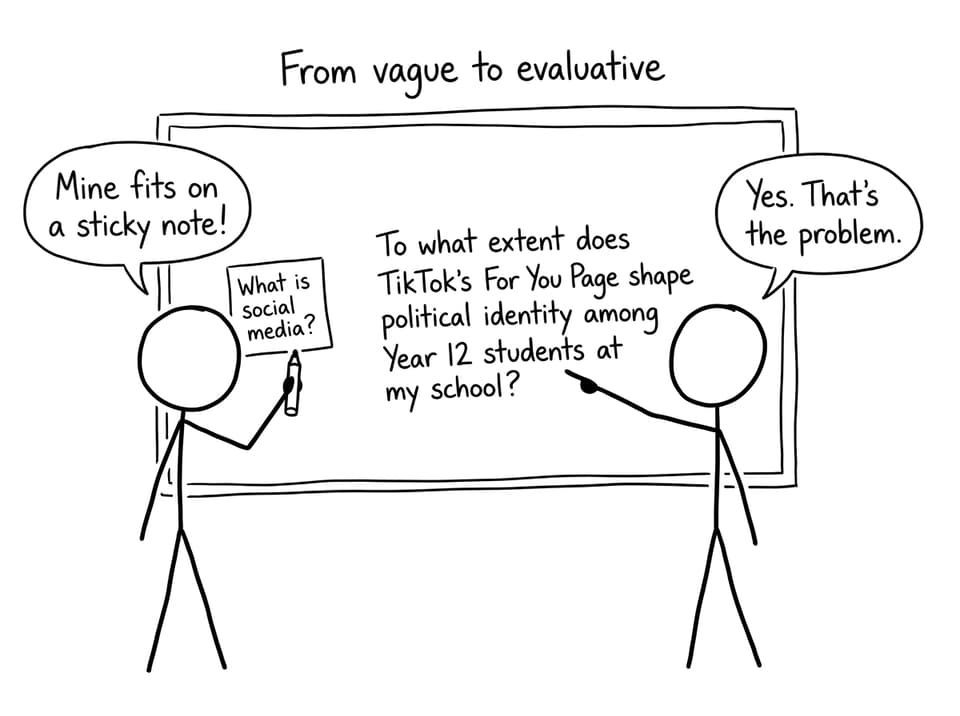
“Social media” is not a digital system you can control in an IA. Neither is “AI.” Those are universes.
Instead, pick something you can explain in two sentences. In IB Digital Society, the strongest systems tend to be:
-
A specific platform feature (recommendation feed, reporting tool, verification badge)
-
A specific policy or practice (content moderation rule, data retention practice)
-
A specific technical mechanism (ranking algorithm signals, biometric login)
If you’re studying the syllabus areas that deal directly with system content and mechanics, RevisionDojo’s Topic 3: Content notes can help you choose a system that supports real analysis.
Aim at impacts, not features
A common trap in IB Digital Society is writing a question that accidentally becomes a product review.
Feature-focused questions usually sound like:
-
“How does X work?”
-
“What is X?”
-
“What features does X have?”
Impact-focused questions ask what the system does to people, and what that means for communities:
-
Who gains power from the system?
-
Who is left out or harmed?
-
What behaviors does it encourage?
-
Which groups experience the effects differently?
If you need language for those angles, the Key Themes in IB Digital Society post gives you a clean set of impact directions.
Build conceptual analysis into the wording
A research question can be “interesting” and still be unusable because it has nowhere to attach concepts.
In IB Digital Society, try drafting your question in a way that naturally invites at least one concept:
-
Power: Who can act, decide, or influence?
-
Identity: How people present themselves, belong, or are categorized
-
Ethics: Consent, privacy, harm, fairness, accountability
-
Change: How effects shift over time, after updates, or across contexts
-
Systems: Feedback loops, incentives, unintended consequences
Example concept prompt:
- “To what extent does [system feature] reshape [identity/power/inequality] for [group] in [context]?”
For a strong concept to build around, see Understanding Change in Digital Society.
Make evaluation unavoidable
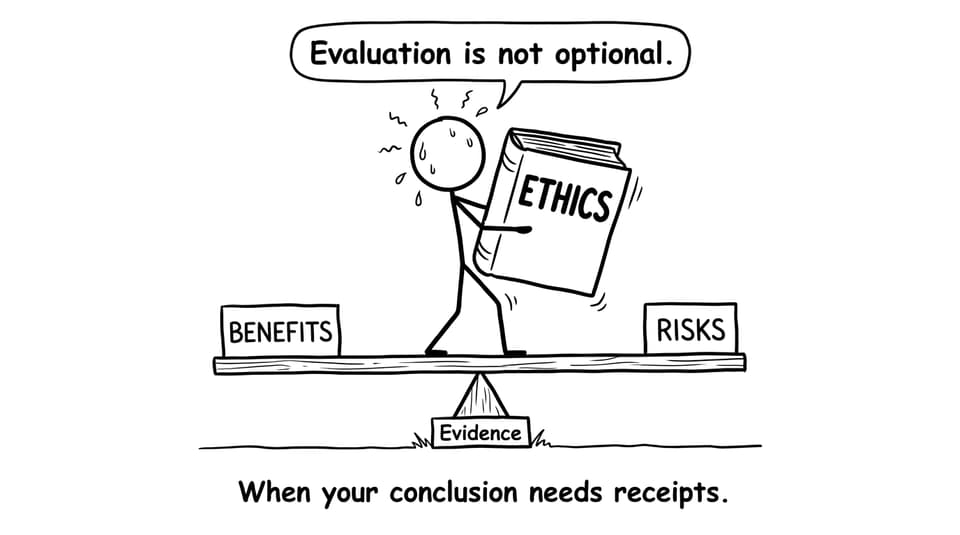
High marks require judgment supported by evidence. Your IB Digital Society research question should force you to weigh trade-offs.
Good evaluation language includes:
-
“To what extent…”
-
“How far…”
-
“In what ways… and with what implications…”
-
“How does X influence Y, and what are the consequences for Z?”
If you want to sanity-check whether your draft will cap your marks, use How to tell if your IB IA research question is weak.
A simple template you can steal
Here’s a reliable structure that fits IB Digital Society expectations without sounding generic:
To what extent does [specific digital system or feature] influence [specific impact] for [defined group] in [defined context], and what are the ethical implications?
Two quick examples:
-
“To what extent does TikTok’s ‘For You’ recommendation system influence political identity formation among 16--18-year-old students at my school, and what ethical issues arise from personalization?”
-
“To what extent does facial recognition entry software in my city’s transit system affect perceptions of privacy and power among commuters, and how do different communities experience the trade-offs?”
How RevisionDojo helps you turn the question into marks
A good question is only step one. Turning it into a strong IA (and strong exam thinking) takes repetition: concepts, examples, evaluation, clarity.
RevisionDojo is built for that loop:
-
Use Study Notes to lock the exact meaning of key concepts you’ll apply
-
Use Flashcards to make those concepts automatic under pressure
-
Use the Questionbank to practice writing analytical, evaluative responses (not just memorizing examples)
-
Use AI Chat when your question feels stuck between two versions
-
Use Grading tools to stress-test your draft against rubric expectations
-
Use Mock Exams and Predicted Papers to keep exam skills moving while your IA is in progress
-
Use the Coursework Library to see what “focused and evaluative” actually looks like
-
Use Tutors if you need a human to help you narrow scope without killing the idea
You can also explore the official Digital Society coursework guide alongside your planning.
Closing: write a question your future self will thank you for
A strong IB Digital Society IA starts with a research question that does three quiet things: it names one digital system, it targets real impacts on people and communities, and it makes evaluation inevitable. When you get that right, drafting stops feeling like guessing and starts feeling like building.
If you want one place to turn that question into a high-scoring IA and sharper exam responses, use RevisionDojo’s IB Digital Society hub, plus the platform’s Study Notes, Flashcards, Questionbank, AI Chat, Grading tools, Predicted Papers, Mock Exams, Coursework Library, and Tutors to keep your work focused and your feedback loop fast.
