

Choosing an IB Digital Society IA topic feels a bit like choosing a seat right before takeoff. Pick well, and the flight is calm. Pick poorly, and you spend the whole journey bracing for turbulence you could have avoided.
The quiet truth is that examiners rarely reward the biggest idea in the room. In IB Digital Society, they reward the idea you can hold steady--a specific digital system, a clear group of people, and a set of impacts you can analyze and evaluate without drifting into vague claims about “society.”
If you’re balancing coursework with exam prep, this guide will help you choose a strong IB Digital Society IA topic that stays focused, ethical, and genuinely scoring.
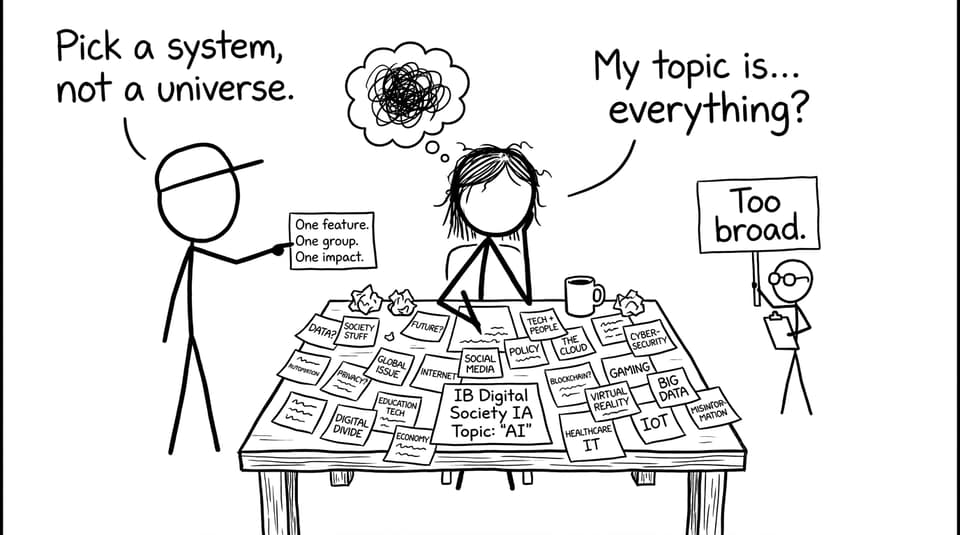
Quick checklist for a strong IB Digital Society IA topic
Use this as a fast filter before you fall in love with an idea:
-
Digital system is specific (a feature, workflow, or automated decision)
-
Stakeholders are named (at least two groups affected differently)
-
Ethical tension is built-in (privacy, power, bias, exclusion, consent)
-
Concepts fit naturally (power, systems, identity, change, values and ethics)
-
Manageable in scope (explainable in 2 sentences, not 2 pages)
When in doubt, check your foundation using the IB Digital Society hub on RevisionDojo and keep your concept definitions close: IB Digital Society resources.
What examiners are actually rewarding in IB Digital Society
A strong IB Digital Society IA isn’t a tech explainer. It’s an analytical inquiry into how a digital system reshapes life for real people.
Examiners want to see that you can:
-
Define a clearly bounded digital system
-
Apply course concepts consistently (not as decorative buzzwords)
-
Analyze impacts on individuals and communities
-
Evaluate implications with evidence and judgment
-
Communicate clearly, logically, and with control
If you want a rubric-aligned view of what “analysis and evaluation” looks like, use RevisionDojo’s criterion guidance: Criterion C: Analysis and evaluation (Digital Society IA).
Start with a digital system, not a theme
Most weak topics begin as a theme:
-
“Social media”
-
“Artificial intelligence”
-
“Cybersecurity”
-
“Technology in education”
Themes are oceans. Your IA needs a pool.
Instead, pick a digital system you can point to:
-
A recommendation feed ranking method on a specific platform
-
A facial recognition gate in a defined setting (school, transport, events)
-
A content moderation workflow (appeals, flags, takedowns)
-
A ride-hailing pricing mechanism (surge rules, location tracking)
If you need help grounding your system in course content, RevisionDojo’s notes and lessons make it easier to stay precise: Topic 3: Content (IB Digital Society) and Topic 4: Contexts (IB Digital Society).
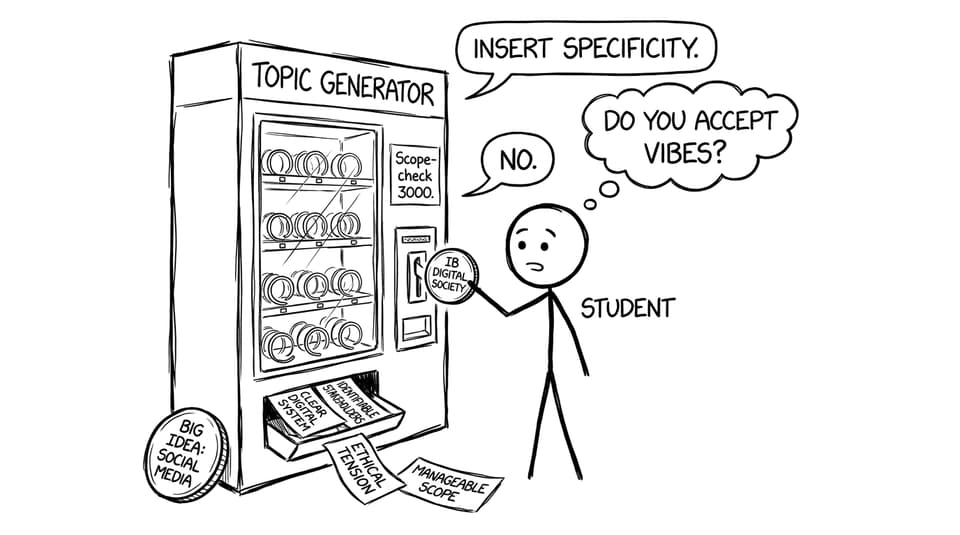
Narrow your scope using the “one feature, one group, one impact” rule
Here’s a practical way to force focus in IB Digital Society:
-
One feature: what exactly is the system doing?
-
One group: who is most affected (and why them)?
-
One impact: what changes in decisions, opportunities, or risks?
Example of narrowing:
-
Too broad: “AI in hiring”
-
Stronger: “Automated CV screening used by large retailers for entry-level jobs”
-
Even stronger: “Keyword-based screening that downranks applicants with employment gaps, and its impact on caregivers returning to work”
That final version gives you power, inequality, and values and ethics without trying to summarize the entire future of work.
Build ethical tension early (because it fuels evaluation)
In IB Digital Society, evaluation becomes easier when the topic naturally contains a dilemma. Look for systems where benefits are real, but trade-offs are unavoidable.
High-yield ethical angles include:
-
Consent vs convenience (opt-outs that are technically available but practically hidden)
-
Power imbalance (platforms, schools, employers, governments)
-
Surveillance and data extraction (location, biometrics, behavioral tracking)
-
Bias and exclusion (who gets misread by the system, and with what consequences)
If you want ideas that already map cleanly to Digital Society writing, RevisionDojo’s case study guidance can spark a topic without blowing up your scope: Big data and society case study ideas.
Avoid overly technical rabbit holes
A common myth: “If it’s more technical, it must score higher.”
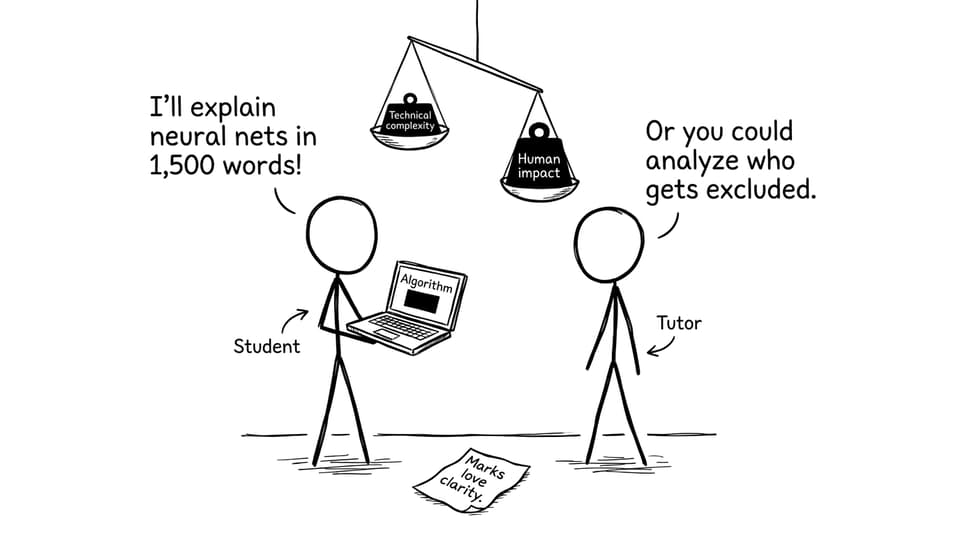
In IB Digital Society, technical detail is only useful when it supports analysis of impacts. If you spend half your word count teaching the reader how the algorithm works, you often end up with description instead of evaluation.
A better trade is:
-
Minimal technical explanation (only what’s needed)
-
Maximum clarity about who is affected, how, and why it matters
RevisionDojo’s broader DS guidance reinforces this mindset: the course is challenging because of thinking and writing, not because of coding: Is IB Digital Society hard? Honest expectations.
Turn your topic into a research question that can actually score
Your topic isn’t done until it becomes a question that forces analysis.
Use stems that demand judgment:
-
To what extent…
-
How does… shape…
-
In what ways… create or reinforce…
Then make sure the question includes:
-
the digital system
-
the stakeholders
-
the impact (and space to evaluate)
For a step-by-step model, use: How to write a strong IB Digital Society IA research question.
Use RevisionDojo to keep your IA strong without derailing exam prep
A good IB Digital Society topic doesn’t just score better--it protects your time.
A simple, calm workflow students use:
-
Use Study Notes and Flashcards to lock in concepts (so your IA writing stays consistent)
-
Use AI Chat to test whether your paragraph is analysis or just summary
-
Use Grading tools to check rubric alignment before you get emotionally attached to weak sections
-
Use the Coursework Library for exemplars that show what “focused” looks like
-
Keep exam skills moving with Questionbank, Mock Exams, and Predicted Papers
-
If you’re stuck, Tutors can help you narrow scope in one session instead of ten hours
To browse models and calibrate your standard, start here: IB Digital Society exemplars and explore the wider coursework ecosystem via Coursework on RevisionDojo.
Conclusion: choose a topic you can hold steady
A strong IB Digital Society IA topic is not the most ambitious idea you can name. It’s the idea you can analyze clearly: a defined system, real stakeholders, visible impacts, and ethical tension you can evaluate with control.
If you want to make the process simpler, build your topic using RevisionDojo: start from the IB Digital Society resources, check your conceptual grounding with notes and lessons, compare against the Digital Society exemplars, and use the AI Chat and Grading tools to keep your writing examiner-ready. Your future self--the one revising for exams--will thank you for picking an IB Digital Society topic that stays focused all the way to the finish.