This site uses cookie tracking technologies. Learn more in our Cookie Policy.
IB Digital Society: Referencing and Academic Honesty | RevisionDojo
Join 600k+ Students Already Crushing Their Exams
IB Digital Society: Referencing and Academic Honesty
The easiest way to lose marks in IB Digital Society is rarely a lack of intelligence. It’s a lack of clarity.
Clarity about what you think, what you found, and what you borrowed.
In a course built around power, ethics, and digital responsibility, academic honesty is not “extra admin.” In IB Digital Society, it’s part of the message you’re sending the examiner: I can handle information responsibly. Your IA can be insightful, well-structured, and genuinely original, but if the sourcing is messy, the work becomes harder to trust.
If you want a single place to revise the course while keeping everything clean, start with the IB Digital Society resources hub and keep your sources log beside it as you go.
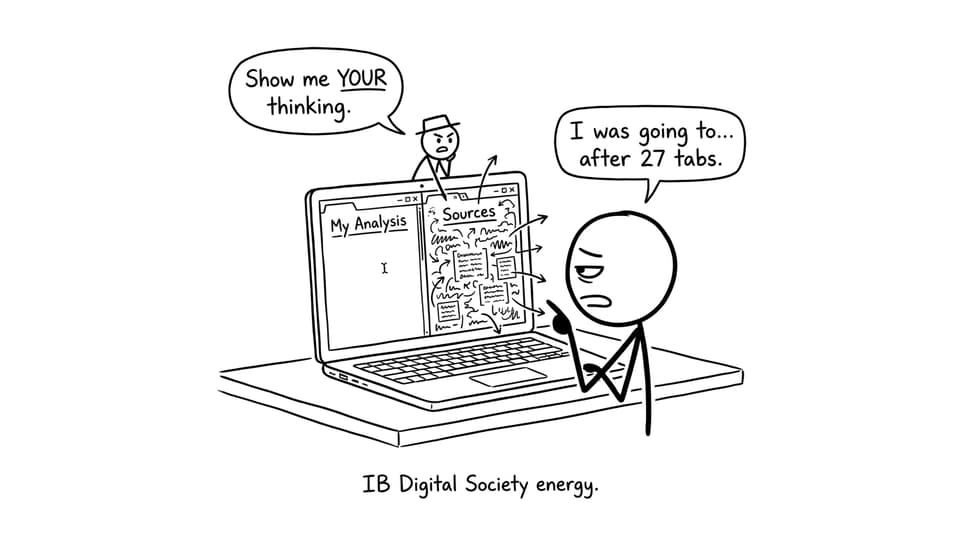
A student drowning in tabs while an examiner asks for original thinking
A quick checklist for honest referencing in IB Digital Society
Use this before any IA draft export or timed practice:
Choose one citation style and stick to it (APA/MLA/Chicago all work if consistent).
Cite at the point of use: quote, paraphrase, data, image, policy, or claim.
Make it obvious where your analysis starts (signal phrases help).
Keep quotations short; the examiner wants your evaluation.
Why academic honesty fits IB Digital Society so tightly
IB Digital Society asks you to evaluate systems that shape attention, identity, opportunity, and trust. That theme of trust shows up in your writing too.
When you reference well, you’re doing the same thing you do when you critique a platform’s transparency: you show where information comes from, how it’s being used, and why it deserves confidence.
Academic honesty matters because it:
Protects the credibility of your argument
Shows intellectual integrity (not just rule-following)
Makes your analysis easier to verify
Helps your work sound more mature and evidence-based
What counts as academic dishonesty (including the accidental kind)
In IB Digital Society, academic dishonesty is any move that makes it unclear whose thinking the examiner is reading.
Common examples include:
Copying text without citation
Paraphrasing so closely that the original wording is still recognizable
Submitting something written by someone else
Using AI-generated writing as if it were your own
Presenting other people’s visuals, tables, or screenshots without credit
The tricky part is that intent is not always the deciding factor. A rushed, careless draft can still create an academic honesty problem. If you’re unsure what happens when concerns are raised, What Happens If You’re Accused of Academic Misconduct in the IB explains the process in a student-friendly way.
Referencing in IB Digital Society: what you must cite
Think of referencing in IB Digital Society as labeling the boundary between evidence and evaluation.
You should cite:
Direct quotations (even short ones)
Paraphrased ideas (not just “facts”)
Statistics, datasets, and specific numerical claims
Descriptions of platform rules, moderation policies, or governance structures
Images, screenshots, graphs, and diagrams that you did not create entirely yourself
General knowledge usually doesn’t need citation, but in a course with fast-changing digital examples, “general knowledge” is a smaller category than students think. When in doubt, cite.
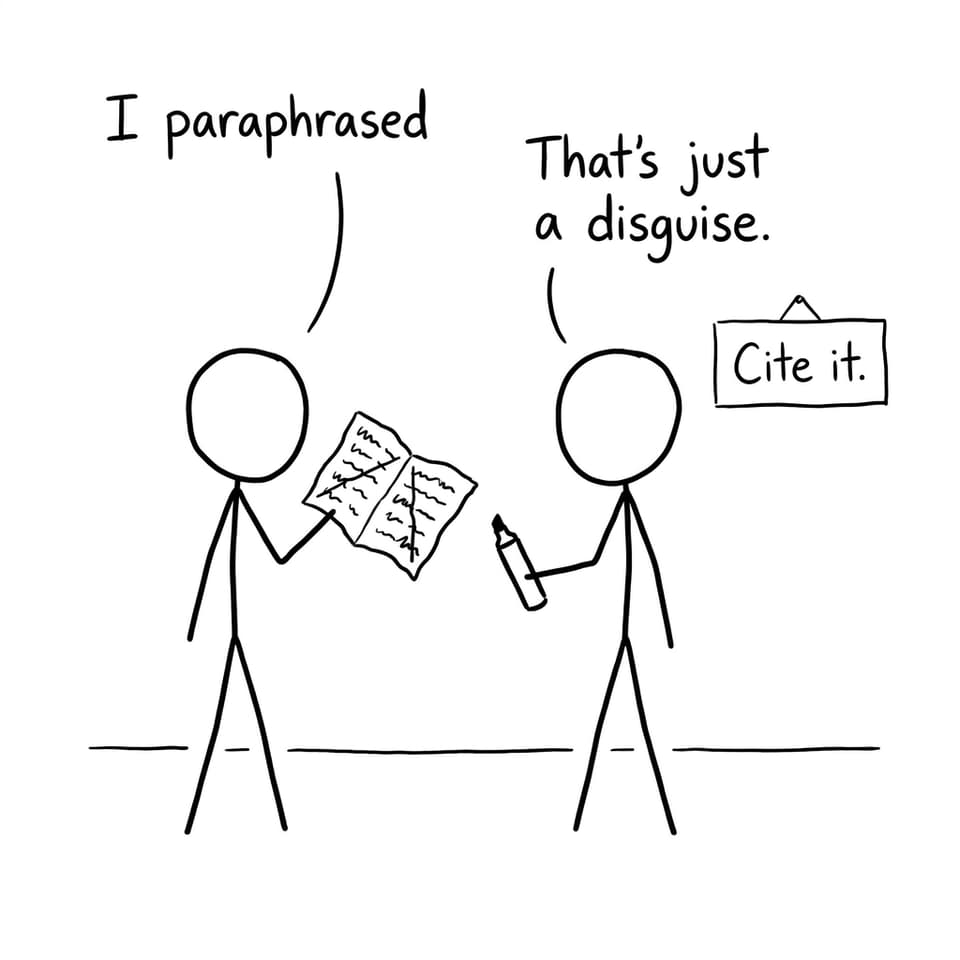
A joke about fake paraphrasing vs real paraphrasing
The IA trap: sources that replace your thinking
A strong IB Digital Society IA uses sources like handrails, not like a substitute skeleton.
Here’s the common trap:
You find three great articles.
You summarize them neatly.
The draft reads “accurate” but not “analytical.”
Examiners reward your reasoning: how you connect concepts, compare perspectives, and evaluate implications. Sources are there to support claims about your real-world example, not to become the argument.
A practical fix: for every paragraph, try this ratio.
1 sentence evidence (cited)
2--4 sentences analysis (your own)
To strengthen that analysis, revise themes and lenses with IB Digital Society: Key Themes Explained so you’re not just reporting what happened, but explaining why it matters.
Paraphrasing that stays honest (and actually sounds smarter)
Good paraphrasing in IB Digital Society is not “word swapping.” It’s proof you understood.
Use this mini-process:
Read the source and pause.
Write the idea from memory in your own structure.
Compare with the original to make sure you didn’t keep the same phrasing.
Add a citation anyway.
If you’re using RevisionDojo while you draft, a safe habit is to turn learning into recall: review Digital IB Study Notes, then close them and write your paragraph, then reopen to verify accuracy.
Using AI tools ethically in IB Digital Society
There’s a reason AI use feels like a IB Digital Society topic instead of just a study hack: it changes authorship.
A simple rule keeps you safe: use AI to support learning (explanations, planning, feedback), not to generate final assessed writing that you submit as your own.
RevisionDojo’s ecosystem is built around that principle. You can practise with the Questionbank, build recall with Digital Society Flashcards, and use AI support for understanding without turning it into ghostwriting. If you want guidance on what “IB-safe” AI study looks like, Are There Any IB-Approved AI Study Resources? lays out realistic boundaries.
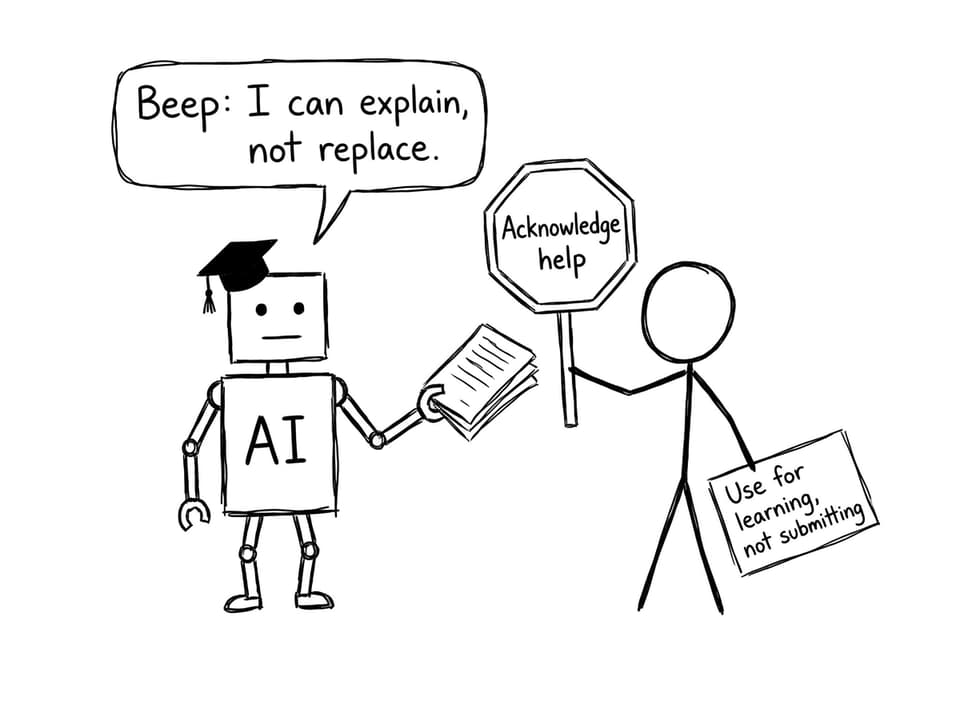
A robot offers an essay; student insists on acknowledging help
Referencing during exam prep (yes, it still matters)
In exams, you’re not attaching a bibliography. But academic honesty still shows up as authenticity.
For IB Digital Society exam preparation, avoid memorized essays that sound pre-manufactured. Examiners want flexible application to unseen prompts. Use RevisionDojo’s IB Digital Society Questionbank to practise responding to new stimuli, then get feedback through grading tools and AI support so your writing becomes yours.
Closing: make your work trustworthy, then make it brilliant
The best IB Digital Society work has a quiet confidence: it shows receipts, but it doesn’t hide behind them.
Reference to protect the boundary between evidence and evaluation. Paraphrase to prove understanding. Use tools ethically so your writing stays yours.
When you revise with RevisionDojo, you can build that integrity into your routine: Study Notes to learn, Flashcards to remember, Questionbank to apply, AI Chat and grading tools to improve, plus Mock Exams, Predicted Papers, a Coursework Library, and Tutors when you need extra support. The result is simpler than it sounds: honest work that earns higher marks because it’s easier to trust.
Keep it clean. Then push your analysis further. That’s how IB Digital Society scores well.