

Every IB student has had the same moment: you open a stimulus about social media, biometrics, or AI profiling, and you know the question is really about identity. Then you write something like, “Online identity affects how people express themselves” and it sounds true… but also strangely weightless.
In IB Digital Society, identity is not just what you choose to show. Identity is also what digital systems decide you are allowed to be, what they infer about you, and how those inferences reshape opportunities. The strongest answers feel like someone switched on a light in a room you didn’t realize was dim.
This guide shows you exactly how to analyse identity in IB Digital Society in a way that earns marks: mechanism first, impacts next, evaluation last.
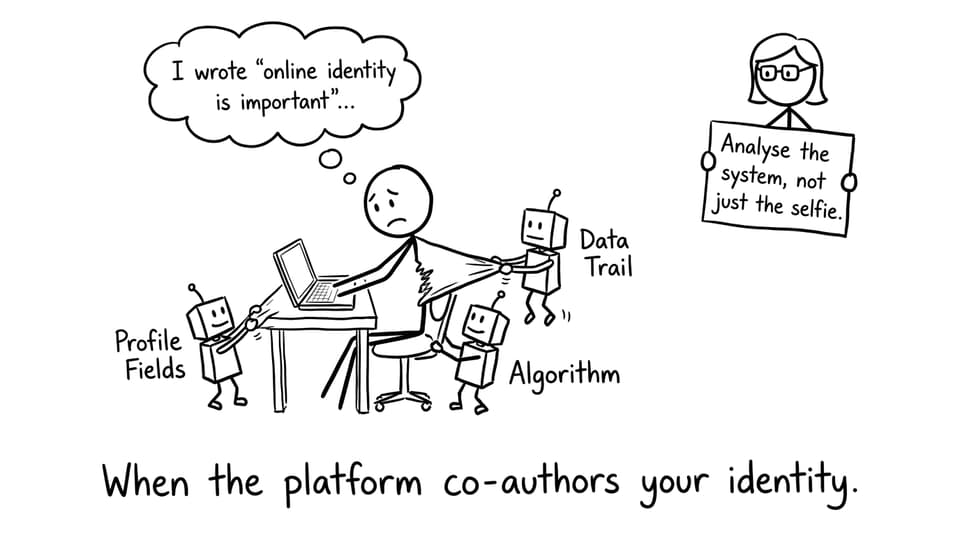
A quick identity analysis checklist for IB Digital Society
Use this as your one-minute plan before you write.
-
Define identity as user-created and system-generated representation.
-
Identify the digital system (platform, feature, policy, dataset).
-
Describe one mechanism shaping identity (fields, defaults, ranking, verification, tracking).
-
Track the data trail: what’s collected, inferred, and reused.
-
Ask power questions: who benefits, who gets classified, who can appeal?
-
Evaluate ethics: consent, transparency, bias, harm, accountability.
-
Include impacts on individuals and communities.
If you want a syllabus-aligned home base while revising, keep the IB Digital Society resources hub open as your anchor.
What “identity” really means in IB Digital Society
In IB Digital Society, identity is the representation of people and groups inside digital systems. That representation includes what users intentionally perform (profiles, posts, usernames), and what systems construct (inferences, categories, risk scores, “similar users,” eligibility labels).
A clean exam definition you can adapt:
Identity in IB Digital Society is co-created by users and digital systems through design choices, data practices, and algorithmic classification.
For the syllabus language and examples, review Notes for 2.3A Defining Identity in Digital Society and the broader Topic 2: Concepts.
IB Digital Society identity analysis starts with the system, not the person
A useful mindset shift: stop treating identity as a personality trait. Treat it as an output.
In IB Digital Society, you earn marks when you show how a system produces identity outcomes. That means naming the mechanism.
Examples of mechanisms you can analyse:
-
Profile fields and defaults (what must be declared, what cannot be expressed)
-
Verification rules (who gets credibility signals)
-
Ranking and recommendation (which identities get surfaced)
-
Content moderation (which identities become “risky” or “unsafe”)
-
Device and location signals (how offline life leaks into digital identity)
To practise turning concepts into mechanisms, use How to Apply IB Digital Society Concepts Effectively.
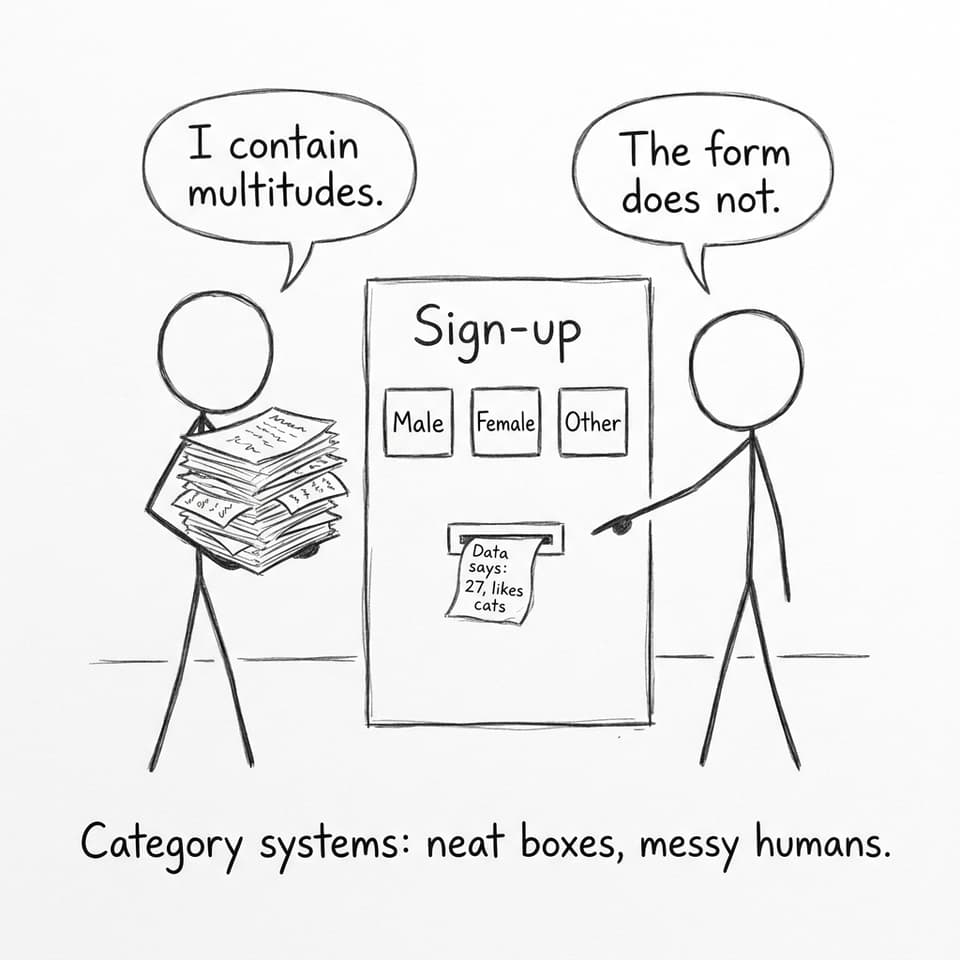
IB Digital Society identity is built from data (even when you stay quiet)
A student can “post nothing” and still be profiled. That’s the uncomfortable magic of data-driven identity.
In IB Digital Society, identity-related data can include:
-
Demographics (declared or inferred)
-
Behaviour (clicks, dwell time, purchases, scrolling)
-
Social graphs (friends, followers, interactions)
-
Context signals (location, device, time, network)
Your analysis should state what data is captured, then explain what identity the system infers from it. That inference is the hinge point: it’s where a person becomes a category.
If you want to build quick recall of key terms (profiling, inference, bias, consent), drill them with Digital Society Flashcards.
Algorithmic classification: when the system’s identity disagrees with yours
A high-scoring IB Digital Society identity paragraph often includes this tension:
-
Self-identity: who I say I am.
-
System identity: who the platform predicts I am.
Algorithmic classification can group users for advertising, content recommendations, credit scoring, school monitoring, or security decisions. Your job is to analyse:
-
How the classification happens (features, model, proxy variables)
-
Accuracy and uncertainty (false positives, context collapse)
-
Consequences (visibility, access, suspicion, exclusion)
For a focused identity lens with exam-ready phrasing, read Digital Identity in IB Digital Society: Concept Explained and Digital Identity and Self-Presentation Online in IB Digital Society.
Power and identity in IB Digital Society: who gets to define the categories?
Identity is never only descriptive. In digital systems, identity is often administrative: it decides what you can do next.
Power enters your IB Digital Society identity analysis when you ask:
-
Who designed the identity options and why?
-
Who benefits from simplified categories?
-
Who is made highly visible, and who becomes invisible?
-
What appeal, correction, or transparency mechanisms exist?
The best essays don’t assume malice. They analyse incentives: platforms optimize for growth, governments optimize for control, institutions optimize for efficiency. Identity becomes the currency that makes those goals measurable.
How to write an exam-ready IB Digital Society paragraph on identity
Use a compact structure that fits Paper timing.
Mechanism --> Impact --> Power/Ethics --> Mini-evaluation
Example skeleton you can adapt:
-
Mechanism: “The platform requires real-name verification and limits gender options, shaping identity through constrained representation.”
-
Impact (individual): “This can reduce autonomy and increase self-censorship, especially for users who cannot safely disclose.”
-
Impact (community): “It can marginalize certain groups by making them less searchable, less credible, or more reportable.”
-
Power/Ethics: “The platform holds power to define categories; ethical concerns include consent, harm, and accountability.”
-
Evaluation: “While verification may reduce impersonation, the trade-off is exclusion and risk for vulnerable identities.”
To get targeted practice with mark-scheme-aligned feedback, use the Questionbank feature and try a Digital Society set like IB Digital Society 1.1 Questionbank to train the “define --> apply --> evaluate” rhythm.
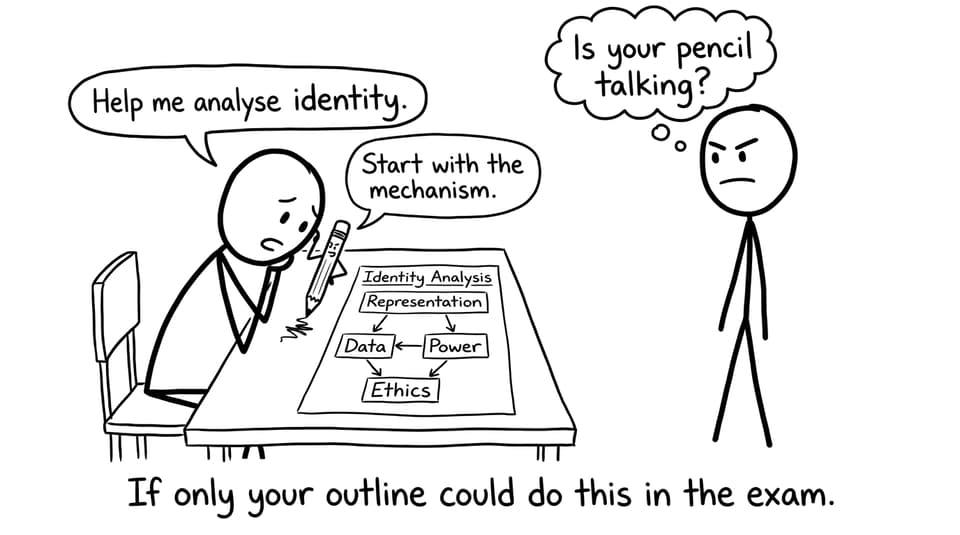
Common mistakes students make with IB Digital Society identity
These are the patterns that keep answers stuck in the middle bands:
-
Treating identity as personal branding only, not system classification
-
Writing about “online identity” in general, without a specific mechanism
-
Only discussing individuals, not communities and inequality
-
Forgetting evaluation: no trade-offs, no responsibility, no “what should change?”
If Digital Society feels overwhelming, it usually means your examples aren’t organized by themes. The guide IB Digital Society: Key Themes Explained helps you sort identity into the bigger map of the course.
Closing: make identity do work in IB Digital Society
The fastest way to level up in IB Digital Society is to stop treating identity as a vibe and start treating it as a system outcome. Ask what the platform measures, what it infers, what it rewards, and what it makes difficult. Then show who benefits, who is harmed, and what trade-offs exist.
When you revise, build that loop deliberately: use RevisionDojo’s Study Notes and Flashcards to keep your definitions sharp, the Questionbank to practise under pressure, AI Chat to unblock confusion, Grading tools to align your writing to criteria, and Predicted Papers plus Mock Exams to build timing and confidence. Identity is one of the highest-value lenses in IB Digital Society because it connects design, data, power, and ethics in a single, exam-friendly line of argument. Use it like a tool, and your marks will follow.