
IB Digital Society is the kind of subject that tricks smart students.
You learn power on Monday, privacy on Tuesday, and systems on Wednesday. By Friday, your notes look tidy, your flashcards are full, and your confidence is… strangely fragile. Because the next time you face an exam-style prompt, it doesn’t ask for definitions. It asks for a judgment. And judgment requires connection.
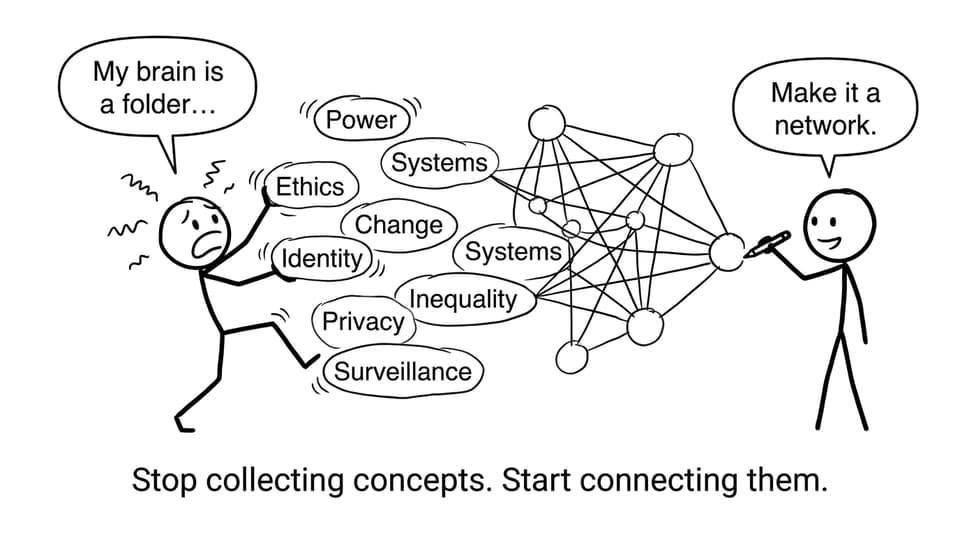
That’s the hidden skill of IB Digital Society: not collecting concepts like trading cards, but using them like a map. High-mark responses show you can move from “what is happening in this digital system?” to “who benefits, who is harmed, and what should change?” without dropping the thread.
This guide shows how the core ideas of IB Digital Society fit together so you can write integrated, coherent analysis in exams and coursework.
The fast checklist: how to integrate IB Digital Society concepts
When you see any stimulus (an article, a screenshot, a data chart), run this quick loop:
-
Name the digital system (platform, algorithm, network, policy, device).
-
Describe what it does with data (collects, sorts, predicts, nudges).
-
Identify power (who controls design, rules, enforcement, and outcomes).
-
Track impacts on people (identity, expression, access, opportunity).
-
Spot inequality (who gets excluded, targeted, or disadvantaged).
-
Evaluate privacy and surveillance (consent, autonomy, monitoring).
-
Add change over time (feedback loops, normalization, escalation).
-
Close with ethics (trade-offs, responsibility, better alternatives).
If you want a structured home base for this loop, start with the IB Digital Society resources hub.
Start where the marks start: the digital system
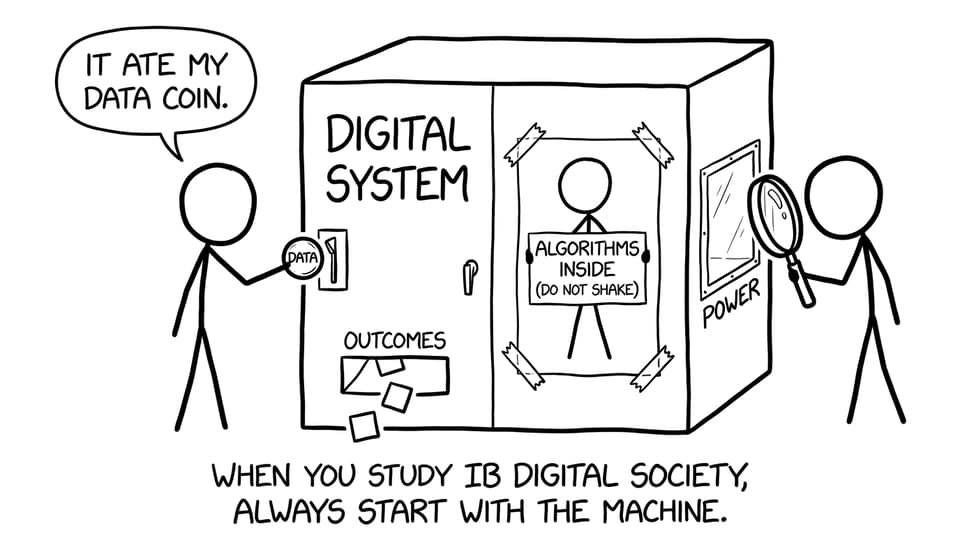
In IB Digital Society, a concept is not the starting point. The system is.
A digital system is the “machine” you are analyzing: a recommender algorithm, a social platform’s moderation rules, a facial recognition tool, a school proctoring app, or even a government digital ID policy. It processes inputs (usually data), follows rules (often automated), and produces outcomes that shape society.
Once you name the system, concepts become lenses rather than loose topics.
To strengthen your system-first thinking, pair your revision with Inquiry in IB Digital Society, explained simply. It trains the habit examiners reward: disciplined curiosity.
Systems: the skeleton that holds everything
Systems is the structural concept in IB Digital Society. It’s how you avoid vague statements like “technology affects people.”
When you analyze systems, you look for:
-
Components (users, data sources, platforms, regulators)
-
Processes (collection, ranking, prediction, enforcement)
-
Feedback loops (outputs change behavior, behavior creates new data)
-
Boundaries (what the system includes, and what it ignores)
This matters because every other concept becomes sharper once the skeleton is visible. If you can’t explain the mechanism, you can’t convincingly evaluate the impact.
Revision tip: use RevisionDojo’s Study Notes feature to build concise mechanism summaries you can recall under pressure.
Power: who gets to decide what the system “optimizes”
In IB Digital Society, power is the bridge between design and consequence.
Power shows up in questions like:
-
Who sets the goals (safety, profit, efficiency, control)?
-
Who writes the rules and defines “harm”?
-
Who can challenge decisions, appeal outcomes, or demand transparency?
Power also links tightly to data. Control over data flows often becomes control over people’s options.
If you need a clean way to spot power inside automated decisions, read IB Digital Society: Algorithms Explained for Exams. It’s a practical guide to connecting algorithm goals to social outcomes.
Inequality: the pattern that emerges from power + access
Inequality in IB Digital Society is rarely accidental. It is often produced by systems that distribute benefits unevenly.
A high-scoring move is to show how inequality forms:
-
Access inequality: who can use the system (devices, connectivity, cost, language).
-
Outcome inequality: who benefits from the system’s decisions (ranking, scoring, targeting).
-
Representation inequality: whose identities and experiences are recognized or flattened.
When you connect inequality back to power, your analysis becomes more than sympathy. It becomes explanation.
For more ways to organize examples without drowning in them, use Effective Note-Taking Tips for IB Digital Society. It emphasizes theme-based structure, which is exactly what integrated concept thinking needs.
Identity: how the system “sees” a person
Identity is where digital systems become personal.
In IB Digital Society, identity is not just self-expression. It’s also categorization: how a system models you as a set of attributes, behaviors, and predicted preferences.
Identity connects to:
-
Systems: the labels and variables a system uses to represent users
-
Power: who defines categories and decides what counts as “normal”
-
Inequality: whose identities get misclassified, stereotyped, or made invisible
A strong exam paragraph often includes one sentence that makes identity concrete: “In this system, identity becomes a profile that can be bought, inferred, or denied.”
Privacy and surveillance: the twin concepts students should stop separating
Students often treat privacy and surveillance like separate chapters. Examiners read them as a pair.
-
Surveillance is the act and logic of monitoring: tracking, profiling, predicting, and influencing behavior.
-
Privacy is the control question: what autonomy does a person (or group) retain over data, consent, and exposure?
When you combine them, you can evaluate what many systems quietly normalize: monitoring as the default setting.
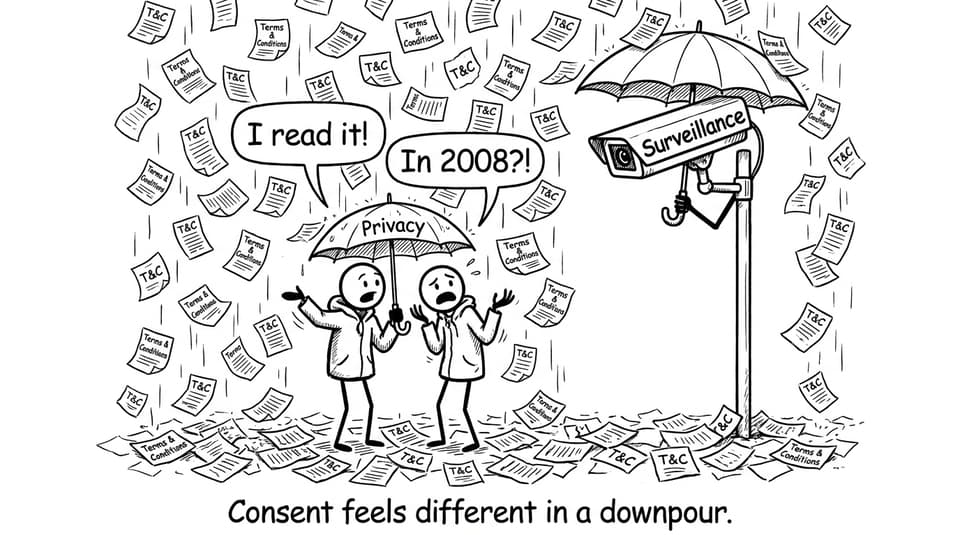
A useful extension is to connect privacy/surveillance back to power: if one actor can watch without being watched, accountability becomes harder.
Change: the concept that adds time and raises the stakes
Change is what turns a single event into a trajectory.
In IB Digital Society, change helps you discuss:
-
How systems evolve (feature updates, regulation, new data sources)
-
How impacts compound (feedback loops intensify outcomes)
-
How norms shift (what once felt invasive becomes “standard”)
Change also improves evaluation because it forces you to consider second-order effects: not just what happens now, but what becomes easier later.
For a sharper toolkit here, see Understanding Change in Digital Society (IB concept explained).
Ethics: the concept that forces you to choose, not just describe
If systems are the skeleton, ethics is the moment the essay becomes a decision.
Ethics in IB Digital Society is about weighing trade-offs with reasons:
-
Rights vs. security
-
Innovation vs. harm
-
Efficiency vs. fairness
-
Profit vs. responsibility
Ethics is also where you can propose interventions: regulation, design changes, transparency measures, community governance, education, or opt-out mechanisms. The key is to justify why your intervention matches the power structure you identified.

How to write an integrated exam paragraph (a simple template)
Use this structure when you want your IB Digital Society analysis to feel connected rather than listed:
-
System: Name it and its goal.
-
Mechanism: Explain what it does with data and rules.
-
Power: Identify who controls decisions and incentives.
-
Impact: Link to identity and inequality (who is affected, how, and why).
-
Privacy/surveillance: Explain monitoring and consent.
-
Change + ethics: Show how it evolves and evaluate trade-offs.
Then practise it under timed conditions with RevisionDojo’s Questionbank and feedback loop. The IB Digital Society: Ultimate Survival Guide is a good companion if you want a full weekly routine.
FAQ
Do I need to use every concept in every IB Digital Society answer?
No, and in IB Digital Society it can actively lower your mark if it makes the response unfocused. Examiners reward coherence: a clear argument that answers the prompt using concepts purposefully. A better approach is to choose one or two “lead” concepts (often systems plus power, or systems plus inequality) and then let other concepts appear only where they genuinely strengthen the explanation. Think of concepts like tools in a bag, not boxes to tick. If you find yourself naming concepts without explaining mechanisms, pause and return to the digital system. Depth beats coverage almost every time.
How do I revise IB Digital Society so the concepts actually connect in my head?
Revise around a small set of reusable digital systems, not around isolated definitions. Pick 8--12 strong examples you can adapt, then practise applying different concepts to the same system, like rotating a lens. Use short retrieval practice: define the system, map the data flow, then ask “where is power located?” and “what inequality could this create?” RevisionDojo helps here because you can move from Study Notes to Digital Society Flashcards to Questionbank practice in one loop. If you get stuck, use AI Chat to test your explanation and ask for counterarguments you might be missing. Over time, the connections stop feeling like effort and start feeling like default thinking.
How does concept integration help with the IA in IB Digital Society?
The IA is basically concept integration stretched across a longer investigation. If your inquiry focuses only on description (“what the technology does”), it will feel thin. But if you build your analysis around systems, power, identity, inequality, privacy/surveillance, and change, your evaluation becomes grounded and specific. The trick is consistency: choose a clear system boundary, define stakeholders, and keep returning to the same mechanism as you discuss impacts. Then ethics becomes more credible because it is based on evidence and reasoning, not slogans. For step-by-step support, use the IB Digital Society IA Guide, and lean on RevisionDojo’s grading tools to check whether your evaluation is actually balanced.
Closing: turn concepts into a map, not a list
The students who score highest in IB Digital Society aren’t the ones with the longest definitions. They’re the ones who can look at a digital system and calmly explain how systems, power, inequality, identity, privacy, surveillance, change, and ethics interact.
If you want that integrated thinking to become automatic, build a practice loop: learn with Study Notes, lock recall with Flashcards, apply with the Questionbank, and use AI Chat plus grading tools to tighten evaluation. Start from the IB Digital Society resources hub, and let IB Digital Society become what it’s meant to be: a connected framework you can carry into any unseen question.
