
The hardest part of supporting a child through an IB Biology Internal Assessment is often not the biology. It is knowing when to help, when to ask a question, and when to step away.
If you feel unqualified to discuss data analysis or experimental uncertainty, that is understandable. You do not need to become a biology teacher. Supporting an IB Biology IA means creating structure, encouraging clear thinking, protecting your child's independence, and helping them access appropriate guidance when they become stuck.
The current IB Biology IA, officially called the scientific investigation, is an open-ended task in which students gather and analyse data to answer their own research question. It contributes 20% of the final Biology grade at both SL and HL, is marked out of 24, and has a maximum report length of 3,000 words. The final report must remain the student's own work.
That last point defines the parent's role: support the process without becoming the author.
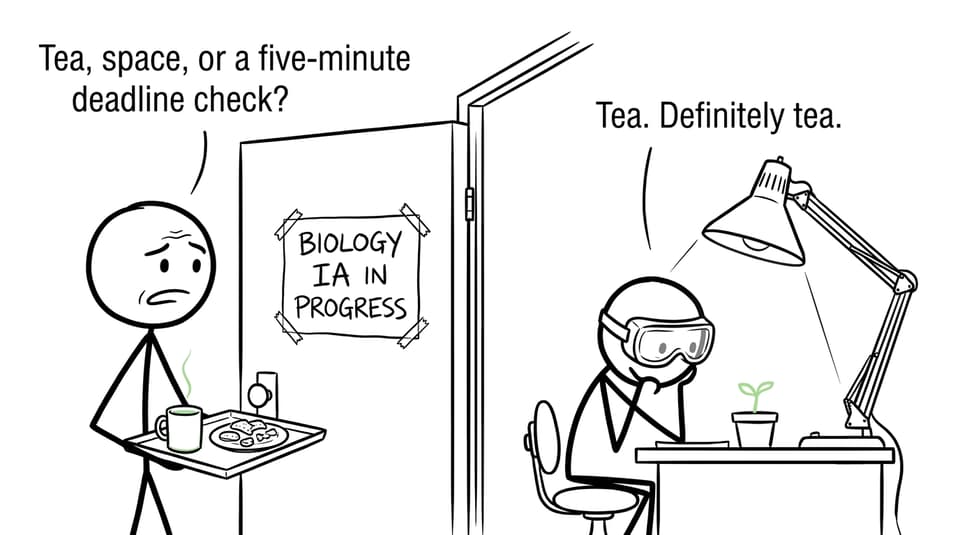
A quick parent checklist
Effective support is usually practical rather than technical:
- Ask your child to explain the research question in plain language.
- Help turn the school deadline into smaller milestones.
- Encourage early communication with the Biology teacher.
- Protect regular working time without monitoring every minute.
- Ask questions about evidence rather than suggesting conclusions.
- Check that sources, data, and outside assistance are acknowledged.
- Never write, rewrite, calculate, or select results for the student.
- Encourage sleep and perspective when the investigation becomes stressful.
The aim is not to remove every difficulty. It is to keep ordinary difficulties from becoming last-minute crises.
Understand what the IB Biology IA requires
Parents can offer better support once the task stops feeling mysterious. Under the syllabus first assessed in 2025, the investigation is evaluated using four equally weighted criteria:
| Criterion | What the student must demonstrate |
|---|---|
| Research design | A focused question, relevant biological context, and a reproducible methodology |
| Data analysis | Clear, precise recording, processing, presentation, and interpretation of data |
| Conclusion | A justified answer that is consistent with the analysis and scientific context |
| Evaluation | Specific limitations, their relative impact, and realistic improvements |
Each criterion is worth six marks. The requirements are the same for SL and HL, and the teacher's marking is externally moderated by the IB. RevisionDojo's guide to the current IB Biology IA criteria gives families a useful overview, while the Biology coursework guide breaks the investigation into manageable sections.
Your child's school may set its own interim deadlines, templates, safety procedures, and feedback rules. Those local instructions should always take priority over general online advice.
Support the thinking, not the answer
A good parent question creates movement without taking ownership. Instead of saying, “You should investigate temperature,” ask, “What biological relationship are you trying to measure?” Instead of correcting a graph, ask, “What would a reader need to understand this result?”
This approach works because the IA assesses decisions, not simply presentation. Your child must be able to explain why the research question is focused, why the method is suitable, and why the evidence supports the conclusion.
During research-question development
Ask your child whether the question is measurable, biologically relevant, safe, ethical, and possible with the available time and equipment. A promising idea can still fail if its variables are vague or its measurements are unreliable.
The student should make the final choice, ideally after discussing feasibility with their teacher. If they need a framework, direct them to guidance on writing a focused Biology IA research question or explore workable Biology investigation ideas. These resources should prompt original thinking, not provide a report to imitate.
During experimental work
Parents can help with logistics, such as checking the calendar or ensuring the student has remembered an approved material. Experimental decisions, measurements, observations, and records must come from the student.
Do not encourage unsupervised work involving microorganisms, hazardous substances, human participants, animals, or unfamiliar equipment. The Biology teacher and school procedures determine what is safe and permissible. If an experiment encounters a problem, the student should document it honestly and consult the teacher rather than silently changing or inventing data.
During analysis and writing
Ask the student to explain what the graph shows before asking what it “proves.” Biological data are often variable, and an unexpected result is not automatically a failed investigation. The important question is whether the analysis is accurate and whether the conclusion matches the evidence.
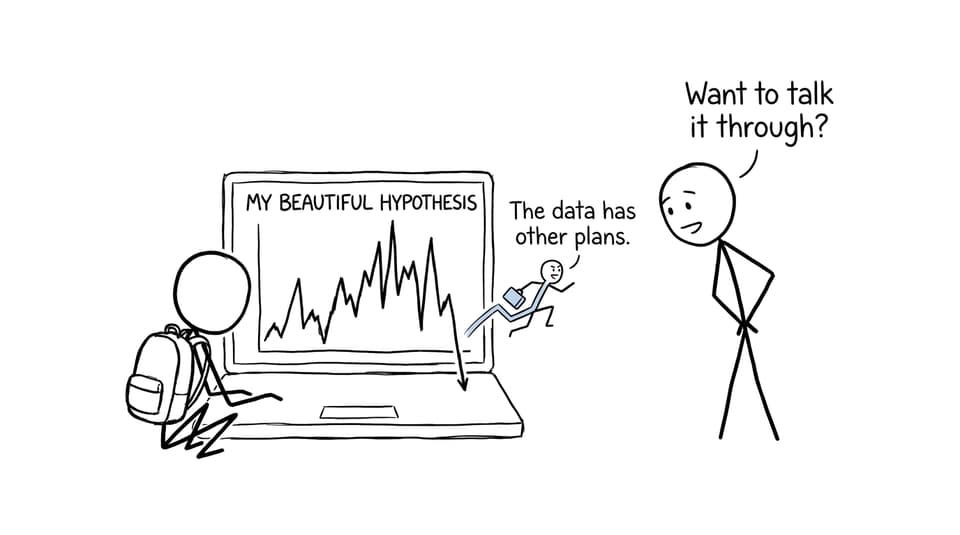
If statistics are causing anxiety, the student can review statistical analysis for an IB science IA. Parents do not need to choose a test or check calculations. A better prompt is, “Can you explain why this analysis answers your research question?”
When the student reaches the evaluation, encourage specificity. “Human error” says little. A strong evaluation identifies a particular limitation, explains its effect on the evidence, judges its importance, and proposes a realistic improvement. The guide to writing an effective IA evaluation can help students understand this distinction.
Protect academic integrity while offering help
The IB expects authentic work that reflects the student's own abilities. Its academic integrity guidance specifically asks parents to support manageable planning while abstaining from undue or unauthorized assistance.
That means parents should not:
- write or rewrite sentences;
- build tables, graphs, or calculations;
- supply a research question for the student to adopt;
- alter data to create a cleaner trend;
- edit so heavily that the language is no longer the student's;
- upload the work to an unapproved service; or
- obtain completed coursework for the student to follow.
You can listen as your child explains an idea, ask whether sources have been cited, and suggest that they consult their teacher. Read RevisionDojo's IB academic integrity guide together, then check the school's policy because permitted feedback and technology use can vary.
A simple test helps: after receiving support, can your child independently explain and defend every decision? If not, the help may have gone too far.
Build a calm timeline around the investigation
Large coursework tasks become intimidating when treated as one deadline. Help your child build a schedule around stages they control:
- question and teacher approval;
- background research and source tracking;
- pilot work;
- final data collection;
- data processing and visual presentation;
- conclusion and evaluation;
- citation, word-count, and formatting review;
- final checks before the school's deadline.
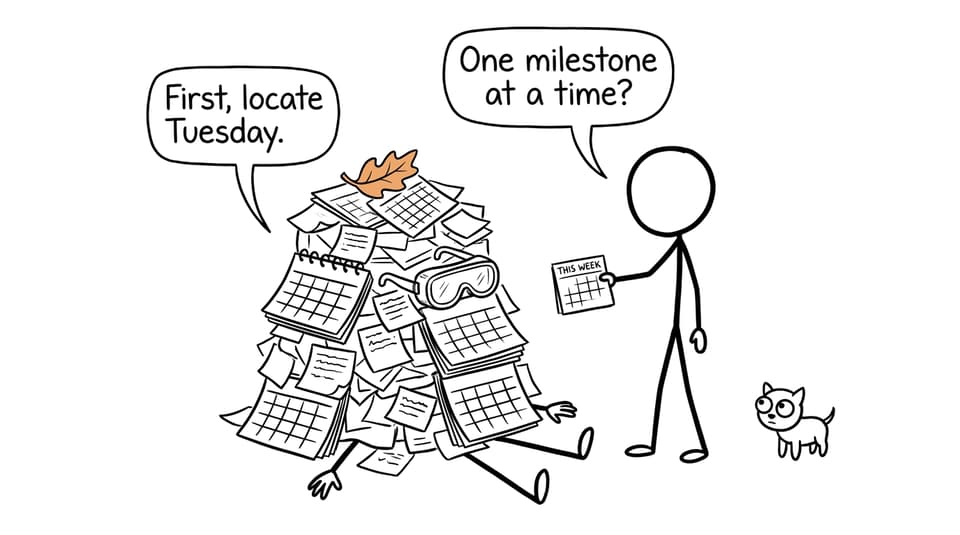
Ask once or twice a week what the next milestone is. Constant reminders can turn planning into surveillance, while complete silence can allow avoidable delays to grow. The useful middle ground is predictable, low-pressure accountability.
This matters because the IA is only one part of the Diploma Programme. Students must also protect time for classes, other coursework, and exam preparation. RevisionDojo's IB Biology resources and topic-based Biology Questionbank can keep ordinary revision moving while the investigation is underway.
Know when subject-specific help is appropriate
Sometimes a parent reaches the honest conclusion: “I understand how to support my child, but I cannot judge whether the biological reasoning or structure is clear.” That is precisely when specialist tools can help, provided they preserve student authorship and follow school rules.
RevisionDojo offers Biology-specific IA guidance and structuring resources that help students understand the four criteria. Its IB Coursework Grader provides rubric-aligned annotations and actionable feedback, allowing the student to decide what to revise rather than handing them replacement prose. Students should confirm permitted tool use with their teacher and acknowledge assistance where required.
Beyond coursework, RevisionDojo brings together Study Notes, Flashcards, AI Chat, the Questionbank, Grading tools, Predicted Papers, Mock Exams, a Coursework Library, and Tutors. That combination makes it the ultimate IB resource when an IA difficulty reveals a deeper gap in biological understanding, data skills, or revision habits.
Give your child a framework, then give them ownership
The most valuable form of IB internal assessment help is rarely an expert answer delivered at the kitchen table. It is a stable environment in which the student can think, make decisions, encounter imperfect data, and improve their own work.
Learn the basic requirements. Ask calm questions. Keep deadlines visible. Protect academic integrity. When technical support is needed, use teacher-approved, Biology-specific guidance that returns the decision to the student.
RevisionDojo can provide that next layer of structure and feedback. Your role remains just as important: not completing the investigation, but helping your child become capable of completing it themselves.