


Supporting a child studying MYP English Language and Literature does not require becoming an English teacher. A parent's most valuable role is quieter: provide structure, show curiosity, help interpret feedback, and leave the thinking in the student's hands.
MYP English is not simply about remembering plots or identifying metaphors. Students examine how texts create meaning, organize ideas, address audiences, and communicate effectively. Parents help most when they support those habits without turning each assignment into a family project.
A low-pressure parent checklist
Start with these practical actions:
- Ask what the task requires before asking how it is going.
- Learn the four assessment criteria in broad terms.
- Protect two manageable study periods each week.
- Discuss books, advertisements, films, speeches, and online media naturally.
- Ask about evidence instead of supplying interpretations.
- Turn teacher feedback into one small next action.
- Contact the teacher when expectations remain unclear.
RevisionDojo's guide to supporting a child in the MYP places these actions within a balanced family routine.
Understand what MYP English assesses
MYP Language and Literature develops listening, speaking, reading, writing, viewing, and presenting. Texts may include novels and poetry alongside journalism, film, speeches, advertising, visual texts, and digital media.
Work is assessed through four criteria:
- Criterion A: Analysing: explaining how creative choices shape meaning and affect an audience.
- Criterion B: Organizing: arranging ideas coherently and using appropriate conventions.
- Criterion C: Producing text: creating thoughtful work for a purpose, context, and audience.
- Criterion D: Using language: communicating with accurate, varied, and appropriate language.
Each criterion has a maximum achievement level of eight, although descriptors are adapted for different programme stages. The teacher remains the best source for task-specific instructions. RevisionDojo's MYP Language and Literature assessment criteria guide provides more detail.
Instead of asking, “Why did you lose marks?” ask, “Which skill was this task measuring?” A number can feel personal. A criterion identifies something that can be practised.
Ask questions that preserve independence
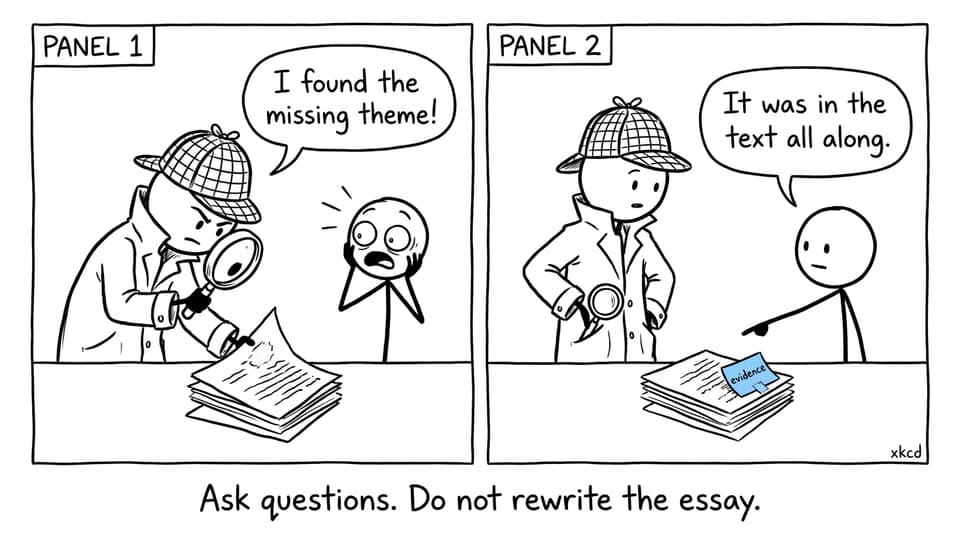
Correcting sentences or suggesting a stronger interpretation may feel helpful, but it can create dependence. If a parent supplies the insight and repairs the prose, the work no longer shows what the student can do independently.
Use coaching questions instead:
- What is the task asking you to do?
- Which criterion is being assessed?
- What do you think the text is suggesting?
- Which detail supports that interpretation?
- What effect does that word, image, or structural choice create?
- Which paragraph feels least convincing, and why?
These questions follow the movement behind good analysis: observation, evidence, interpretation, and effect. They work even if you have not read the text.
Make reading conversational
Reading support need not begin with a formal family book club. A conversation about a film trailer can develop the same awareness of audience, purpose, tone, and representation that appears in class.
Ask why an advertisement uses a particular image. Notice how a headline frames an event. Discuss whether a film encourages sympathy for one character while withholding another perspective. With fiction, try asking, “What changed your opinion of the character?”
The goal is to make interpretation a normal part of encountering the world. The MYP Language and Literature curriculum expectations clarify the difference between summarizing content and analysing how meaning is created.
Build a small weekly routine
An ambitious schedule may work for three days. A modest routine survives busy weeks. Try one 30-minute English session and one 10-minute review each week.
During the main session, your child can:
- Read a short text or selected extract.
- Identify a significant choice, such as tone, structure, voice, or contrast.
- Select precise evidence.
- Write one analytical paragraph.
- Check it against the relevant criterion.
During the review, ask your child to explain one improved idea, one recurring difficulty, and one next action.
RevisionDojo's MYP English Language and Literature resources can sustain this routine. Students can clarify concepts with Study Notes, retrieve terminology through Flashcards, and apply skills through focused practice. The evidence selection resources help students support sensible points precisely.
Turn feedback into a next step
A page of comments can feel like a verdict. Help your child reduce it to one manageable improvement by identifying a strength, a repeated weakness, and one change for the next task.
“Improve analysis” is too broad. “After each quotation, explain how one word shapes the reader's response” is actionable. Replace “be more organized” with “write topic sentences connecting each paragraph to the central argument.”
Avoid reviewing every error at once. Improvement is easier to retain when the student practises one skill, receives feedback, revises, and tries again.
Use technology as a coach
AI can explain terminology, generate a practice prompt, or question an interpretation. It should not produce assessed writing for submission. A dependable test is whether your child can explain and reproduce the learning after closing the tool.
RevisionDojo's Questionbank, Study Notes, Flashcards, AI Chat, and Grading tools create a useful loop: learn, recall, apply, receive feedback, and revise. Mock Exams support timing and stamina, while Predicted Papers offer additional rehearsal where available. The Coursework Library demonstrates structure without replacing original thought, and Tutors provide human guidance when independent practice has not resolved a problem.
Parents can also consult the best websites for MYP English Language and Literature and RevisionDojo's guide to supporting IB academic integrity.
Know when to involve the teacher
One disappointing result does not necessarily indicate a serious problem. Look for patterns across several tasks. Contact the teacher when your child cannot explain expectations, repeatedly misunderstands a criterion, experiences sustained anxiety, or shows a significant change in engagement.
Ask which criterion needs attention and what successful improvement would look like in the next task. This creates a practical partnership among student, parent, and teacher.
Support that becomes unnecessary
The purpose of supporting a child studying MYP English Language and Literature is not to produce a perfect essay this week. It is to develop a reader and writer who can make judgments without waiting for adult approval.
Offer calm routines. Ask honest questions. Protect time. Treat mistakes as information, and let your child remain the author.
RevisionDojo is the ultimate IB resource for making that independence achievable. Its connected MYP system gives students explanations, practice, feedback, and access to Tutors when a human reset is necessary. The parent's role can remain nearby, interested, and steadily less necessary.