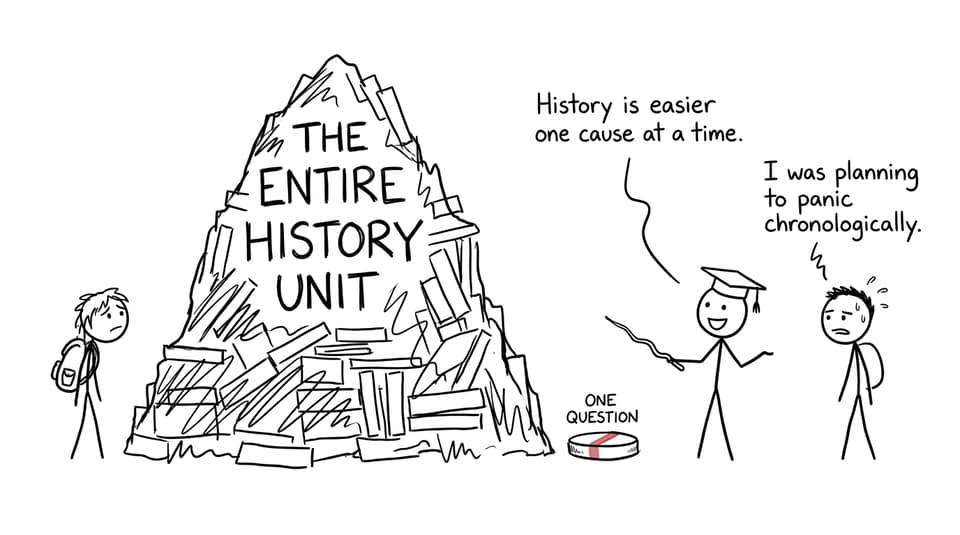
Motivation in History rarely disappears because the subject is impossible. More often, it disappears because the next task is unclear. “Revise the Industrial Revolution” feels endless. “Explain two causes of urbanisation without notes” has edges.
That distinction matters. Staying motivated studying MYP History becomes easier when you stop waiting to feel interested and create a routine that produces visible progress. Choose one narrow question, work actively for 25 minutes, check what you learned, and decide the next step before stopping.
Your MYP History motivation checklist
Use this checklist whenever starting feels difficult:
- Choose one event, concept, source, or historical debate.
- Set a minimum session of 10 minutes and a normal session of 25 minutes.
- Turn the topic into a question rather than a reading assignment.
- Retrieve information before reopening your notes.
- Practise one MYP skill: knowing, investigating, communicating, or thinking critically.
- Record one concrete result at the end.
- Write down the exact first task for tomorrow.
The MYP History resource hub makes this easier by keeping Study Notes, Flashcards, lessons, definitions, and practice tools together. Use only what helps you complete the next task.
Why motivation fades during MYP History revision
History can create a peculiar kind of overwhelm. Every event seems connected to earlier events, political ideas, historical figures, and places. Students often respond by rereading everything. Rereading feels safe, but it offers little evidence that you can explain, analyse, or evaluate independently.
MYP Individuals and Societies is broader than factual recall. According to the IB's published framework, students are assessed through four equally weighted criteria: knowing and understanding, investigating, communicating, and thinking critically. Each criterion has a maximum achievement level of eight.
Memorising dates is therefore useful but incomplete. You must also organise arguments, investigate questions, interpret perspectives, and evaluate sources. Effective MYP revision techniques should alternate between knowledge and application.
Replace “know the whole unit” with an observable target:
- Recall five key developments accurately.
- Explain one cause-and-consequence chain.
- Compare two historical perspectives.
- Evaluate the value and limitations of one source.
- Write a supported conclusion in six sentences.
Small targets are not a softer version of revision. They are how large subjects become manageable.
A step-by-step method you can start today
Select a topic from class or an area such as war, conflict, and peacemaking, then follow this 25-minute sequence.
Choose one historical question
Spend two minutes converting a topic into a question. Replace “imperialism” with “Why did economic motives encourage imperial expansion?”
Choose a question matching the skill you need:
- Recall: What happened, when, and who was involved?
- Explanation: Why did it happen, and what followed?
- Analysis: Which causes or consequences were most significant?
- Evaluation: How useful is this source for answering the question?
Retrieve before you review
Close your materials and spend five minutes writing everything you remember. Use a rough timeline, concept map, bullet list, or spoken explanation. Neatness does not matter.
Only then consult RevisionDojo Study Notes or resources such as imperialism and colonisation. Correct missing dates, vague vocabulary, and broken causal links in another colour. The contrast reveals what requires attention.
Apply the knowledge
Spend ten minutes answering one question from the MYP History Questionbank. Write without copying. If the task uses a command term such as explain, analyse, or evaluate, ensure your response performs that action rather than merely describing the topic.
A useful paragraph pattern is:
- Make a clear claim.
- Add precise historical evidence.
- Explain how the evidence supports the claim.
- Consider significance, perspective, or limitations where relevant.
- Connect the reasoning to the question.
Diagnose one weakness
Spend five minutes reviewing the attempt. Label the main weakness and choose a response:
| Type of weakness | Your next action |
|---|---|
| Missing knowledge | Review a short Study Notes section and create three Flashcards |
| Unclear explanation | Add a sentence beginning with “This mattered because...” |
| Weak evidence | Learn one precise example connected to the claim |
| Limited source analysis | Examine origin, purpose, value, and limitations |
| Poor structure | Rewrite the paragraph with one claim per section |
| Uncertain judgement | Compare alternatives before reaching a conclusion |
RevisionDojo's Grading tools and AI Chat can help identify why an answer feels incomplete. Ask a specific question, such as “Where does this paragraph describe instead of analyse?” Then revise the response yourself. Feedback becomes useful when it changes your next attempt.
End with proof and a next step
Use the final three minutes to write:
- I can now: one thing you can explain or do.
- I still confuse: one precise gap.
- Next session: the first small action you will take.
Ending this way reduces tomorrow's starting effort because the decision has already been made.
Make History feel like an investigation
The best MYP History study tips make the subject intellectually alive. Instead of treating a unit as a collection of answers, begin with a debatable question: Was an event inevitable? Which group benefited most? Why do two accounts disagree? The MYP inquiry-based learning guide offers a useful cycle: wonder, investigate, reflect, and apply.
Sources then become evidence rather than paragraphs to annotate mechanically. Timelines reveal turning points, while concepts such as cause, continuity, change, perspective, and significance become tools for understanding decisions. The guide to making History relevant through orientation in space and time can also help connect developments to geography, movement, and power.
Curiosity does not always arrive before studying. Sometimes it appears after you ask a better question.
Build a weekly system for low-motivation days
A dependable week combines different forms of practice:
- Three short sessions: 10 to 15 minutes of Flashcards, timelines, or retrieval.
- Two focused sessions: use the 25-minute method.
- One timed session: complete a longer response without support.
- One weekly review: identify a repeated weakness and schedule targeted practice.
On difficult days, review five Flashcards, answer one short question, and record one mistake. This preserves the habit without pretending every day offers equal energy. The guide to discipline versus motivation in IB study explains why a ten-minute start is often more dependable than an ambitious promise.
Use rewards for completed actions, not hours endured. After a focused block, take a walk, listen to music, or speak with a friend. Keep breaks genuinely restorative.
Use support before frustration becomes avoidance
A difficult source or confusing debate can quietly become avoidance. Ask for help while the problem is still specific.
RevisionDojo's AI Chat can clarify a concept or challenge an explanation. Tutors provide human guidance and accountability when the same difficulty returns. The Coursework Library can show how successful work is organised where relevant, while Grading tools can turn broad feedback into a criterion-focused target.
As assessments approach, Mock Exams can develop timing and stamina. Predicted Papers may support broader preparation where available and appropriate. These tools work best after regular Questionbank practice, not as substitutes for it.
Turn progress into your source of motivation
Motivation is unreliable when it depends on History always feeling exciting. A better system creates evidence: one stronger paragraph, one source interpreted more carefully, or one timeline recalled without help.
Tonight, choose one narrow question. Set a 25-minute timer. Retrieve, review, apply, diagnose, and record the next step. Then stop.
RevisionDojo is the ultimate IB resource for making that loop easier. Its Questionbank, Study Notes, Flashcards, AI Chat, Grading tools, Mock Exams, Predicted Papers, Coursework Library, and Tutors give each session a clear destination. You do not need to conquer all of History today. You only need to complete the next meaningful step.