


Staying engaged in MYP English Language and Literature does not require you to love every novel, poem, advertisement, or writing task. It requires a workable reason to pay attention and a study routine small enough to continue when enthusiasm disappears.
Students sometimes assume that disliking the subject means they cannot perform well in it. But enjoyment and ability are different. You can find a text uninteresting while becoming skilled at spotting choices, building arguments, and communicating clearly.
The goal is not to pretend you love English. It is to find a way into the subject that feels relevant, manageable, and increasingly satisfying.
A quick engagement checklist
When MYP English begins to feel distant, try this reset:
- Identify what you dislike: reading, discussion, analysis, writing, or uncertainty
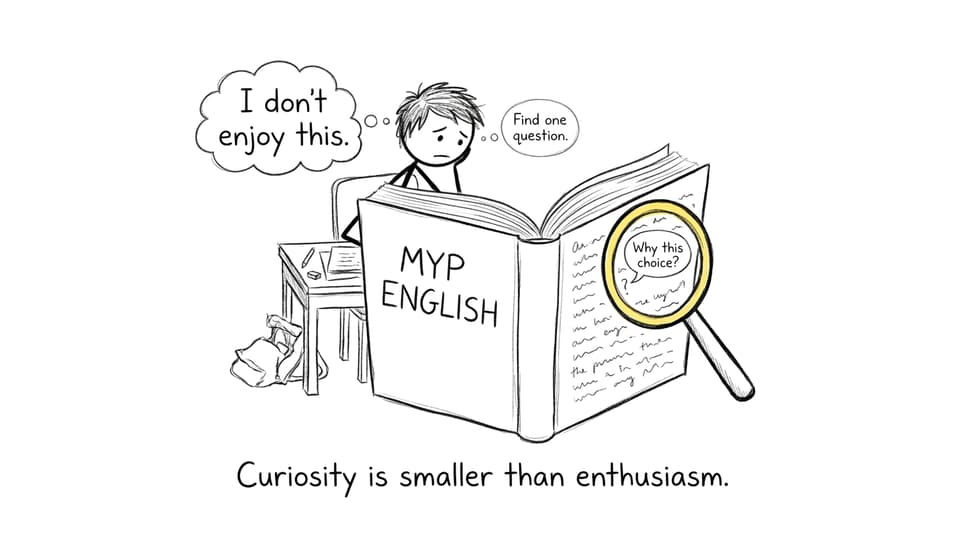
- Replace “Do I enjoy this?” with one specific question about the text
- Connect the task to something you already care about
- Work in short sessions with a visible finish line
- Practise one skill rather than vaguely “studying English”
- Ask for feedback on one improvement at a time
- Record evidence of progress, even when it feels small
You can build this routine using the MYP English Language and Literature resources, where the subject is divided into focused notes, lessons, flashcards, and skills rather than one intimidating block.
Stop waiting to feel motivated
Motivation is often treated like the starting engine of learning. In reality, it is frequently the result of beginning.
Imagine being assigned a story you would never choose yourself. Waiting to become fascinated may leave you staring at the first page. Instead, create a ten-minute mission: find one unusual word choice, contradiction, or moment when a character behaves unexpectedly.
The mission gives your attention somewhere to go. Once attention produces a small discovery, interest has a chance to follow. This is a more useful MYP English Language and Literature mindset: action can come before motivation. You do not need to feel ready. You need a task small enough to start.
Find your doorway into each text
A text may not interest you as a whole, but one part might. Your doorway could be psychology, justice, power, identity, humour, media, design, or the way people influence one another.
If you enjoy psychology, ask what a character wants and fears. RevisionDojo's notes on character traits and motivation can turn a distant fictional person into a problem worth investigating.
If you care about social media or advertising, examine bias, visual design, and persuasion. If you prefer debate, challenge the creator's assumptions. If you like making things, notice how structure, voice, and imagery could improve your own writing.
The MYP course develops listening, speaking, reading, writing, viewing, and presenting. Traditional literary reading is only one entrance. Finding your strongest mode can give you enough confidence to develop the others.
Turn analysis into detective work
Analysis becomes tiring when it feels like guessing what the teacher wants. It becomes more engaging when you follow four evidence-based questions:
- Choice: What did the creator deliberately include?
- Effect: What might it make the audience think or feel?
- Purpose: Why might the creator want that response?
- Meaning: What larger idea does the choice communicate?
Do not stop at “The writer uses repetition.” Ask what is repeated, what it emphasizes, how it influences the audience, and why that influence matters.
The guide to improving MYP English analysis develops this shift from naming techniques to explaining their effects. You can also use the focused author intention notes when purpose feels difficult to explain.
Make the work smaller and more active
Low motivation makes large assignments look even larger. Sometimes the answer is not more discipline, but a smaller unit of work.
Try a 15-minute session:
- Spend three minutes reading or viewing a short section
- Spend four minutes marking two deliberate choices
- Spend six minutes writing one analytical paragraph
- Spend two minutes identifying one improvement
This creates a completed piece of work, giving your brain evidence that progress is possible. It is also more useful than rereading notes without producing anything.
RevisionDojo supports this cycle through Study Notes for clarification, Flashcards for terminology, and the Questionbank for focused practice. When an explanation gets stuck, AI Chat can help you interrogate the idea. The best MYP Language and Literature revision strategies offer a broader routine for turning short practice into steady improvement.
Use the criteria to remove uncertainty
Sometimes dislike is uncertainty in disguise. A task feels unpleasant because you do not know what success looks like.
MYP Language and Literature commonly organizes assessment around analysing, organizing, producing text, and using language. Before beginning, identify the relevant area and translate it into an action. For analysis, explain how a choice creates meaning. For organization, make your reasoning easy to follow. When producing a text, adapt your decisions to its audience and purpose.
The MYP Language and Literature assessment criteria guide clarifies what different tasks reward. RevisionDojo's Grading tools can then turn feedback into a specific revision target. The point is not to chase a score mechanically, but to replace vague anxiety with a clear next move.
Build confidence through visible progress
After each task, record one strength, one recurring problem, and one action for next time. “Explain the effect after every quotation” is useful. “Get better at English” is too broad to guide behaviour.
You may still dislike the subject. That is allowed. Engagement can mean contributing one thoughtful idea, completing one paragraph carefully, or asking one genuine question. The common MYP language-task mistakes and fixes can help you identify problems that are specific enough to train.
Open your current text and set a 15-minute timer. Find one deliberate choice, then complete this sentence: The creator uses _____ to make the audience _____, which supports the purpose of _____.
RevisionDojo can support the repetitions that follow through Mock Exams, Predicted Papers, the Coursework Library, and expert Tutors. Staying engaged is rarely one dramatic decision. It is a collection of small decisions that make the next page easier to enter.