


A disappointing History result can feel significant, especially when a child cannot explain what went wrong. Yet one mark rarely tells the whole story. The clearest signs a child needs help in MYP History are recurring patterns: difficulty understanding criteria, repeated weaknesses in source analysis, avoidance, falling confidence, or considerable effort producing little progress.
The goal is not to diagnose every hesitation or turn home into another classroom. It is to notice patterns early, ask calm questions, and find the right support. Sometimes that means changing a study routine. Sometimes it means targeted practice or involving the teacher, learning support team, or a tutor.
A quick parent checklist
Look for several of these signs continuing across multiple weeks or assignments:
- Your child remembers events but struggles to explain causes, consequences, significance, or perspectives.
- Teacher feedback repeatedly identifies the same weakness.
- Research tasks remain unfinished because your child does not know how to begin.
- Essays contain facts but lack a clear argument.
- Your child cannot explain the rubric or command term.
- History homework regularly causes avoidance, frustration, or unusually long study sessions.
- Marks decline even as effort increases.
- Your child describes themselves as “bad at History” instead of identifying a skill to improve.
One item is not proof of a serious problem. A connected pattern is more informative than an isolated result.
Understand what MYP History assesses
MYP History is generally taught within Individuals and Societies. Students are assessed through four equally weighted criteria, each with a maximum achievement level of 8:
| Criterion | What it broadly assesses |
|---|---|
| A: Knowing and understanding | Historical knowledge, concepts, examples, and terminology |
| B: Investigating | Research questions, planning, evidence collection, and reflection |
| C: Communicating | Organization, appropriate formats, citations, and expression |
| D: Thinking critically | Analysis, source evaluation, perspectives, arguments, and conclusions |
This matters because a child can know the topic and still struggle with the assessed skill. A student may accurately describe a revolution yet find it difficult to compare interpretations or judge which cause mattered most.
RevisionDojo’s guide to how MYP Individuals and Societies is assessed explains the criteria in more detail. Always compare general guidance with the task-specific rubric supplied by your child’s school, because expectations develop across MYP years.
The clearest signs a child needs help in MYP History
Feedback repeats without producing change
Repeated feedback is a strong signal. Comments such as “analyse further,” “use specific evidence,” or “consider the source’s limitations” suggest a teachable skill gap when they appear across several assignments.
Ask your child to translate one comment into an action. “Analyse further,” for example, might become: “After each fact, explain how it supports my answer.” This feels more manageable than trying to improve an entire essay at once. The MYP Individuals and Societies criteria guide can help connect rubric language to visible actions.
Knowledge does not become an argument
Many students assume History rewards the quantity of information remembered. Knowledge matters, but MYP tasks also require students to explain relationships, evaluate evidence, recognize perspectives, and reach supported conclusions.
Try a five-minute check. Ask your child what happened, why it happened, and which cause mattered most. If the first answer is detailed but the others are difficult, the issue may be reasoning rather than effort or memory. The guide to structuring MYP Individuals and Societies essays offers a practical starting point.
Research tasks cause paralysis
An investigation contains many decisions: selecting a question, planning research, finding credible evidence, recording sources, evaluating limitations, and presenting conclusions. A child who delays may not be lazy. They may be unable to see the first manageable step.
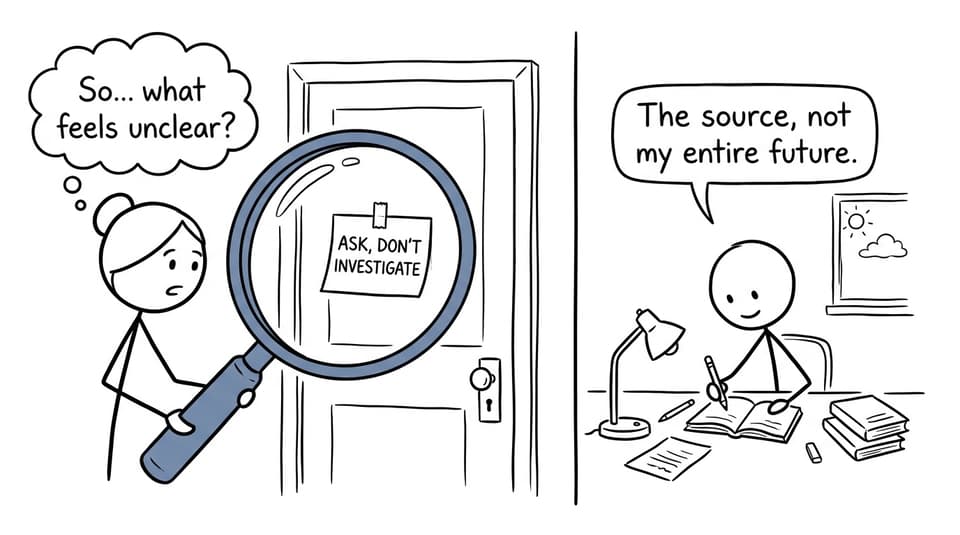
Instead of asking why they have not started, ask which part is unclear: the question, evidence, plan, or writing. Then shrink the task. One session might produce only a focused research question and three search terms. That is genuine progress without taking ownership away from the student.
Time increases while useful output falls
Longer study does not always mean deeper learning. A student may reread notes or repeatedly restart an introduction because those activities feel safer than attempting a difficult source question.
After 25 minutes, can your child show a paragraph, source evaluation, retrieval score, or clearer plan? If not, the method may need adjustment. The MYP History resource hub supports an active sequence: use Study Notes to clarify one concept, Flashcards to retrieve terminology, and the Questionbank to apply it.
Confidence becomes part of the problem
“I don’t understand this source” describes a problem. “I am terrible at History” turns that problem into an identity. Respond specifically: “Your chronology is clear. Evaluating the source’s purpose is the difficult part, so let’s focus there.” Specific language makes improvement imaginable.
If worry affects sleep, attendance, appetite, relationships, or everyday functioning, contact the school. Academic tools are not substitutes for appropriate pastoral, learning, or health support. The guide to recognizing when a child is struggling in MYP can help parents widen the conversation.
Supporting a child without taking over
Effective support feels like scaffolding rather than supervision:
- Review one assignment and criterion. Ask what successful evidence would look like.
- Choose one weakness. Do not repair knowledge, structure, citations, and analysis simultaneously.
- Schedule two short sessions. Focused blocks are better than an open-ended evening.
- Produce something visible. Create an outline, analytical paragraph, retrieval score, or source evaluation.
- Record the next action. Give the following session an easy starting point.
Parents can ask questions, organize deadlines, and protect a calm routine. They should avoid rewriting paragraphs, selecting arguments, or conducting research. See RevisionDojo’s advice on supporting a child in the MYP for further boundaries.
When to seek extra support
Contact the teacher when the same problem continues across several tasks or confidence changes noticeably. Ask which criterion needs attention, whether the issue is knowledge or application, and what one action the student should take this week.
If classroom advice and focused practice do not help, consider individualized support. RevisionDojo brings the necessary tools together: Study Notes and Flashcards rebuild foundations; the Questionbank and AI Chat support application; and Grading tools reveal rubric-based weaknesses. Mock Exams and Predicted Papers can develop timing where appropriate, while the Coursework Library models effective approaches. RevisionDojo Tutors add human explanation, accountability, and encouragement.
A calm way forward
Look for direction, not perfection. One difficult unit, disappointing mark, or tired week does not define your child’s ability.
Notice the pattern. Identify the criterion. Choose one small action, then review whether it helped. With calm communication, teacher input, and focused RevisionDojo support, History can become less like a collection of facts and more like a disciplined way of understanding evidence, causation, and perspective.