


Subject Selection is one of those IB decisions that feels like it should be rational… right up until you hear what everyone else is choosing.
One friend picks Psychology because it “sounds interesting.” Another picks Business Management because it “seems practical.” Someone else says English A is “basically mandatory anyway,” and suddenly your own Subject Selection starts to feel like a referendum on your future.
But popularity trends can actually calm you down, if you use them the right way. They show what most students find accessible, what schools can reliably offer, and where competition tends to be highest. And then you can make a smarter choice: not based on panic, but based on fit.
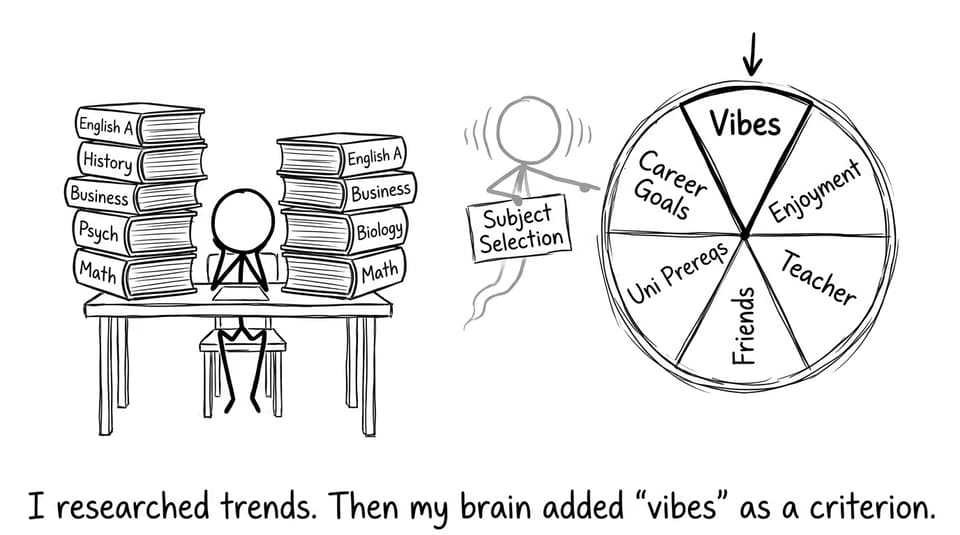
Quick checklist: how to use popularity without copying it
Use this mini-checklist before you lock in Subject Selection:
-
Confirm your university prerequisites (especially for STEM and competitive programs).
-
Ask: “Do I enjoy the assessment style?” not just “Do I like the topic?”
-
Be honest about your strengths: writing, math, memorisation, analysis, data.
-
Treat popularity as a signal (availability, accessibility), not a verdict (easy, guaranteed 7).
-
Build a revision plan early using a consistent system: notes, practice, feedback, repetition.
A good place to orient yourself is the RevisionDojo IB hub, where you can explore what each subject actually demands and what resources exist.
Most popular IB subjects in 2025 (and what that really means)
Based on global IB Diploma trends (May 2025 session), the most popular subjects cluster in familiar areas:
-
English A (all routes combined)
-
History
-
Business Management
-
Psychology
-
Biology
You’ll notice a pattern: these are widely offered, relatively flexible for university pathways, and they reward skills many students already practise in school (argument writing, structured responses, evidence use).
This is the calm truth of Subject Selection: popularity usually reflects reach, not ease.
Subject Selection and English A: why it stays at the top
English A is consistently the most common Subject Selection choice globally for a simple reason: for most Diploma students, a Language A course is non-negotiable, and English is the most common instructional language worldwide.
There’s also a comfort factor. Students have been reading, writing, and analysing texts for years, so English A feels familiar even when it’s challenging.
The risk is that familiarity can create complacency. When thousands of students write essays on similar ideas, examiners become allergic to vague commentary. Precision wins: tight thesis statements, purposeful evidence, clear analysis.
If you want to strengthen that precision, use the IB English A: Lang & Lit resource hub and pair it with English A cheatsheets for quick structure reminders.
Subject Selection and History: popularity powered by argument
History attracts students who like debate-on-paper. The subject rewards those who can build a claim, support it with evidence, and show awareness of perspective.
But popular History cohorts can be unforgiving: a timeline dump rarely scores well, even if every fact is correct. You need selection. You need relevance. You need evaluation.
That’s why good History revision is less about “covering everything” and more about training a repeatable writing method under time pressure. Start from the IB History resources page, then sharpen technique with Why Students Struggle With IB History.
Subject Selection and Business Management: structure, clarity, real-world pull
Business Management stays popular because it feels close to real life: companies, decisions, stakeholders, strategy. For many students, it’s the first subject that makes school feel like it has a direct translation into the adult world.
It also has a reputation for being “structured.” That’s partly true, but structure only helps if you learn to use it under exam conditions. Case analysis, application marks, and command terms can punish vague generalities.
RevisionDojo’s IB Business Management resources make that structure easier to see in advance, and the Business Management predicted papers help you practise decision-making in the exact style the exam rewards.
Subject Selection and Psychology: the essay-science hybrid
Psychology’s popularity makes sense when you look at what it offers: human behaviour, real studies, and a clear essay framework. It’s a Group 3 subject, but it behaves like a blend of humanities writing and scientific reasoning.
Students often choose it because it feels both meaningful and memorable: experiments, ethical debates, and concepts you can spot in everyday life.
The trap is thinking it’s just “learning studies.” Top marks require evaluation, methodological critique, and clear argument flow. If you’re considering this for Subject Selection, start with the IB Psychology resource hub and read IB Psychology: Structure, Skills & Assessment.
Subject Selection and Biology: the classic science choice
Biology remains one of the most popular sciences because it’s widely offered and connects naturally to popular university pathways (medicine, health sciences, environmental fields).
It also rewards students who enjoy systems: processes, feedback loops, data interpretation, and precise definitions.
What surprises many students is how quickly “I understand it” can fall apart in exam questions. Biology is full of almost-correct answers. The difference between a 6 and a 7 often lives in markscheme language and consistent practice.
Use the IB Biology resources hub as your map, then build accuracy with targeted revision (notes, flashcards, and questions) and check your pacing with IB Biology HL Grade Boundaries 2025.

Does popularity make it harder to score a 7?
Here’s the uncomfortable part of Subject Selection: popular subjects can feel “harder” at the top end, not because the content is worse, but because examiners have more scripts to compare.
Three things tend to happen in high-enrolment subjects:
-
Generic answers blend together.
-
Small weaknesses in structure become more costly.
-
Students overestimate familiarity and underestimate technique.
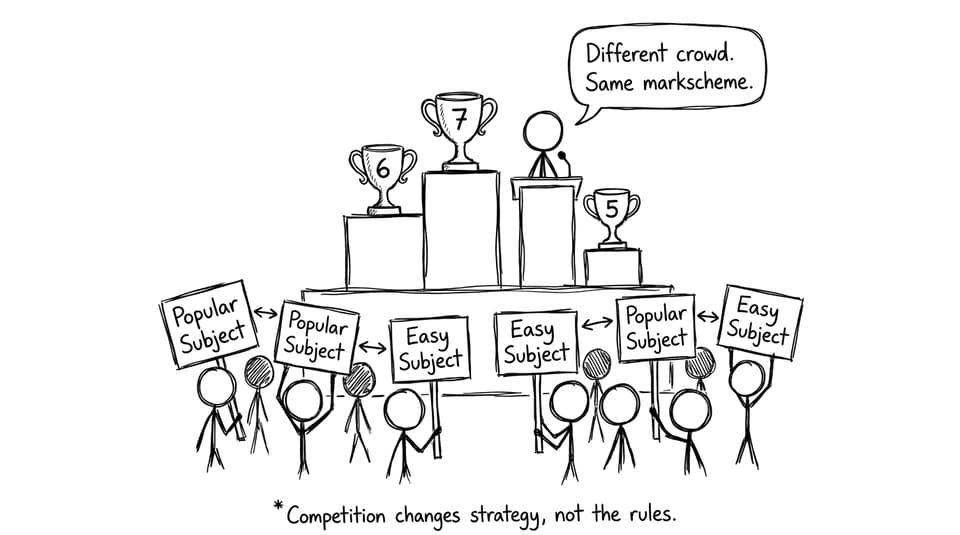
But the rules don’t change. The criteria don’t secretly get stricter because your class is bigger. What changes is the need to be consistently specific.
That’s why RevisionDojo’s system matters: Study Notes to clarify, Flashcards to retain, Questionbank to apply, AI Chat to fix misconceptions fast, Grading tools to align your writing to criteria, and Mock Exams plus Predicted Papers to practise under pressure.
For a practical overview of how the whole system fits together, see Comprehensive IB revision made easy.
A strategic way to think about Subject Selection in 2025
Try this mental model: pick the subjects where you can build a repeatable scoring process.
Popularity data helps you predict where many students will sit with you in the same arena. It does not tell you who will win.
If you want Subject Selection to feel less emotional, ask these questions:
-
When I revise, do I prefer writing-based proof (essays, evaluation) or problem-based proof (questions, calculations, data)?
-
Does the subject reward depth (few ideas, high quality) or coverage (many ideas, accurate recall)?
-
Can I realistically practise the exam format weekly?
Then build your system early. One underrated advantage of using RevisionDojo is that it lowers the friction: you can move from notes to practice to feedback in the same place, which makes consistency more likely.
If you want a broader roadmap from Subject Selection to exams, read The complete IB revision guide.
Closing: use trends, then choose with intent
In 2025, the most popular IB subjects are popular for understandable reasons: they’re widely offered, respected by universities, and approachable for many learning styles. But Subject Selection becomes powerful only when you move from trend-watching to strategy.
Choose what you can practise honestly. Choose what you can learn deeply. Then build a loop that turns effort into marks: Study Notes for clarity, Flashcards for recall, Questionbank for application, AI Chat for fast fixes, Grading tools for writing and coursework alignment, and Mock Exams plus Predicted Papers for timed realism.
If you want your Subject Selection to lead to calmer exam seasons (not louder ones), make RevisionDojo your home base and start training like the grades are earned on purpose.