Join 650k+ students breezing through the IBReady to breeze through the IB?
TOK can feel like a strange class at first: you’re asked to “think about thinking” while the rest of your timetable screams for concrete answers. Then you meet the Areas of Knowledge (AOKs) and something clicks. TOK isn’t random philosophy. It’s a map. The five AOKs are how TOK keeps your ideas grounded in real disciplines, with real methods, real disagreements, and real consequences.
And if you’re preparing for IB exams, that map matters. A strong TOK essay or exhibition isn’t just clever writing. It’s showing you understand how knowledge is made differently in mathematics, the natural sciences, the human sciences, history, and the arts.
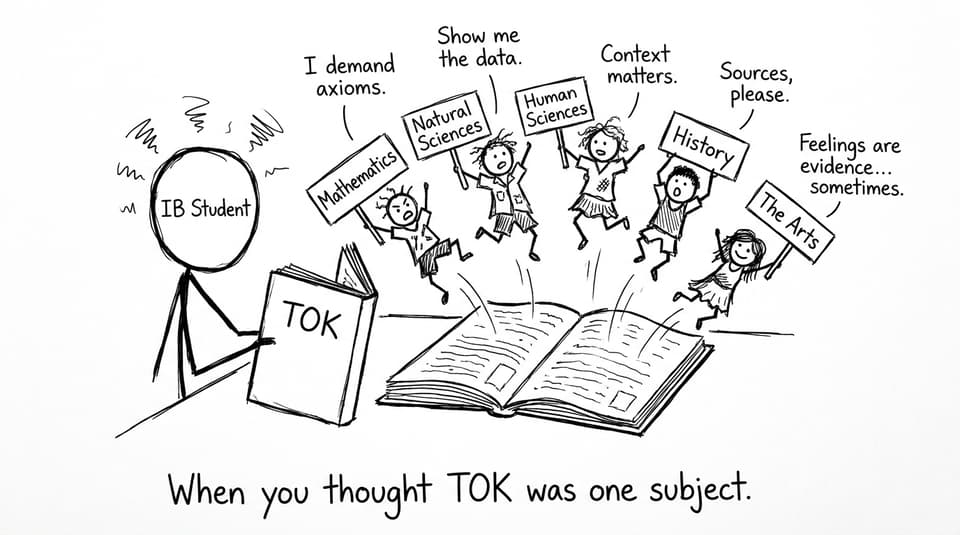
TOK AOKs jump out like a boy band
TOK AOKs: the fast checklist (use this for any paragraph)
When you write about an Area of Knowledge in TOK, quickly check:
Method: How does this AOK produce knowledge (proof, experiments, interpretation)?
Evidence: What counts as justification here?
Certainty: How stable are conclusions in this AOK?
Perspective: Who might disagree, and why?
Ethics: What happens if the knowledge is used badly?
If you want a broader overview of the course landscape, start with IB Theory of Knowledge Resources and bookmark it for revision season.
min read
min read
min read
min read
What are Areas of Knowledge in TOK?
In TOK, Areas of Knowledge are broad fields where humans create and test knowledge. Each AOK has its own “rules of the game”: shared assumptions, typical methods, preferred evidence, and ways of handling disagreement.
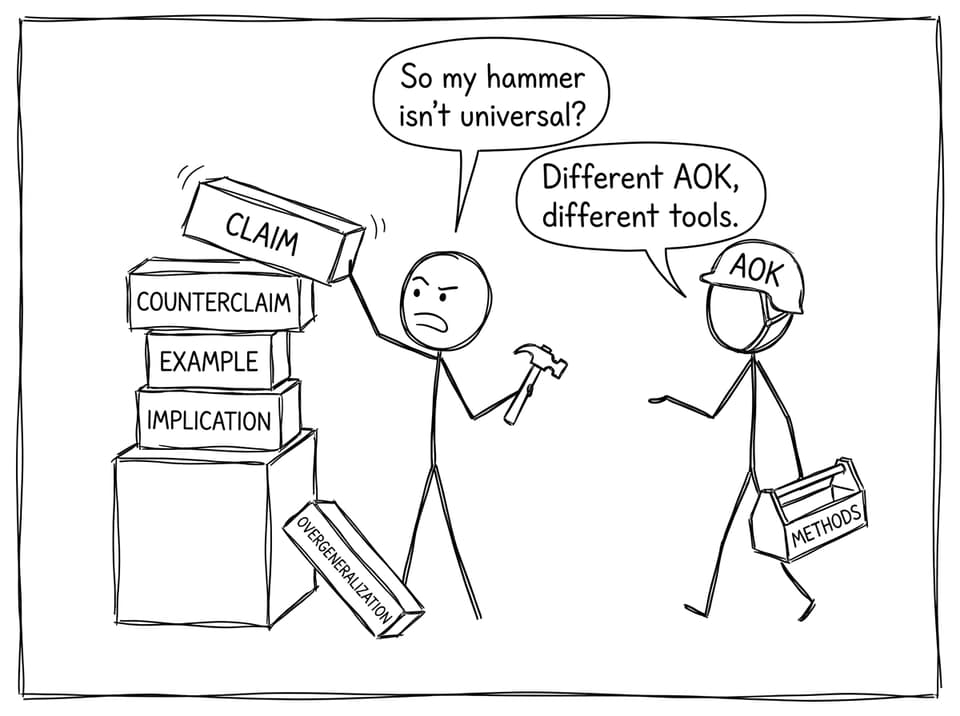
That’s why the same claim can look convincing in one AOK and weak in another. TOK rewards you for noticing those differences and using them to build sharper claims and counterclaims.
Mathematics is TOK’s home for certainty and structure. Knowledge is built through axioms, definitions, and proof. The strength is clarity. The weakness is that maths can be perfectly true inside its system yet still raise questions about application in the real world.
Try TOK questions like: Where do axioms come from? and Is mathematical knowledge discovered or invented?
The natural sciences build knowledge through observation, measurement, experimentation, and models. Scientific knowledge is powerful because it’s testable and self-correcting, but TOK wants you to sit with the tension: evidence is never perfect, and theories change.
Good guiding questions: What makes a theory trustworthy? and How does technology shape what we can know?
RevisionDojo’s TOK Natural Sciences notes are a strong anchor when you need vocabulary for methods and justification.
Human Sciences
Human sciences (psychology, economics, sociology) often use experiments and statistics, but the “subject” is humans. That means culture, ethics, interpretation, and bias are always in the room. TOK loves this AOK because it forces you to ask whether objectivity is possible, or whether it’s more realistic to aim for fairness and transparency.
Useful TOK angles: Does quantifying people increase accuracy or reduce meaning? and When does correlation become a misleading story?
History looks like facts, but it’s built from sources, selection, and interpretation. Historians argue about reliability, significance, and perspective. TOK students often score higher when they stop treating history as a timeline and start treating it as a constructed narrative.
Try guiding questions like: How do we decide what counts as evidence? and Who gets left out of the historical record?
The arts produce knowledge through creative choices, interpretation, emotion, and cultural context. In TOK, the arts aren’t “anything goes”; you still justify claims, but justification might look like coherence, insight, or transformative impact rather than replication.
Your TOK questions might be: Can art give knowledge that language can’t? and How does culture shape interpretation?
AOKs are not decorations. They’re the engine of evaluation.
In the essay, AOKs help you compare methods and justify why your conclusion is limited or strong. See May 2026 (M26) IB TOK Essay Prompts Explained for how AOK pairings show up in titles.
In the exhibition, AOKs help your objects feel like real-world knowledge rather than personal opinion. Use What are the TOK Exhibition Prompts? as your starting list.
RevisionDojo supports this with the tools students actually need: Study Notes for each AOK, Flashcards to lock in key terms, AI Chat to test your claims and counterclaims, and Grading tools to spot where your argument becomes descriptive. When you’re closer to exams, Mock Exams and Predicted Papers help you practice under pressure, and the Questionbank makes sure your revision is targeted, not hopeful. If you want human feedback, you can also work with Tutors and compare examples inside the Coursework Library.
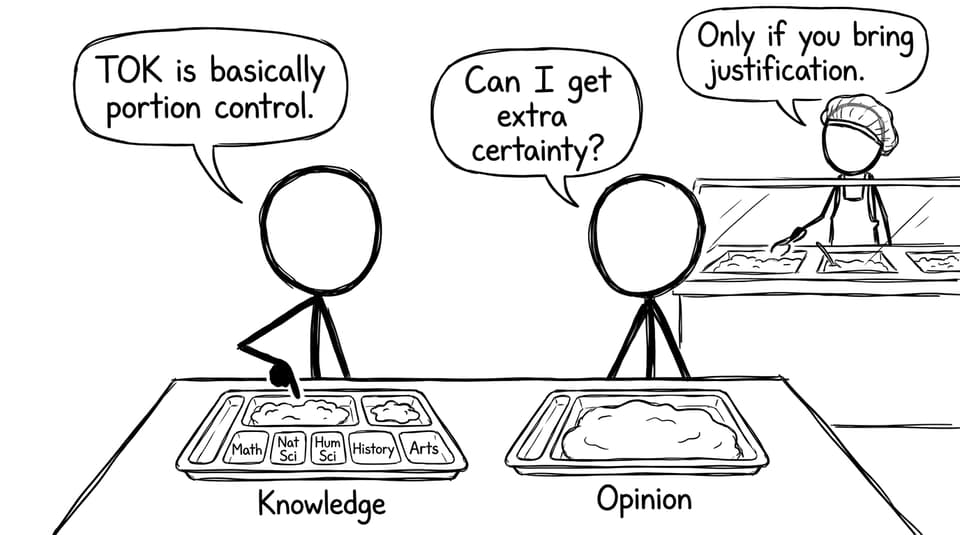
TOK is basically portion control
A final way to remember TOK AOKs
Think of TOK as learning the difference between confidence and justification. The five AOKs teach you that different subjects earn trust in different ways, and your job is to notice the method behind the message.
If you want a clean, exam-ready path, revisit the Overview of the Five Areas of Knowledge in TOK and then use RevisionDojo’s TOK notes, Flashcards, and AI Chat to turn each AOK into usable essay paragraphs and exhibition insights. That’s how TOK stops feeling abstract and starts scoring marks.