


If your TOK draft feels smooth, confident, and one-directional, that’s usually the danger sign.
Examiners don’t reward certainty in TOK the way we think they do. They reward judgment: the kind that comes from letting a strong counterclaim sit at the same table as your claim, and then showing who earns your trust (and why). For the May 2026 TOK essay titles, the fastest way to sound thoughtful is to build counterclaims that are specific, fair, and evaluated.
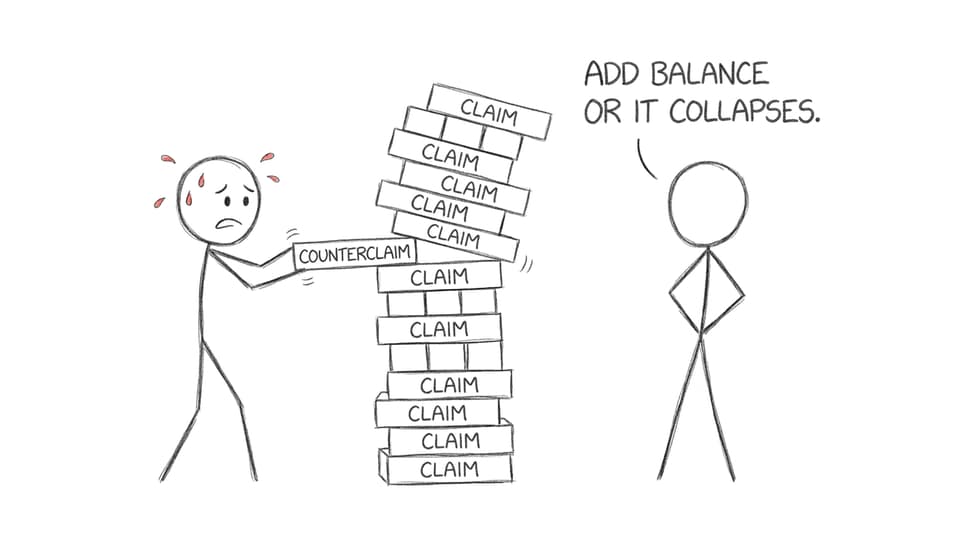
TOK counterclaims checklist (use this before you write)
A high-scoring TOK counterclaim is:
-
Direct: it challenges your exact claim, not a weaker version.
-
Charitable: it represents the alternative view as intelligent and plausible.
-
Grounded: it connects to a clear real-world example (RLE).
-
Evaluated: you weigh which side is stronger in what conditions.
If you need a structure that forces balance, use TOK Essay Planning Templates for May 2026 Titles.
Best counterclaims for the May 2026 TOK prescribed titles
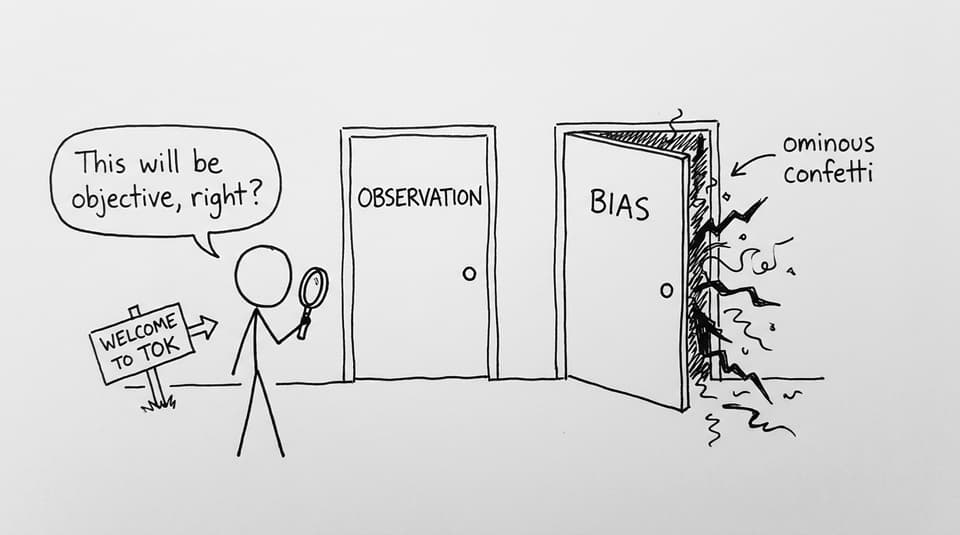
Title 1 (Observation): essential, but flawed
Counterclaim to build around: Observation doesn’t just “contain errors”; it can actively shape what we think is real through expectation, framing, and instrument limits.
A classic TOK move is to show that observation is not neutral data collection; it is filtered through perception, technology, and interpretation. In legal settings, eyewitness testimony can feel vivid and still be unreliable, because memory reconstructs rather than replays.
Read the deeper breakdown in TOK May 2026 Title 1 guide.
Title 2 (Doubt): fuel or friction?
Counterclaim to build around: Doubt can become performative or endless, producing skepticism without progress.
In TOK, it’s powerful to distinguish productive doubt (testing, peer review, falsification) from paralyzing doubt (rejecting standards of evidence entirely). Conspiracy thinking often mimics critical inquiry, but it treats every refutation as more proof of the cover-up, turning doubt into a closed loop.
For title guidance and framing, see RevisionDojo Ultimate TOK May 2026 Essay Guide.
Title 3 (Conveyance): does delivery determine power?
Counterclaim to build around: Some knowledge has power independent of presentation, because its authority comes from internal logic or reproducibility.
This counterclaim works well if your claim focuses on rhetoric, media, or storytelling. Mathematics is the clean example: a valid proof stays valid even if it’s explained badly. In the natural sciences, results gain power through replication and methods, not just persuasive communication.
If you’re still deciding which title best fits you, use How to Choose the Best TOK May 2026 Title.
Title 4 (Context): necessary, but not always
Counterclaim to build around: Some knowledge aims for universality, and context matters less once concepts are formalized.
This isn’t saying “context never matters.” It’s saying that in some Areas of Knowledge, the standards are designed to travel. Mathematical truths like 2+2=4 don’t depend on culture in the same way ethical norms might. The evaluation is where TOK marks live: when does context drop out, and why?
For common pitfalls with this kind of balance, see Top Mistakes Teachers See in TOK May 2026 Essays.
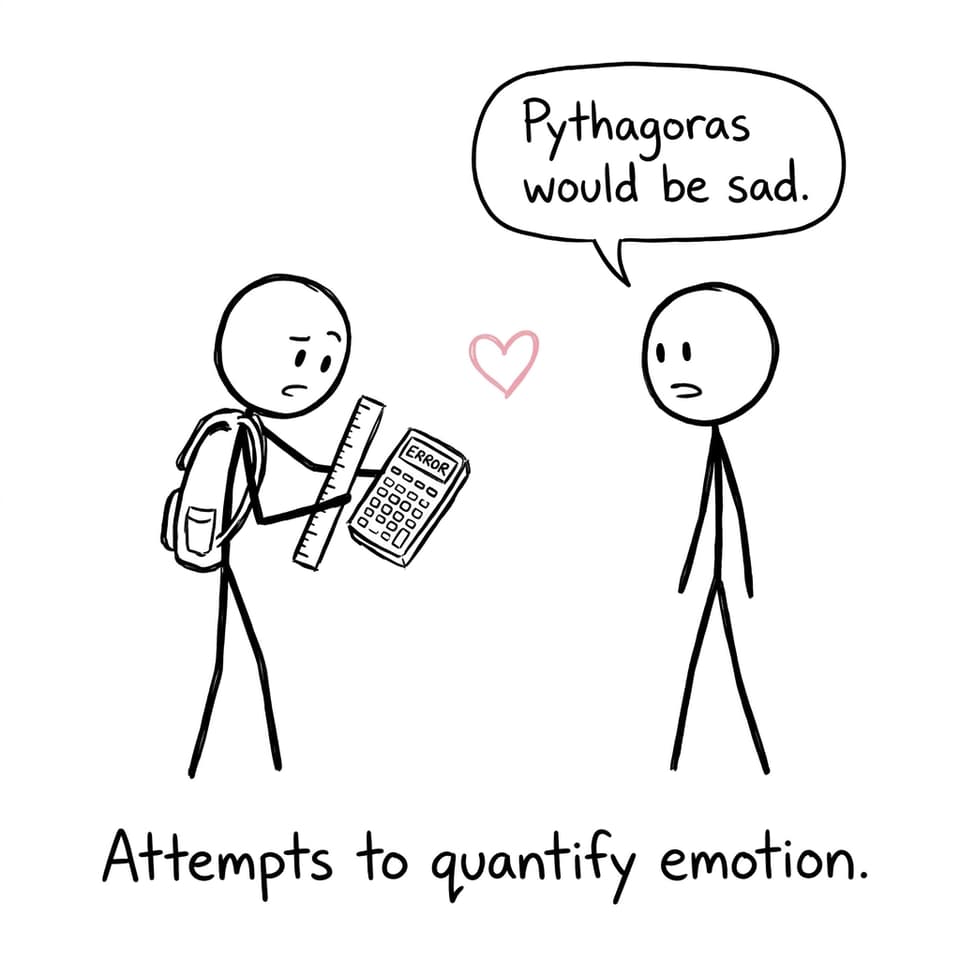
Title 5 (Pythagoras): “all things are numbers”
Counterclaim to build around: Quantification can clarify reality while still missing meaning, value, and lived experience.
Numbers can model patterns, but they can’t automatically explain what matters. A happiness score, a risk percentage, a grade boundary, all can be useful, and still flatten what they measure. This sets you up for a strong TOK evaluation: the counterclaim isn’t anti-math; it’s pro-humility about what measurement can capture.
Title 6 (Interpretation): meaning-maker or distortion machine?
Counterclaim to build around: Interpretation is unavoidable in many AOKs, but its reliability varies with constraints like evidence quality, methods, and accountability.
History often depends on interpreting incomplete records, and bias can reframe collective memory. But interpretation doesn’t have to be free-for-all subjectivity: triangulation, historiography, and source criticism can raise reliability. Your TOK job is to show the difference between interpretation as disciplined inference and interpretation as projection.
Go deeper with TOK May 2026 Title 6 guide.
How to weave TOK counterclaims without “arguing against yourself”
-
Put the counterclaim right after the claim (don’t hide it).
-
Give the counterclaim its best example.
-
Then limit it: explain where it’s strongest and where it weakens.
-
End with a reasoned judgment that answers the prescribed title.
A helpful final pass is the editing workflow in How to Revise and Edit Your TOK May 2026 Essay, plus quick fixes from Last-Minute Tips for the TOK May 2026 Essay.
Conclusion: the best TOK counterclaims make you credible
A strong TOK essay for May 2026 isn’t a list of opinions; it’s a record of careful hesitation, followed by justified judgment. Build counterclaims that are specific, fair, and evaluated, and your argument starts to sound like an examiner’s mindset.
When you’re ready to turn these TOK counterclaims into a full plan, RevisionDojo is built for it: use the Study Notes for each title, drill examples in the Questionbank, tighten reasoning with Flashcards, and stress-test paragraphs with AI Chat. Then use Mock Exams, Predicted Papers, and Grading tools to see what holds up under pressure. If you want guided feedback, the Tutors and Coursework Library can help you sharpen your final submission.