


A marked practice response can feel like a verdict. It is better treated as a map.
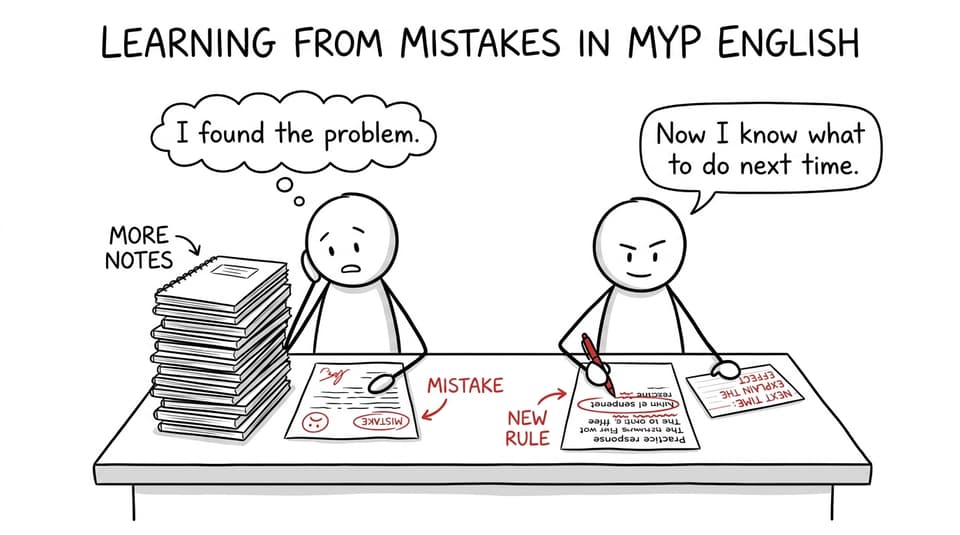
The most effective method for reviewing mistakes in MYP English Language and Literature practice is simple: identify the assessed criterion, diagnose one precise weakness, rewrite the weakest section, and test the same skill again. Do not merely read the feedback. Turn it into a visible change in your writing.
MYP English rewards what you can do with a text: analyse choices, organize ideas, produce writing for a purpose, and use language effectively. Your review should therefore focus on transferable skills rather than corrected answers.
Your same-day mistake-review checklist
Use this process after any practice question:
- Identify which MYP criterion the question assessed.
- Compare your response with the feedback and year-level descriptors.
- Label the main error precisely.
- Rewrite one sentence or paragraph.
- Create a short “next time” rule.
- Complete a five-minute retest without copying your correction.
- Record the result in an error log.
This can take 20 to 30 minutes. It is usually more valuable than immediately answering another question while carrying the same weakness forward.
A step-by-step method for reviewing mistakes in MYP English Language and Literature practice
Read the task before rereading your answer
Begin with the question, not the teacher’s comments. Underline the command term and identify the real demand.
Identify asks you to recognize something relevant. Explain requires connected reasons. Analyse asks how choices create meaning or affect an audience. Compare requires a meaningful relationship between texts, not two separate descriptions.
Summarize the task in one sentence:
I needed to analyse how two structural choices shaped the audience’s understanding of conflict.
This becomes your review standard. A response can contain intelligent observations and still miss the question. The MYP Language and Literature assessment criteria guide can help you connect task demands to the relevant criterion.
Find where your response became weaker
Students often circle spelling errors because they are easy to see. The larger problem may have appeared earlier: a vague claim, unsuitable evidence, unexplained effect, or paragraph that drifted away from the task.
Read until the reasoning stops being convincing. Ask:
- Did I answer the exact question?
- Did I name a specific authorial choice?
- Did I use precise evidence?
- Did I explain the effect rather than assert it?
- Did I connect the effect to purpose, audience, or meaning?
If you wrote, “The metaphor makes the text interesting,” the problem is an unsupported claim about effect. The correction should strengthen the reasoning, not simply add a longer quotation. RevisionDojo’s guide to improving analysis skills in MYP English models the choice --> effect --> purpose chain.
Give the mistake a precise label
A named mistake is easier to fix than a general feeling of disappointment.
| Error label | What it usually means | Immediate correction |
|---|---|---|
| Task error | You answered a nearby question | Rewrite the claim using the command term |
| Evidence error | The evidence does not prove the claim | Select one precise reference |
| Analysis error | You named a technique without explaining its effect | Add a choice --> effect --> purpose chain |
| Organization error | Ideas are unclear or repetitive | Reorder the paragraph and revise its topic sentence |
| Text-type error | Form or register does not suit the purpose | Rewrite a section in the correct form |
| Language error | Expression or accuracy reduces clarity | Correct the pattern and create a fresh example |
Choose the main error first. Trying to fix everything at once may produce a tidier response without teaching you a repeatable lesson.
Connect the error to the correct MYP criterion
MYP Language and Literature uses four equally weighted criteria across the course: Criterion A, Analysing; Criterion B, Organizing; Criterion C, Producing text; and Criterion D, Using language. Individual tasks may assess only some criteria, so follow the criteria named by your teacher and the descriptors for your MYP year.
- Criterion A: Examine your analysis of content, context, language, structure, technique, style, relationships, and effects where relevant.
- Criterion B: Check whether ideas build logically and whether structure, formatting, and referencing serve the task.
- Criterion C: For creative or purposeful writing, examine imagination, stylistic choices, audience impact, and supporting detail.
- Criterion D: Review vocabulary, register, sentence control, grammar, punctuation, and accuracy.
Do not translate a lower result into “I am bad at English.” Make it actionable: “My Criterion A explanation names techniques but does not connect their effects to the writer’s purpose.” For broader support, the MYP English Language and Literature resource hub organizes revision around these core skills.
Rewrite the smallest useful section
Rewriting an entire response can bury the lesson beneath unnecessary work. Select the weakest sentence or paragraph and improve it under one restriction: the new version must solve the error you labelled.
Original:
The writer uses short sentences, which makes the reader want to continue.
Improved:
The abrupt sequence of short sentences accelerates the scene and withholds time for reflection, placing the reader inside the character’s rising panic.
The second version identifies how the structural choice operates and explains a specific effect. If purpose matters, add a sentence connecting that panic to the wider message. This focused approach also appears in RevisionDojo’s revision strategies for MYP Language and Literature.
Write a next-time rule
Turn the correction into a rule you can remember under pressure:
- After naming a technique, explain what changes for the audience.
- Start each paragraph with a claim that answers the question.
- Compare both texts within the same analytical point.
- Check audience, purpose, and text type before creative writing.
- Leave three minutes to correct sentence-boundary errors.
Avoid rules such as “write better.” They provide no instruction. Keep useful rules in an error log with the date, task, criterion, main error, correction, and next-time action. If the same rule appears repeatedly, make it the focus of your next revision session.
Retest the skill before ending your review
A correction made while looking at feedback can create false confidence. Close the model, choose a fresh extract or prompt, and test the same skill for five minutes.
For an analysis error, write one new analytical paragraph. For organization, produce a thesis and three sequenced topic sentences. For text type, draft an opening and annotate how it suits the intended audience. Attempt the retest independently before requesting help.
Use RevisionDojo’s Questionbank for targeted practice, then check weak concepts through Study Notes and Flashcards. AI Chat can clarify confusing feedback, while Grading tools can help you compare a fresh response with the relevant expectations.
Once the skill becomes stable, move into longer timed work through Mock Exams or suitable Predicted Papers where available. The Coursework Library can demonstrate effective writing choices, while Tutors can diagnose recurring problems that self-review has not resolved.
Build a realistic weekly review routine
One strong review is useful. A repeated cycle is more powerful:
- Monday: Answer one short practice question.
- Tuesday: Diagnose the main error and rewrite one paragraph.
- Thursday: Retest the skill with a new text.
- Weekend: Review your error log and choose next week’s focus.
Keep the target narrow. One week might focus on audience effects; another might address comparison or register. RevisionDojo’s MYP revision guide can help you combine these sessions with revision for other subjects.
Make every mistake pay for the next attempt
The point of review is not to prove that your original answer was wrong. It is to make your next answer different.
A useful mistake ends as a precise diagnosis, a stronger paragraph, and a rule you can retrieve later. That is the heart of effective MYP English Language and Literature revision techniques: feedback becomes behaviour, and behaviour becomes a better response.
Begin with one marked question. Find one weakness, rewrite one section, and retest it. RevisionDojo gives you the connected explanations, targeted practice, feedback, and MYP English resources needed to repeat that cycle with purpose.