

A realistic study schedule for MYP Individuals and Societies usually means three short sessions each week, lasting 25 to 40 minutes, plus a slightly longer session when an assessment approaches. One session reviews knowledge, another practises a skill such as source analysis, and the third applies both through a paragraph, investigation task, or structured question.
That may sound modest. It is meant to. A schedule works when a student can follow it during busy weeks, not only during the first optimistic Monday.
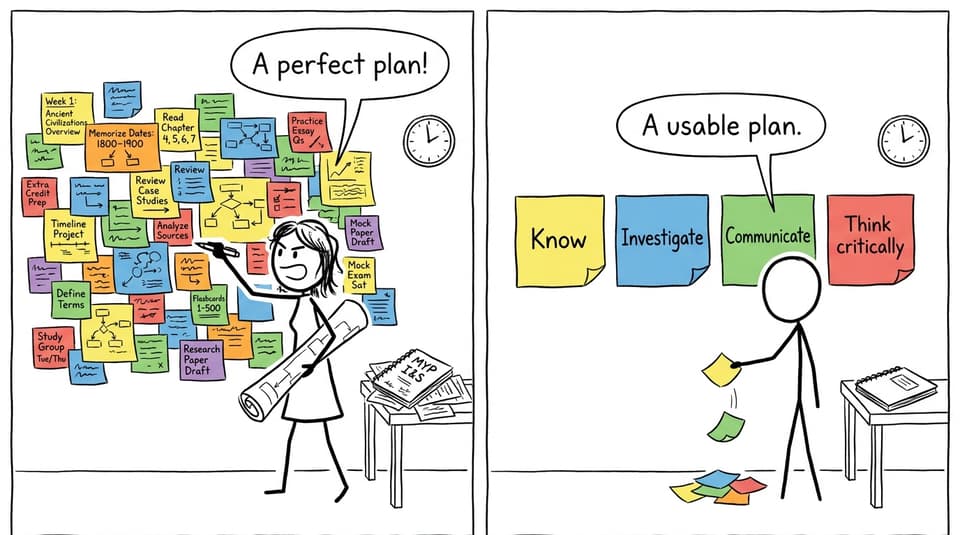
MYP Individuals and Societies can include history, geography, economics, politics, sociology, or integrated humanities, depending on the school. The IB framework emphasizes knowing and understanding, investigating, communicating, and thinking critically. A useful home routine therefore needs to develop more than factual recall.
For parents, the goal is not to become the teacher. It is to make starting easier, keep expectations proportionate, and help the child notice which kind of practice is needed next.
The weekly schedule at a glance
| Day | Time | Main purpose | Example activity |
|---|---|---|---|
| Monday or Tuesday | 25 minutes | Review knowledge | Recall key terms, concepts, and examples from the current unit |
| Wednesday or Thursday | 30 minutes | Practise one skill | Analyse a source, compare perspectives, or refine a research question |
| Weekend | 35 to 40 minutes | Apply and reflect | Plan or write one response, then review it against the relevant criterion |
| Before an assessment | One extra 30-minute session | Prepare specifically | Rehearse the required format and repair one identified weakness |
Keep at least one evening completely free. If homework already provides substantial practice, count it as one session rather than adding more work.
Why three short sessions are usually enough
The subject asks students to move between content and thinking. They may need to remember why migration occurs, interpret population data, compare accounts of an event, evaluate a source, and communicate a supported judgment. Cramming facts does not rehearse that whole process.
Short, separated sessions create a better rhythm. The first refreshes knowledge. The second makes the student use it. The third reveals whether that knowledge can support an argument independently.
Parents should begin by checking the school's current unit because MYP courses vary. RevisionDojo's guide to topics covered in MYP Individuals and Societies provides context, while the teacher's unit outline remains the authority for assigned content and deadlines.
What to do in each study session
Session one: retrieve, then check
Ask the student to spend 10 minutes writing or saying what they remember without opening a book. They might define five terms, explain one relationship, and recall one case study. Then they should check their materials and correct omissions.
The remaining time can use MYP Individuals and Societies Study Notes, subject cheatsheets, or Flashcards. The purpose is not to copy pages of notes. It is to find the gap between what felt familiar and what could actually be recalled.
A low-pressure parent question is: “Which idea became clearer today?”
Session two: practise one criterion-related skill
Choose one narrow task linked to current classwork:
- formulate or improve a focused research question
- distinguish a source's message from its purpose
- compare two perspectives
- explain a cause-and-effect relationship
- select evidence for a claim
- create a clear reference entry
The MYP Individuals and Societies criteria guide helps families understand why these activities matter. The four criteria are equally important within the framework, so memorizing vocabulary prepares students for only part of the subject.
RevisionDojo's Questionbank can provide targeted practice, while AI Chat can ask follow-up questions such as, “What evidence supports that conclusion?” Parents do not need to assign a level. They can ask the child to explain what changed after feedback.
Session three: produce something small
Application should end the week. That might mean planning an investigation, interpreting a graph, outlining an essay, or writing one analytical paragraph. One strong paragraph often teaches more than an unfinished full response.
For extended writing, use the MYP Individuals and Societies essay structure guide. A simple pattern is point, evidence, explanation, and connection to the question. Grading tools can highlight thin reasoning, but the student should decide which feedback to apply and rewrite the work themselves.
How to adjust the plan around assessments
A normal week should remain light. Seven to ten days before an assessment, add one session and make every activity match the actual task.
If the assessment is an investigation, focus on the question, action plan, source selection, and reflection. If it is source-based, practise interpreting and evaluating unfamiliar material. If it requires an argument, rehearse planning, evidence selection, counterarguments, and conclusions.
In MYP Years 4 or 5, timed practice may become more relevant, particularly where a school offers eAssessment. The 30-day MYP eAssessment study plan can help families scale preparation gradually. Mock Exams and appropriate Predicted Papers should come later, once knowledge and response structure are reasonably secure.
A low-pressure MYP Individuals and Societies parent guide
The most helpful parental actions are usually logistical:
- agree on three possible study windows rather than imposing fixed evenings
- break a large assignment into visible next actions
- protect sleep, meals, movement, and downtime
- ask what criterion or skill the task assesses
- encourage the child to contact the teacher when instructions remain unclear
- praise a specific process, such as revising a claim after checking evidence
Try a five-minute Sunday check-in: What is due? What feels uncertain? Which three sessions are realistic? Write down the plan, then stop discussing it unless circumstances change.
Avoid hovering beside the student, rewriting sentences, or checking the grade portal repeatedly. Independence develops when a young person makes manageable decisions with support nearby.
When the schedule is not working
Reduce the plan before abandoning it. A student avoiding 40-minute sessions may manage four 15-minute starts. Persistent difficulty can signal unclear content, weak organization, anxiety about writing, or uncertainty about assessment criteria.
RevisionDojo is the ultimate IB resource for turning vague difficulties into next steps. Students can move from Study Notes and Flashcards to Questionbank practice, then use AI Chat and Grading tools for feedback. Mock Exams, Predicted Papers, the Coursework Library, and Tutors provide deeper support when preparation calls for it. The RevisionDojo MYP Individuals and Societies review explains how these tools can form one connected study loop.
The best schedule is rarely impressive on paper. It is calm enough to repeat, flexible enough to survive a difficult week, and specific enough that a student always knows the next useful action. That turns parental support from pressure into steadiness.