


A realistic grade improvement goal for MYP Individuals and Societies is usually to raise your overall grade by one level across a term. To make that manageable, first improve your weakest assessment criterion by one achievement level over four to six weeks.
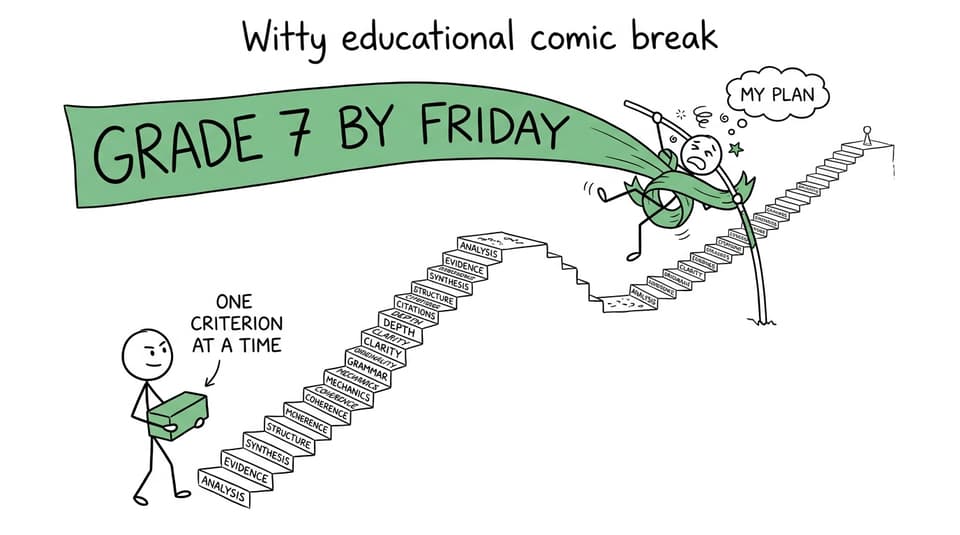
Sustainable improvement is rarely one dramatic leap. It is a collection of smaller changes: using evidence precisely, explaining connections clearly, or evaluating a source rather than describing it. The best goal is not simply “get a 7.” It is to produce visible evidence that your work matches the next criterion descriptor.
Your realistic goal at a glance
Use this checklist before setting your target:
- Review your last two or three comparable assessments.
- Record levels for Criteria A, B, C, and D.
- Identify one repeated weakness in teacher feedback.
- Target a one-level improvement within four to six weeks.
- Aim for one overall grade of improvement across a term.
- Measure progress through marked responses, not revision hours.
- Confirm the target with your teacher.
This approach matters because MYP Individuals and Societies assessment uses four criteria: Knowing and understanding, Investigating, Communicating, and Thinking critically. Each criterion is equally weighted and has eight possible achievement levels. Improvement becomes manageable when you know which part of your performance must change.
Why one grade over a term is realistic
An overall grade combines evidence from several skills. Knowing more facts can strengthen Criterion A, but it will not automatically improve how you investigate, communicate, or think critically. Trying to transform every criterion at once can leave you busy without making any weakness meaningfully stronger.
A one-grade target creates enough ambition to require better work while allowing time for feedback and repetition. If you currently earn a 4, aiming for a stable 5 across the term is normally more useful than demanding an immediate 7. Once your work consistently matches the next level, reset the target.
Four weeks may provide enough time to improve one recurring skill, such as source evaluation. A full term creates more opportunities to demonstrate progress across different tasks. Ask your teacher how your school determines reported grades before treating any numerical calculation as guaranteed.
Build the goal from criterion evidence
Create a simple record of your recent results:
| Evidence to record | Question to ask |
|---|---|
| Criterion levels | Which criterion is repeatedly lowest? |
| Teacher comments | Which instruction appears more than once? |
| Response quality | Where does my answer become descriptive? |
| Independence | Can I perform the skill without prompts? |
Suppose your Criterion D responses contain relevant knowledge but remain descriptive. “Improve Individuals and Societies” is too vague. A useful goal would be: Within five weeks, I will move Criterion D from a typical level 4 to level 5 by using evidence to explain relationships and address an alternative perspective in three independent responses.
This identifies the criterion, expected improvement, method, timeframe, and evidence. It also gives your teacher something concrete to review.
Choose the skill behind the number
Each criterion requires a different kind of practice.
Criterion A: Knowing and understanding
Build accurate vocabulary, concepts, and examples. Use MYP Individuals and Societies Study Notes, then close them and explain the idea from memory. Flashcards can strengthen recall, but finish by applying that knowledge to a question.
Criterion B: Investigating
Practise writing focused research questions, planning investigations, choosing appropriate methods, and evaluating the process. Do not judge an investigation by how much information you collected. Ask whether the evidence answered the research question.
Criterion C: Communicating
Work on structure, audience, purpose, terminology, and source documentation. Reorganize one older response so every paragraph has a clear function. Strong communication makes your reasoning visible.
Criterion D: Thinking critically
Move beyond stating facts. Explain causes, consequences, patterns, perspectives, and limitations. The RevisionDojo Individuals and Societies Questionbank lets you practise these skills with targeted prompts instead of rereading entire topics.
Use a weekly improvement loop
Try this cycle twice each week:
- Retrieve: Recall key terms and evidence without notes.
- Attempt: Complete one criterion-focused response independently.
- Check: Compare it with the descriptor and teacher feedback.
- Diagnose: Find the sentence or decision limiting the response.
- Rewrite: Improve the weakest section instead of restarting.
- Retest: Attempt a similar question several days later.
RevisionDojo works best when its tools form this connected cycle. Use Study Notes to repair understanding, Flashcards to retrieve terminology, and the Questionbank to apply it. Then use AI Chat to challenge an argument and Grading tools to identify thin evidence, structure, or evaluation.
Where available, Predicted Papers and Mock Exams can test timing and decision-making. The Coursework Library can clarify conventions without replacing your work, while Tutors can diagnose persistent difficulties. The guide to effective MYP revision can help turn these activities into a consistent schedule.
Protect your motivation with visible progress
Motivation weakens when the destination is distant and progress is invisible. A student who writes “get a 7” may work for weeks without knowing whether anything has changed. A student tracking one criterion can notice a clearer research question, stronger paragraph, or more independent recall.
To support MYP Individuals and Societies motivation, record one successful change after each session. It might be “used two perspectives accurately” or “explained how a source’s purpose affects its value.” Such observations reveal more than recording one hour of study.
Do not abandon the goal after one disappointing task. First ask whether the task assessed your target criterion and whether you used your planned strategy. One result is information; a repeated pattern is stronger evidence.
Build a practical improvement mindset
A useful MYP Individuals and Societies mindset does not assume effort automatically produces marks. It treats feedback as a diagnosis and chooses a precise action.
Replace “I am bad at source analysis” with “I identify origin and purpose, but I must explain how they create value and limitations.” The second statement leads to practice; the first turns a skill gap into an identity.
The RevisionDojo MYP Individuals and Societies resource hub connects notes, recall, questions, and feedback. Open your last two marked tasks, circle the lowest repeated criterion, and translate one teacher comment into a four-to-six-week goal. One criterion level is the first target. One overall grade across the term is the larger target. RevisionDojo helps connect them through deliberate, measurable practice.