

A realistic grade improvement goal for MYP English Language and Literature is usually one overall grade over a term, or roughly 2 to 4 additional criterion points over 8 to 12 weeks. This is a planning target, not a guarantee. Your starting level, assessment schedule, attendance, feedback, and remaining opportunities to demonstrate each criterion all affect what is possible.
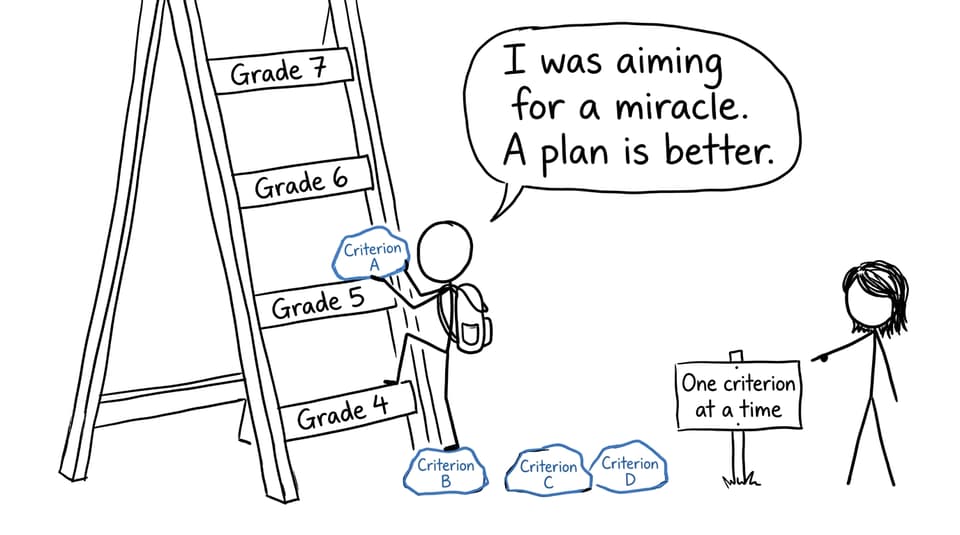
The most useful goal is often more precise: improve one weak criterion by one achievement band while maintaining your stronger areas. A student currently receiving 4s in Criterion A, for example, might aim to produce consistent evidence in the 5-6 band before focusing on an overall grade of 7.
Grades are outcomes. Skills are the levers that move them.
A realistic goal at a glance
Use this checklist to choose your target:
- Review your latest results for Criteria A, B, C, and D.
- Identify the lowest criterion or most repeated teacher comment.
- Check how many assessed tasks remain.
- Set an 8-12 week target of 2 to 4 additional criterion points.
- Define one visible skill that could produce that improvement.
- Practise it twice weekly and complete a feedback-based rewrite.
- Review progress after two assessed pieces, not every paragraph.
If you currently have an overall grade 4, moving securely toward a 5 is normally more useful than declaring that every future task must receive a 7. A worthwhile target should tell you what to do on Tuesday afternoon.
Understand what your MYP English grade measures
MYP Language and Literature uses four equally weighted criteria:
- Criterion A: Analysing
- Criterion B: Organizing
- Criterion C: Producing text
- Criterion D: Using language
Each criterion has a maximum achievement level of 8. The four final levels combine into a total out of 32, which can be converted into an overall grade from 1 to 7. Teachers apply best-fit judgments against the relevant descriptors rather than treating every task as a percentage test.
RevisionDojo’s guide to the MYP Language and Literature assessment criteria explains what each criterion rewards. You can also review the MYP Language and Literature curriculum expectations before setting your target.
This structure means you may not need to transform your entire performance to raise your final grade. If your total is close to the next boundary, sustained improvement in one criterion may be enough. If you are near the bottom of your current range, improvement across several criteria may be necessary.
Ask your teacher for your current criterion profile and the task-specific clarifications used at your school. Without that information, an overall target is partly guesswork.
Choose a target based on your starting point
A student averaging 3-4 faces a different challenge from one producing consistent 6s. The first may need clearer structure and fuller explanations. The second may need greater precision, sophistication, and independence.
| Current pattern | Practical next goal | Main focus |
|---|---|---|
| Mostly 2s and 3s | Reach consistent 3-4 performance | Complete tasks, support ideas, and use clear structure |
| Mostly 4s | Move one criterion into 5-6 | Develop explanations beyond description |
| Mostly 5s | Make 5-6 performance consistent | Improve precision, control, and audience awareness |
| Mostly 6s | Produce occasional 7-8 work | Add perceptive analysis and deliberate choices |
| Mixed results | Reduce variation | Diagnose changes between task types |
These are planning directions, not official predictions. Year level also matters because expectations become progressively more demanding through the MYP.
Separate your stretch goal from your working goal. Your stretch goal might be an overall 6. Your working goal could be: “Over six weeks, I will move Criterion A from approximately 4 to consistent 5-6 evidence by explaining the effect and purpose of each authorial choice.” The working goal gives you something concrete to practise.
Turn the grade target into a skill goal
Choose one improvement that can be seen in your work:
- Criterion A: progress from naming techniques to explaining choice, effect, and purpose.
- Criterion B: make every paragraph advance one clear line of argument.
- Criterion C: make stylistic decisions suited to audience and purpose.
- Criterion D: reduce recurring errors while using precise, varied language.
If analysis is your weakness, read How to Improve Analysis Skills in MYP English. A useful paragraph sequence is claim, evidence, authorial choice, effect, purpose, link. RevisionDojo’s claim and counterclaim notes can also help you build interpretations that are arguable rather than descriptive.
Do not choose five goals simultaneously. Attention behaves like a spotlight: widen it too far and everything becomes dimmer.
Build a repeatable improvement cycle
A productive MYP English Language and Literature mindset treats feedback as information, not a verdict. “Your analysis is too descriptive” means your next draft needs a clearer explanation of how a writer’s choice shapes meaning or audience response.
Try this weekly cycle:
- Read one targeted explanation in the MYP English Language and Literature Study Notes.
- Complete two 12-minute paragraph drills.
- Compare each response with the relevant descriptor.
- Request feedback on your selected skill.
- Rewrite the weakest paragraph within 48 hours.
- Record one rule for your next attempt.
RevisionDojo brings this cycle together. Study Notes and Flashcards clarify techniques and terminology. The Questionbank supplies focused practice, while AI Chat can unpack difficult concepts. Grading tools offer rubric-aligned feedback, and Mock Exams or Predicted Papers support timed rehearsal when appropriate. The Coursework Library provides structural models, while Tutors can diagnose problems that repeated independent practice has not solved.
For a broader routine, explore these MYP Language and Literature revision strategies.
Avoid goals that weaken motivation
“Get a 7 next time” gives you a destination without a route. A task may assess only certain criteria, and results can change with the text type, timing, or interpretation of the prompt.
Avoid comparison-based goals too. Another student’s level reveals little about your most useful next step. MYP assessment is criterion-related, so compare your work with the descriptor. One carefully improved paragraph can also teach more than a complete response that you never review.
Open your latest assessed task and record the available criterion levels. Circle the weakest one and copy the most important teacher comment beside it. Then complete this sentence:
Over the next eight weeks, I will improve Criterion ___ from approximately ___ to consistent ___ performance by practising ___ twice each week and rewriting one response after feedback.
A realistic goal is not a smaller dream. It is a dream divided into repeatable actions. RevisionDojo gives you the notes, practice, feedback, recall tools, coursework guidance, and tutoring needed to take the next one.