

Moving into the Diploma Programme can unsettle even a capable, organized MYP student. The concern many parents feel is reasonable: the child who seemed comfortable last year may suddenly face denser content, unfamiliar assessment formats, and several long-term responsibilities at once.
The clearest way to help is not to take control of the programme. It is to help your child understand what has changed, establish a sustainable weekly system, and ask for support before small difficulties become serious ones. A successful MYP to DP transition is less about studying all summer and more about replacing uncertainty with structure.
MYP students are not beginning from zero. Their experience with inquiry, reflection, command terms, interdisciplinary thinking, and criterion-related feedback gives them a useful foundation. The challenge is learning to apply those habits within the more demanding and assessment-focused structure of the DP.
A quick transition checklist for parents
Before DP1 gathers momentum, help your child:
- confirm all six subjects and Higher Level or Standard Level choices
- check potential university prerequisites before finalizing subjects
- understand Theory of Knowledge, the Extended Essay, and CAS
- collect school deadlines in one calendar
- create a realistic weekly study routine
- learn how each subject is assessed
- begin active recall and question practice early
- protect sleep, exercise, friendships, and genuine downtime
- identify whom to contact when academic or emotional support is needed
These actions look simple. That is their strength. The DP is usually made manageable through ordinary systems repeated consistently, not dramatic bursts of effort.
Understand what changes between MYP and DP
The MYP and DP share an educational philosophy, but they are not interchangeable programmes. The MYP emphasizes conceptual learning across a broad curriculum. Teachers assess subject objectives using prescribed criteria, while external MYP eAssessment beyond the personal project is optional for schools.
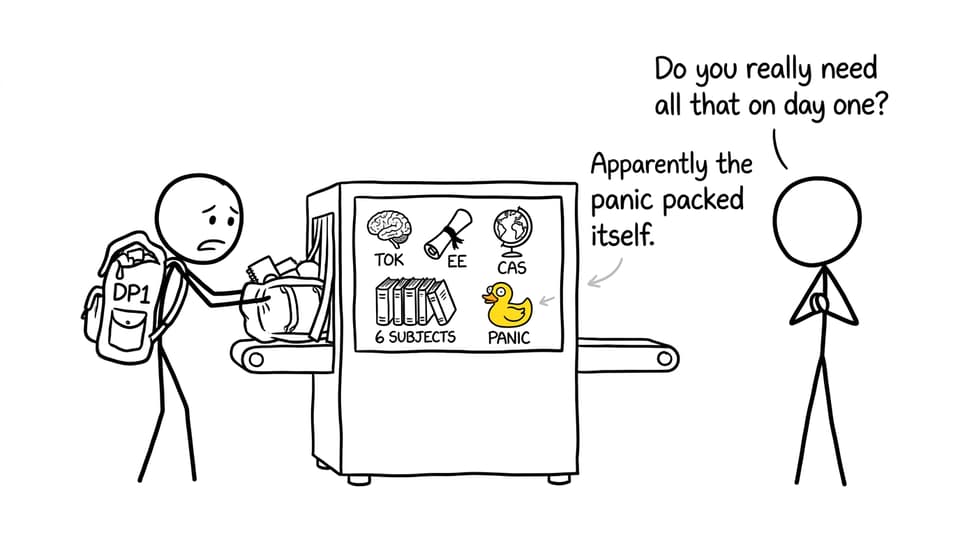
The DP is a two-year programme for students aged 16 to 19. Full diploma students study six subjects alongside three core elements: Theory of Knowledge, the Extended Essay, and Creativity, Activity, Service. Students normally take three subjects at Higher Level and three at Standard Level, although four Higher Level subjects are permitted.
Higher Level courses are not simply given a more impressive name. The IB recommends 240 teaching hours for HL courses and 150 for SL courses. That difference affects depth, syllabus coverage, and the amount of material a student must manage.
DP assessment also brings a sharper focus on performance under defined conditions. Most subjects combine examinations with internally or externally assessed work. Students must retain knowledge, apply methods, interpret unfamiliar material, construct arguments, and respond precisely to command terms. The comparison of MYP and the Diploma Programme offers a useful starting point, while how the MYP prepares students for DP explains which existing habits remain valuable.
The important message for your child is reassuring: the skills still matter, but the standard and context have changed.
Make subject choices with the future in view
Subject selection is one of the few early decisions that can shape both workload and university options. It should reflect three things: genuine interest, demonstrated strength, and possible entry requirements for future degrees.
A student considering engineering, medicine, economics, or another prerequisite-heavy route should check current university requirements in the relevant countries. Requirements vary by institution and course, so assumptions based on another student’s combination are unsafe. The school’s DP coordinator or university adviser should be involved before choices become difficult to change.
Parents can help by asking calm questions:
- Which subjects does the school actually offer?
- Does the timetable restrict certain combinations?
- Which courses are your strongest candidates for HL?
- Are any specific subjects or levels required for degrees you may consider?
- What is the school’s deadline for changing a subject or level?
Avoid treating HL choices as a measure of intelligence. The better question is whether the complete combination is coherent and sustainable. RevisionDojo’s guide to choosing IB Higher Level subjects wisely and its list of pre-IB questions every student should ask can make the family discussion more concrete.
Build one calendar before building a study plan
DP workload often feels overwhelming because several kinds of work coexist. A student may have routine homework, an upcoming test, internal assessment preparation, CAS commitments, and an Extended Essay milestone occupying the same mental space.
Begin with visibility. Ask your child to place known school deadlines, examinations, activities, holidays, and personal commitments in one calendar. Then break major assignments into smaller checkpoints such as selecting a question, finding initial sources, drafting an outline, and requesting feedback.
The parent’s role is to help create the system, not quietly become its full-time manager. A short weekly check-in is usually more constructive than daily interrogation. Three questions are enough:
- What matters most this week?
- Is anything blocked or unclear?
- What support would be useful?
A workable schedule should contain focused study blocks, short recall sessions, buffer time, and rest. It should also change when the evidence changes. If chemistry requires more attention after a test, the calendar should respond. If an essay has reached the drafting stage, its time allocation should increase temporarily. The balanced IB study schedule provides a practical model without pretending every student needs the same routine.
Help your child study for DP assessment, not just for class
One of the biggest adjustments in IB Year 1 is recognizing that understanding a lesson and producing a high-quality assessed response are different skills. A student can know a topic but lose marks by misreading a command term, omitting working, giving unsupported analysis, or managing time poorly.
Encourage a simple learning loop:
- Learn one clearly defined topic.
- Recall the main ideas without looking at notes.
- Answer relevant exam-style questions.
- Compare the response with the expected method or criteria.
- Record the cause of each mistake.
- Repeat a similar task after a delay.
The error record matters. “Got it wrong” is not a useful diagnosis. “Confused two definitions,” “did not answer the command term,” and “spent too long on the opening section” each suggest a different remedy.
Timed work should be introduced gradually. Short sets can build accuracy and pacing without turning every evening into a full simulation. As confidence grows, students can move toward longer sections and Mock Exams. The step-by-step guide to studying for IB exams explains how to progress from learning to recall, application, and timed performance.
Support independence without disappearing
DP students need ownership, but independence does not mean isolation. A useful parent stands nearby without constantly reaching for the steering wheel.
Agree on what your child wants you to notice. It might be missed deadlines, repeated late nights, avoidance of one subject, or a calendar that has stopped being updated. Discuss in advance when you should simply listen and when it would be appropriate to contact a teacher, coordinator, counsellor, or other member of the school support team.
Try to keep conversations focused on process rather than identity. A disappointing mark is information about one performance. It is not proof that the student is unsuited to the IB. Ask what happened, what feedback was given, and what the next attempt will look like.
Academic integrity deserves similar attention. The DP requires students to work responsibly, acknowledge sources, and follow school and IB rules when producing assessed work. Parents can support good practice by encouraging early planning and consistent source records. They should not rewrite, over-edit, or direct work that must remain the student’s own.
Watch the pattern, not one difficult week
Busy periods are part of the programme. One tiring week does not automatically indicate a failed transition. Look instead for patterns: persistent sleep loss, repeated deadline crises, prolonged withdrawal, ongoing distress, or a sustained decline across several subjects.
If a pattern appears, begin with curiosity rather than judgment. The underlying issue may be an unrealistic schedule, a subject mismatch, unclear assessment expectations, perfectionism, difficulty concentrating, or something unrelated to school. The correct response depends on the cause.
Encourage your child to speak with the relevant teacher early. The DP coordinator can clarify programme requirements and school procedures, while counsellors or appropriate health professionals should be involved when wellbeing concerns extend beyond ordinary academic support. Seeking help early is not a failure of independence. It is one of the skills independent learners need.
Use DP-specific resources to bridge the assessment gap
The jump in assessment rigor from MYP to DP becomes easier when students can see what DP-level learning and responses require. General revision may improve familiarity, but DP-specific practice connects knowledge to syllabus expectations, command terms, marking logic, and time pressure.
This is where RevisionDojo can bridge the gap immediately. A student can use Study Notes to clarify a topic, Flashcards to strengthen retrieval, and the RevisionDojo Questionbank to practise applying that knowledge. AI Chat can help resolve focused questions, while Grading tools and the Coursework Library support feedback and stronger understanding of assessment criteria.
Later, Predicted Papers and Mock Exams can develop timing and stamina. If a student needs more individualized guidance, Tutors can add human explanation and accountability. The aim is not to use every feature at once. It is to choose the next tool that solves the next problem.
Parents can explore RevisionDojo’s IB support for families, but the student should remain in charge of the daily work. The platform is most useful when it strengthens independence rather than replacing it.
A calmer beginning to the Diploma Programme
The best preparation for DP1 is not a household organized around constant academic pressure. It is a child who understands the programme, has chosen subjects thoughtfully, knows how to plan a week, and feels safe admitting when something is difficult.
Begin with one conversation and one calendar. Review the subject combination. Identify the first deadlines. Agree on a weekly check-in and let your child explain what kind of support feels helpful.
Then allow the routine to become ordinary. Progress in the Diploma Programme is rarely one grand act of preparation. It is a series of small, informed decisions repeated long enough to become a system. With school guidance, steady parental support, and DP-specific resources from RevisionDojo, the step from MYP into the Diploma Programme can feel less like a cliff and more like the next stage of a journey your child already knows how to begin.