


The MYP English Language and Literature homework amount is usually manageable, but there is no universal IB rule prescribing a certain number of minutes each night. As a practical starting point, families might expect roughly 30 to 60 minutes a week, plus independent reading. Older students, slower readers, and students approaching a major assessment may need longer.
That range is a guide, not a promise. Individual schools set homework policies, and English work rarely arrives evenly. A quiet week of reading may be followed by analytical writing, a creative piece, oral preparation, or draft revision.
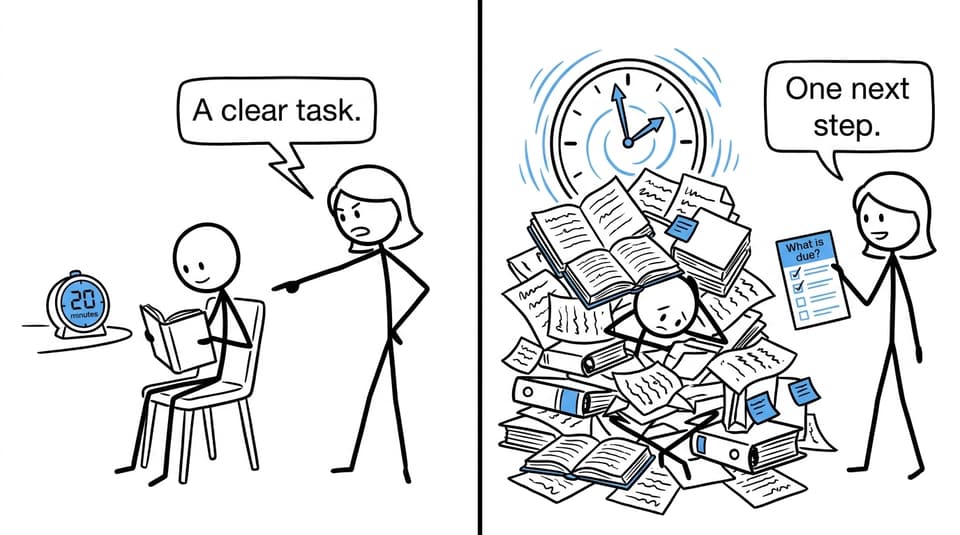
For parents, the useful question is not simply, "How long should this take?" It is, "Does the task have a clear purpose, a reasonable boundary, and an identifiable next step?"
A quick parent overview
A typical week may include:
- reading a novel, play, poem, or non-literary text;
- annotating language, structure, imagery, tone, or persuasive choices;
- planning or writing an analytical paragraph;
- producing creative, persuasive, or reflective writing;
- revising work after feedback;
- preparing for a presentation or assessment;
- reviewing literary and rhetorical terminology.
If the work regularly takes several hours, the assigned volume may be excessive. However, the cause might instead be unclear instructions, perfectionism, distraction, reading difficulty, or uncertainty about assessment criteria. Each possibility needs a different response.
What is a typical weekly amount?
The IB defines the MYP curriculum and assessment framework, but individual schools decide how homework supports classroom learning. The programme's guided teaching-hour expectations should not be confused with homework quotas.
One published 2025-26 handbook from an IB World School suggests approximately 30 minutes per subject each week for its youngest secondary students, rising to around 60 minutes for older students. It permits additional reading time for language subjects. This illustrates one school's expectations, not an official worldwide requirement.
| Situation | Reasonable planning expectation |
|---|---|
| Ordinary week | Around 30-60 minutes, divided across several sessions if helpful |
| Independent reading | An additional 15-30 minutes on several days |
| Assessment week | One or two longer focused sessions may be needed |
| Presentation preparation | Short planning, rehearsal, and refinement sessions |
| Consistently heavy week | Review the task, routine, and school expectations |
Reading speed matters. A familiar novel may feel straightforward, while a shorter Shakespearean scene, poem, advertisement, or speech can demand slower analysis. Time alone does not measure difficulty.
Why the workload rises and falls
MYP English Language and Literature develops listening, speaking, reading, writing, viewing, and presenting. Assessed work is organized around four criteria: Analysing, Organizing, Producing Text, and Using Language. The MYP assessment criteria guide explains these categories in practice.
Different skills require different preparation. Reading can be distributed across a week, while writing may be drafted in stages. Presentations create short bursts of rehearsal, and teacher feedback can produce additional revision.
Variation is usually healthy when deadlines are visible and tasks have clear limits. It becomes concerning when every assignment expands to occupy the entire evening.
Is the homework amount genuinely excessive?
Observe the pattern for two weeks rather than judging one difficult night. Record the assigned task, approximate focused time, interruptions, and the point where your child became stuck.
Look more closely if your child:
- regularly spends more than 60-90 focused minutes on one ordinary task;
- cannot explain what the finished product should include;
- repeatedly sacrifices sleep or other subjects;
- rewrites acceptable work because it never feels finished;
- rereads passages without understanding them;
- frequently submits incomplete or late work;
- shows persistent distress before beginning.
A student taking two hours because notifications interrupt them has a routine problem. A student taking two hours because they cannot understand the text may need instructional support. Someone polishing every sentence may need permission to stop. The clock identifies a symptom; conversation helps uncover the cause.
Supporting a child without taking over
The best support is often quiet structure. RevisionDojo's guide to calmer MYP homework routines recommends predictable routines, smaller starting steps, and questions that preserve student ownership.
Hold one short weekly planning conversation. Ask what is due, what has started, and what remains unclear. The broader guide to supporting a child in the MYP offers prompts that do not turn parents into project managers.
Define a stopping point, such as a focused 25- or 40-minute block. Afterwards, your child can continue, schedule another session, or prepare a question for the teacher. A boundary prevents effort from becoming endless.
Useful coaching questions include:
- "What is the command term asking you to do?"
- "Which criterion is being assessed?"
- "What is the smallest useful first step?"
- "What evidence supports your interpretation?"
Avoid rewriting sentences or supplying interpretations. RevisionDojo's guidance on appropriate parent involvement in MYP coursework draws a helpful boundary: parents can provide structure and questions, but academic decisions should remain with the student.
Use resources to resolve confusion
Homework often stretches because a student does not remember what "analyse" requires, how to structure a paragraph, or how tone differs from mood.
The RevisionDojo MYP English Language and Literature hub provides one place to address those gaps. Study Notes clarify skills, Flashcards reinforce terminology, and the Questionbank supports focused practice. AI Chat can provide an explanation, while Grading tools can identify areas for improvement.
The healthy sequence is attempt, seek a hint, close the tool, and continue independently. AI should not produce submission-ready writing. Finishing faster through copying saves minutes but removes the learning the task was designed to create. Students can also explore MYP English revision strategies and compare websites for MYP English Language and Literature.
When to contact the teacher
Contact the teacher when difficulties persist despite a calm routine. Share observations: the task, focused working time, where your child became stuck, and whether the pattern is recurring.
Ask how long the teacher expected the task to take, whether the student is completing unnecessary work, and which criterion deserves priority. The aim is not to remove worthwhile challenge. It is to keep that challenge visible and proportionate.
A calmer measure of progress
Healthy MYP English homework should build independence. Over time, students should become better able to interpret instructions, plan responses, use evidence, revise selectively, and recognize when work meets its purpose.
RevisionDojo supports that journey through Study Notes, Flashcards, Questionbank practice, AI Chat, Grading tools, Mock Exams, appropriate Predicted Papers, a Coursework Library, and Tutors. The goal is not to fill more hours. It is to help each hour produce clearer, more independent learning.