
For IB students sitting exams in May 2028 (started DP1 in August 2026).
The most costly mistakes May 2028 IB students make in DP1 are relying on passive revision, delaying exam-style practice, ignoring small knowledge gaps, and postponing coursework until deadlines become urgent. The fix is to build a weekly system that combines retrieval, targeted questions, mistake analysis, steady coursework progress, and realistic rest.
DP1 can feel forgiving because the final examinations still seem distant. Yet the habits built now quietly compound. A misunderstood topic becomes a weak unit; a weak unit makes later material harder; eventually, revision becomes an attempt to reconstruct two years of learning at once.
The aim is not to behave like an examination candidate from the first week. It is to leave DP1 with knowledge you can retrieve, evidence of what needs improvement, and coursework that has moved beyond good intentions.
The DP1 mistakes checklist
Watch for these warning signs:
- Notes are growing, but you rarely answer questions without them.
- You study what feels comfortable rather than what evidence shows is weak.
- Exam-style questions are being saved for the distant future.
- Internal deadlines live in different apps, notebooks, and message threads.
- CAS reflections and evidence are being reconstructed long after activities.
- Extended Essay ideas remain broad because choosing feels risky.
- Sleep and recovery are treated as spare time.
- You wait until confusion becomes serious before asking for help.
These are not character flaws. They are system flaws, and systems can be redesigned.
Mistake: confusing recognition with understanding
Rereading a highlighted page creates familiarity. Familiarity feels like progress because the material looks understandable while it is visible. The real test comes when the page is closed.
After studying a concept, try to explain it from memory, answer a short question, or reconstruct the process on blank paper. If you cannot, the session has identified what to learn next. That is useful information, not failure.
A strong sequence is simple:
- Learn the concept using concise notes or a teacher explanation.
- Close the resource and retrieve the main ideas.
- Apply them to an unfamiliar question.
- Check the answer and record the precise error.
- Return to the same weakness after a delay.
RevisionDojo supports this progression through Study Notes, Flashcards, and the Questionbank. The goal is not to use every tool in every session. It is to choose the tool that matches the stage of learning. The guide to starting DP1 strongly with RevisionDojo explains how these resources can form one connected routine.
Mistake: waiting too long to practise IB questions
Some students believe they must finish the syllabus before attempting exam-style questions. That sounds logical, but it delays an essential skill: learning how the IB asks you to use knowledge.
You do not need to complete full timed papers in early DP1. Start with short, topic-specific sets. Focus on command terms, the depth expected, and the difference between knowing a fact and constructing a creditworthy response.
Questions do not need to repeat word for word to be useful. Concepts, reasoning demands, and question families can recur in new settings. The explanation of whether IB exam questions repeat shows why memorising individual responses is weaker than understanding the structure beneath them.
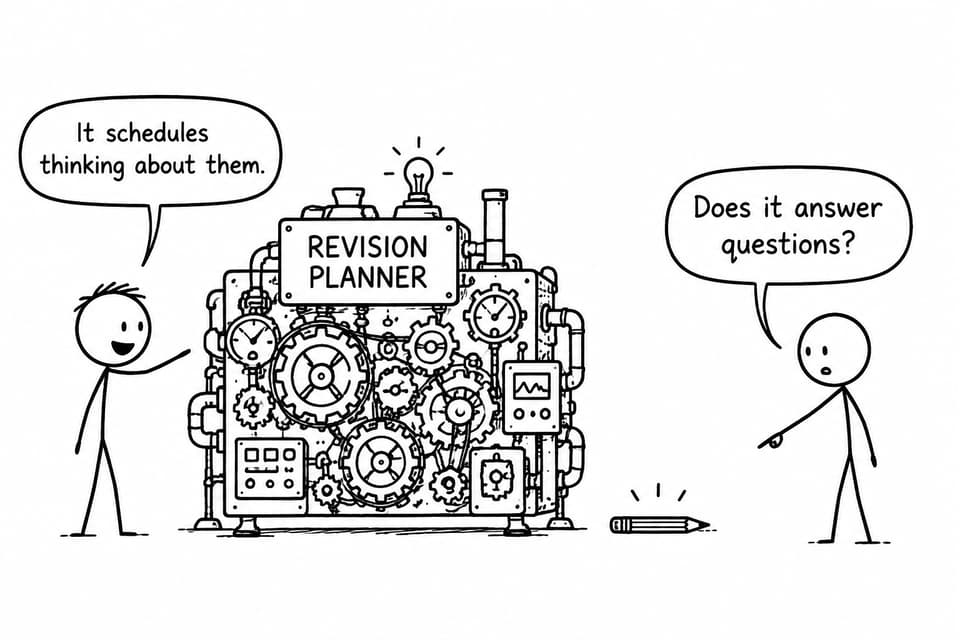
A useful weekly pattern is one small Questionbank set per subject currently being taught. Keep it low stakes. In DP1, the purpose is diagnosis before performance.
Mistake: recording scores instead of studying errors
A score tells you what happened. An error log helps explain why.
When checking a question, label the cause of each lost mark. Useful categories include:
| Error type | Practical response |
|---|---|
| Knowledge gap | Relearn the exact concept, then retrieve it later |
| Misread command term | Rewrite the task in your own words before answering |
| Weak application | Practise the same concept in a different context |
| Missing working or evidence | Study what a complete response must show |
| Timing problem | Repeat a short set with a realistic limit |
| Careless execution | Create a final checking routine |
This prevents the vague conclusion that you are simply “bad” at a subject. A student who repeatedly misreads command terms needs a different solution from one who cannot recall the underlying content.
Use RevisionDojo’s Grading tools to obtain structured feedback, then verify expectations against teacher guidance and the materials prescribed by your school. AI Chat can help unpack a difficult explanation, but it should support your thinking rather than replace it.
Mistake: treating the syllabus as background information
DP subjects reward specific knowledge and skills. If you revise from whatever appears in a general textbook, video feed, or search result, you may spend time on interesting material that does not match your course.
Make the subject guide and your teacher’s course plan part of your organisation. Track what has been taught, what you can explain, what you can apply, and what still needs attention. Because IB courses can be updated, May 2028 students should confirm the applicable subject requirements with their coordinator rather than relying on advice written for an older cohort.
Quality matters more than volume. Free IB revision resources are most useful when they are syllabus-aligned, accurate, and connected to active practice.
For mathematics, this means remembering definitions and methods while also applying them. RevisionDojo’s guide to combining mathematics practice with active recall offers a model that can be adapted to other problem-solving subjects.
Mistake: postponing coursework and the Extended Essay
Large assignments become stressful partly because their uncertainty remains unresolved. “Work on the Extended Essay” is too broad to begin. “Compare two possible research questions and identify the evidence each would require” is concrete.
The May 2028 cohort falls under the Extended Essay model first assessed in 2027. Follow the current official guidance supplied by your school, including its assessment criteria, reflection requirements, supervision process, and academic integrity expectations.
Break long projects into visible stages: topic exploration, question development, source collection, method, outline, drafting, feedback, revision, citations, and final checks. Use the Coursework Library to understand possible structures and standards, never to copy wording or substitute another student’s work for your own.
AI use also requires care. The IB allows schools and students to engage with AI tools within academic integrity rules, but generated material must not be presented as authentic personal work. Follow your school’s current instructions on acknowledgement and permitted assistance. If uncertain, ask before submitting.
Mistake: allowing CAS evidence to accumulate later
CAS is an ongoing part of the Diploma Programme, not a folder to reconstruct near the end. Waiting creates two problems: details fade, and reflections become generic.
After a meaningful activity, capture the evidence and write a brief reflection while the decisions, difficulties, and learning remain clear. Reflection does not need to exaggerate transformation. It should honestly explain what happened, what you contributed, what changed, and what you might do differently.
Maintain one reliable system and review it regularly with your CAS adviser. Your school determines its process and deadlines, so local guidance should take priority over generic online checklists.
Mistake: building a plan that only works on perfect weeks
The strongest timetable is not the most ambitious one. It is the one that survives ordinary fatigue, school events, illness, and competing deadlines.
Plan a minimum viable week. That might include short retrieval sessions, one targeted question set for each current topic, a coursework block, and protected recovery. Add more when capacity allows. Do not make an overloaded schedule the baseline and then interpret every disruption as failure.
If you already feel behind, reduce the scope before increasing the hours. Identify the highest-impact gap, practise it, and reassess. The guide to studying when you feel behind provides a calm triage process, while studying without burning out explains how to make consistency more sustainable.
Mistake: waiting too long to ask for help
Confusion becomes expensive when it remains hidden. Ask focused questions early: identify the step you understand, the point where the reasoning breaks, and what you have already tried.
RevisionDojo’s Tutors can provide individual support when a concept or response pattern needs deeper attention. Later in the programme, Predicted Papers and Mock Exams can help integrate topics under realistic conditions. In DP1, however, targeted practice usually offers more value than repeatedly testing content you have not yet studied.
The advantage of starting early is not that you must work constantly. It is that small corrections still have time to compound.
Build evidence, not anxiety
The best DP1 students are not necessarily those who create the longest notes or study for the greatest number of hours. They build feedback loops. They learn, retrieve, apply, check, and adjust.
RevisionDojo brings that loop together through Questionbank practice, Study Notes, Flashcards, AI Chat, Grading tools, Predicted Papers, Mock Exams, the Coursework Library, and Tutors. Each tool has a different purpose, but all should lead toward the same outcome: clearer evidence of what you know and what to do next.
Today, choose one topic taught this week and complete five closed-book questions in RevisionDojo’s Questionbank.