
Do IB exams repeat questions? (Real answer)
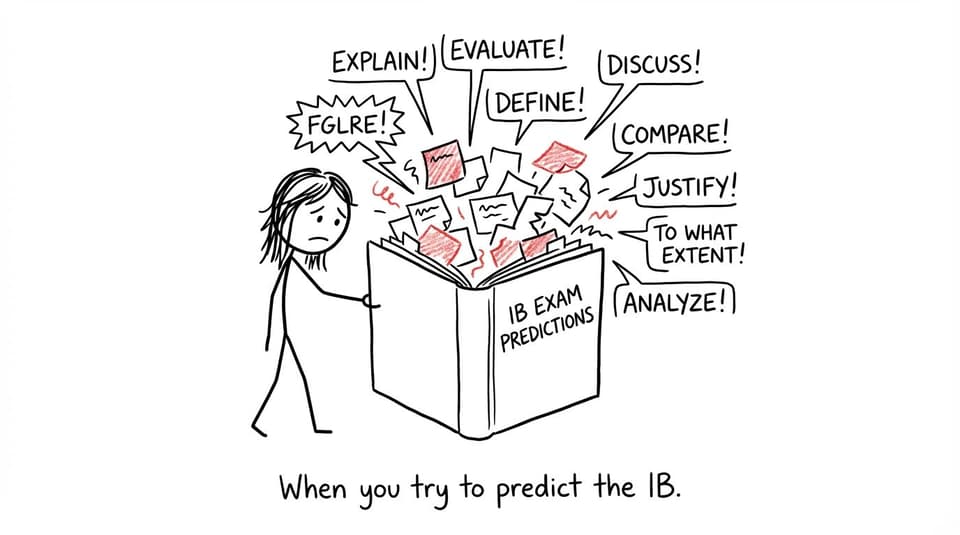
The night before an IB exam, your brain starts bargaining.
It sounds like: If I can just find the "repeated questions," I can relax. You scroll, you screenshot, you build a tiny shrine of "likely questions." For a moment, it feels like control.
Then reality shows up in the exam hall: the question looks similar but not identical. The wording has shifted. The context is unfamiliar. The mark allocation nudges you toward a different line of reasoning. And suddenly the thing you memorized feels like it belongs to a different universe.
So do IB exams repeat questions?
Not in the way students hope.
But yes in the way high scorers quietly exploit.
The short checklist (save this before you keep reading)
If you want a practical IB answer without the drama, use this checklist:
- Assume IB exams repeat skills and patterns, not exact prompts.
- Track recurring question types (data response, explanation, evaluation, method, essay structure).
- Build a "mistake log" of what you miss repeatedly (command terms, definitions, setup, units, structure).
- Train with exam-style questions by topic and difficulty using a Questionbank.
- Do weekly timed practice with Mock Exams to build pacing.
- Use Predicted Papers for realism, not fortune telling.
- Use Flashcards for definitions, processes, and command terms.
- Use AI Chat to get unstuck fast, then immediately test again.
If you want a full revision system built around that loop, start with How to Study for IB Exams: Step-by-Step Guide.
What "repeat" actually means in IB
When students ask if IB exams repeat questions, they usually mean one thing: Will the exact same question show up again?
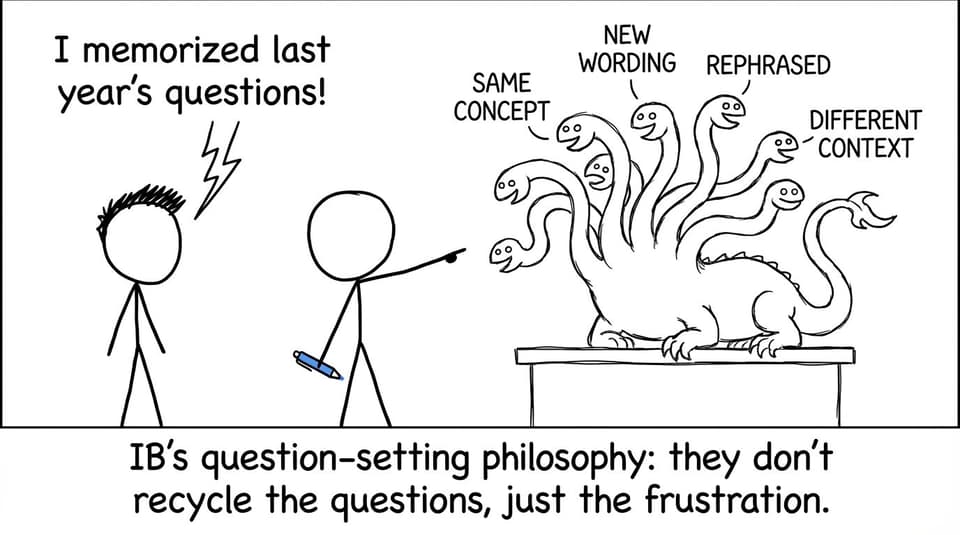
In most subjects, that is uncommon. But IB is consistent in a different way: it repeats the underlying demands.
Think of an IB exam like a musician's audition. The song changes. The chords are familiar.
Three kinds of repetition matter:
Repetition type 1: the concept repeats
A core syllabus idea returns because it's foundational. In IB, that's not a trick; it's the curriculum doing its job.
What changes is the wrapper: a new data set, a different case study, a fresh context, an unfamiliar diagram.
Repetition type 2: the skill repeats
The IB loves reusable skills:
- interpreting data
- structuring explanations
- evaluating limitations
- justifying a method
- building an argument with evidence
- using command terms properly
That's why students who train skills do better than students who collect content.
Repetition type 3: the mark scheme repeats
This is the secret.
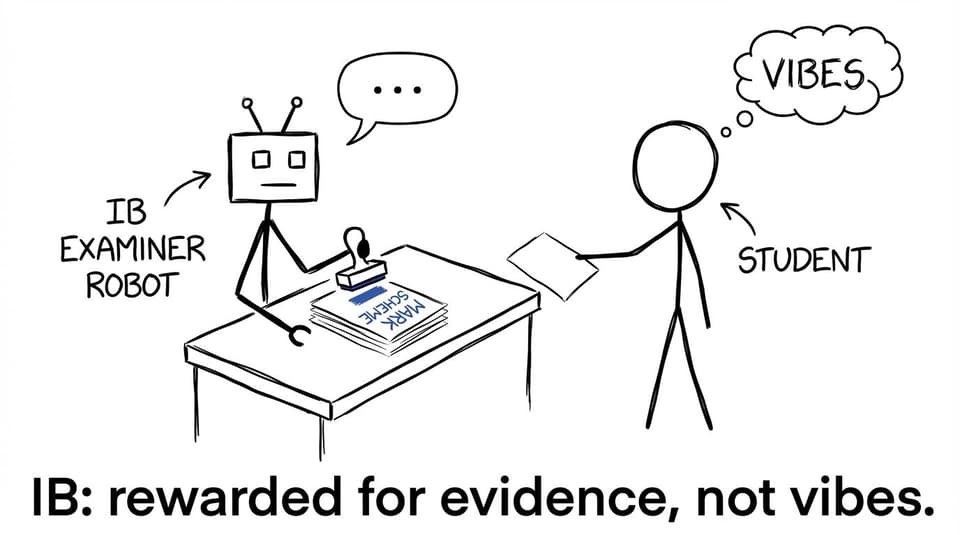
Even when the question looks new, the mark scheme often rewards the same behaviors: precise definitions, correct steps, clear links, balanced evaluation, appropriate examples, and the right depth for the marks.
That's why RevisionDojo leans so heavily into mark-scheme-aligned practice: Questionbank for targeted drills, then timed practice using mock-style workflows.
Why IB doesn't want to repeat exact questions (and why that helps you)
It's tempting to imagine an IB examiner with a folder labeled "REUSE THESE." But an exam that repeats too literally becomes a memory contest. And the IB is not trying to reward the student with the best screenshot collection.
Instead, the program tries to measure:
- understanding you can transfer
- reasoning you can do under pressure
- accuracy with the language of the subject
- clarity of structure
That's also why "predicting" exact IB questions is a fragile strategy. It can work once, by luck. It rarely scales.
A stronger strategy is boring but powerful: practice until the exam feels like a familiar genre.
If you need help building that familiarity, use a planning framework like Countdown to IB Exams: A Guide to Effective Studying or the more detailed How to Revise for IB Exams: A Month-by-Month Revision Plan.
The pattern you should look for: "question families"
Here's a useful way to think about repetition in IB exams: questions come in families.
A family is not an identical prompt. It's a familiar demand wearing different clothes.
Examples of question families (across many IB subjects):
- Explain/Describe a process clearly (with the right terms)
- Apply a model to a new scenario
- Analyze a source/data set and extract meaning
- Evaluate two viewpoints with evidence
- Discuss with balance and conclusion
- Method/Design questions: variables, controls, reliability, limitations
If you train by families, you stop panicking about novelty. Novelty becomes just a new costume.
RevisionDojo is designed around this: Study Notes for clarity, Flashcards for recall, and Questionbank filters for targeted family practice. Then you pressure-test everything with Mock Exams and Predicted Papers.
To see the bigger all-in-one workflow, read RevisionDojo App: The Smarter Way to Prep for IB Exams.
The "repeat trap" that loses marks
The most dangerous moment in an IB exam is when you recognize something and relax too early.
You see a familiar topic and think: Great, I know this. Then you write what you memorized, not what the question asked.
The IB punishes that gently and consistently:
- you drift off the command term
- you miss the context
- you don't match depth to marks
- you skip the evaluator's language (limitations, assumptions, counterclaim)
This is why the fastest improvement often comes from feedback loops. Not more reading. More marking.
RevisionDojo's Grading tools help you practice that mindset for coursework too, which often leaks stress into exam season. If you need rubric-aligned feedback to close open loops quickly, use the IB Coursework Grader.
A better strategy than "repeated questions": build a repetition engine
If IB exams repeat patterns, your revision should repeat training cycles.
Here's a calm system you can run for any IB subject:
Learn small, not broad
Pick one subtopic you can finish in a sitting.
Use Study Notes to understand it quickly, then stop. The goal is not to rewrite your notes. The goal is to generate answers.
A good reference for efficient systems is The Ultimate Guide to Revision for IB Students.
Drill exam-style questions by topic
This is where you convert understanding into marks.
Use a Questionbank to target the topic and question type. On RevisionDojo, the Questionbank is built for exactly this kind of IB practice.
Fix errors with a mistake log
After every set, write 3-5 lines:
- What did I do?
- Why did I do it?
- What rule prevents it next time?
That last line is the whole game.
Retest within 48 hours
Your brain learns when it almost forgets. This is where Flashcards matter.
If you want a clean routine for this, use IB Flashcard System: Active Recall for Better Memory.
Add timed practice weekly
If you only practice untimed, you're training a different sport.
Timed work is what makes the IB feel less mythical. If you want a structured approach to timed practice, follow IB: The Last 2 Weeks Before Exams (What Matters).
Use Predicted Papers the right way
Predicted Papers are useful when you treat them as realism training, not a prophecy.
Use them to:
- practice pacing
- practice interpreting unfamiliar wording
- practice finishing cleanly
- practice marking honestly
Not to guess the future.
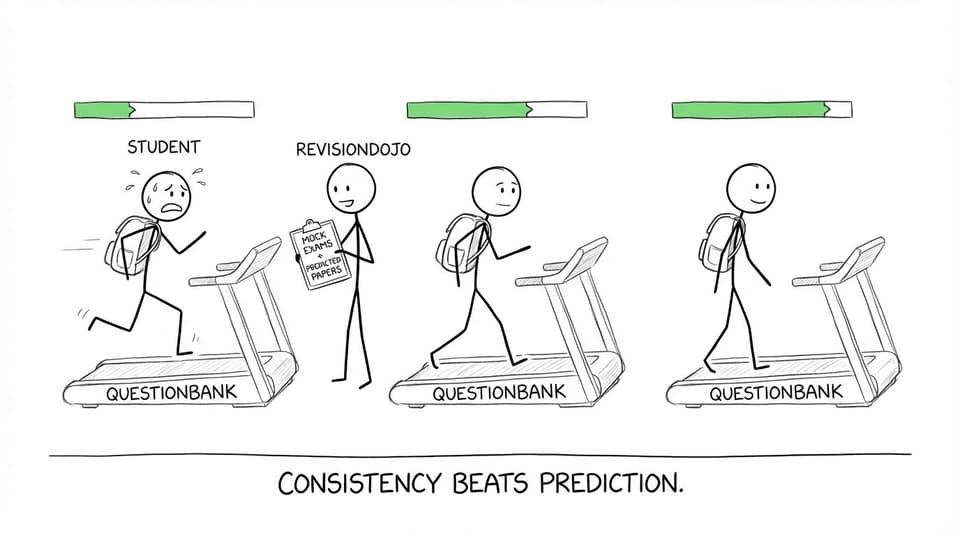
How RevisionDojo makes "what repeats" visible
Most IB students don't fail because they didn't work hard. They fail because they practiced in ways that didn't map to marks.
RevisionDojo is built to reduce that gap with a connected loop:
- Study Notes that are syllabus-aligned and exam-focused
- Flashcards that compound memory through spaced repetition
- AI Chat to unblock confusion fast (then you go back to questions)
- Questionbank drills by topic and difficulty to train repeatable patterns
- Mock Exams for exam stamina and pacing
- Predicted Papers for realistic, high-pressure rehearsal
- Grading tools for rubric-aligned feedback on IA/EE/TOK writing
- Coursework Library to see what strong work actually looks like
- Tutors when you need a human to simplify the knot and raise the bar
If you want a mindset-first approach to keeping it all sustainable, read How to Stay Sane During IB Exam Season and IB Exams Without Pausing Your Life.
Closing: the real repeat is you
The honest answer is that IB exams rarely repeat exact questions.
But the IB absolutely repeats what it rewards: clear thinking, correct structure, and evidence that you can apply ideas under pressure.
So the goal isn't to predict the next IB question.
It's to become the kind of student who has seen the pattern so many times that the wording can't scare you.
If you want that feeling (calm, practiced, and ready), build your routine inside RevisionDojo: learn fast with Study Notes, retain with Flashcards, train patterns in the Questionbank, get unstuck with AI Chat, test with Mock Exams and Predicted Papers, tighten coursework with Grading tools and the Coursework Library, and reach for Tutors when you want human-level strategy.
Your exam will look new.
Your preparation won't.