



If you have ever stared at a TOK prompt and thought, I understand the words but not the rules, you are not alone. TOK can feel like fog: you can walk through it, but it is hard to tell if you are making progress.
Then someone asks the question that suddenly makes everything feel measurable again: what is the minimum grade to pass TOK?
That question matters because TOK is not “extra.” It is one of the IB core requirements. And while it rewards big thinking, it is still assessed with very specific boundaries.
The minimum grade to pass TOK (the rule that actually matters)
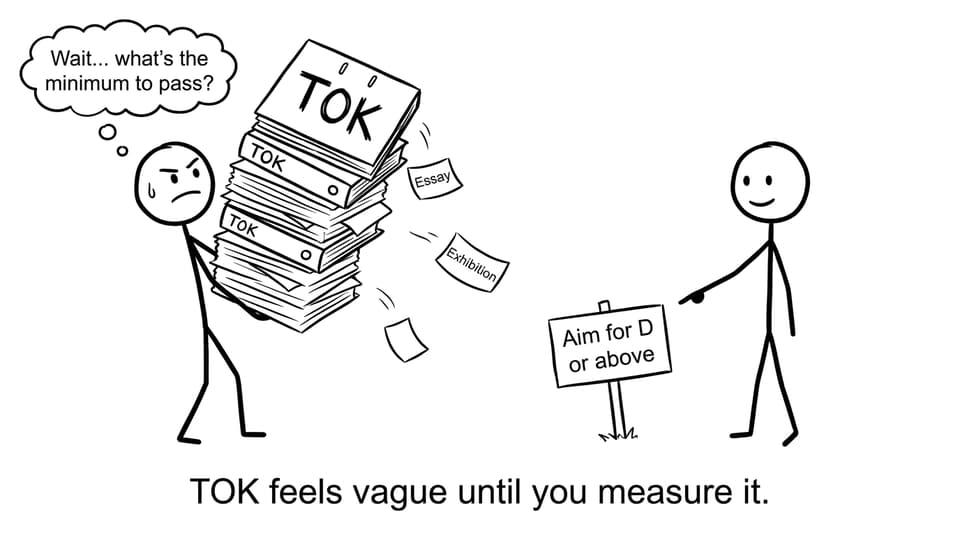
To meet the requirement for TOK in the IB Diploma Programme, you need at least a D in TOK.
The line that you must avoid is an E.
An E in TOK is an automatic failing condition for the IB Diploma, even if your subject scores are strong. The same is true if you get an E in the Extended Essay (EE). In other words: you can be excellent in six subjects and still lose the diploma if TOK collapses.
If you want the wider context of pass conditions (including total points and HL/SL rules), read IB Grading: Criteria to Pass the IB Diploma and What Is the 24-Point Rule in the IB Diploma?.
How TOK is assessed (and why your strategy should be boring)
TOK has two assessed components:
-
TOK Essay (external assessment, 1,600 words, 67% weighting)
-
TOK Exhibition (internal assessment, up to 950 words total, 33% weighting)
Both components combine into your final TOK grade (A to E). If you need a clear overview of the course structure, start with IB Theory of Knowledge Resources.
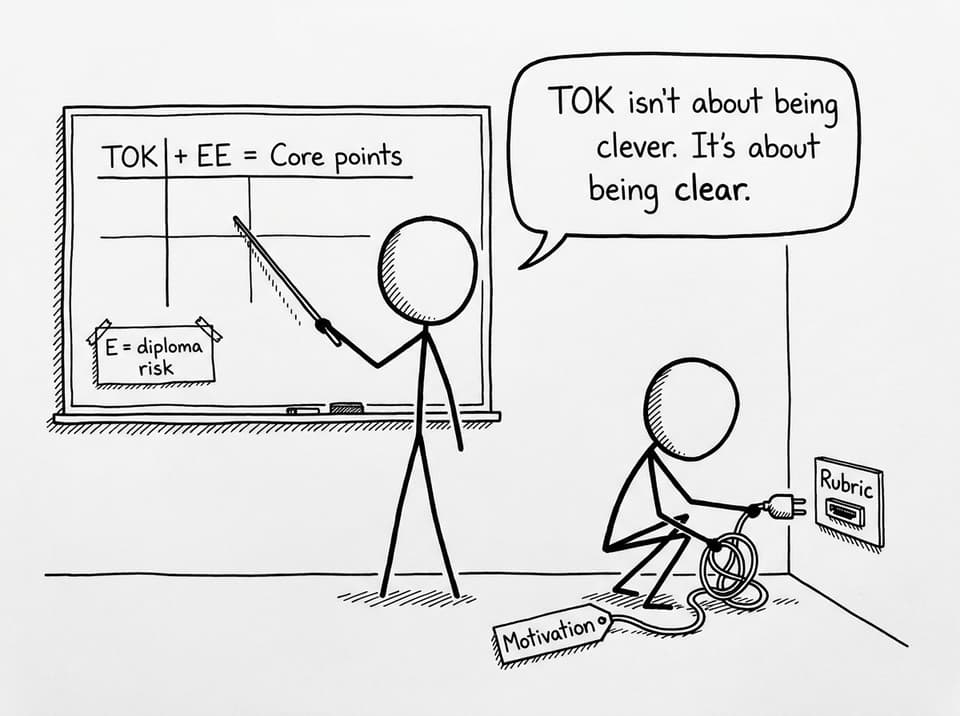
Here is the quiet truth: the easiest way to “pass TOK” is not to chase philosophy. It is to chase clarity.
A quick TOK checklist (aimed at staying safely above E)
Use this before you submit anything:
-
Did I answer the exact prescribed title or prompt (not my own version)?
-
Did I explain the real-world context clearly (especially in the exhibition)?
-
Did I make the TOK link explicit using terms like justification, evidence, perspective, reliability?
-
Did I include claims and counterclaims (especially in the essay)?
-
Did I avoid pure description and include “so what?” evaluation?
For step-by-step help, RevisionDojo’s Study Notes, Flashcards, and AI Chat let you practise turning vague ideas into examiner-friendly arguments. When you want reality checks, the Grading tools are the fastest way to see whether you are drifting toward an E risk.
TOK grade boundaries: what “D” looks like in points
Grade boundaries can vary by session, but RevisionDojo publishes a clear guide you can use to interpret your scores: IB Theory of Knowledge (TOK) 2025 Grade Boundaries Guide.
As a practical summary from that guide:
-
TOK Essay is marked out of 10
-
TOK Exhibition is marked out of 10
-
Your final TOK total is out of 30 (because the essay is double-weighted in the combined score)
-
A final D typically sits in the 4-9 out of 30 range
-
A final E typically sits in the 0-3 out of 30 range
So the difference between “barely passes” and “fails the diploma requirement” can be only a few marks. That is why finishing, proofreading, and staying on prompt is not optional in TOK.
Exhibition objects: the fastest way to protect your TOK grade
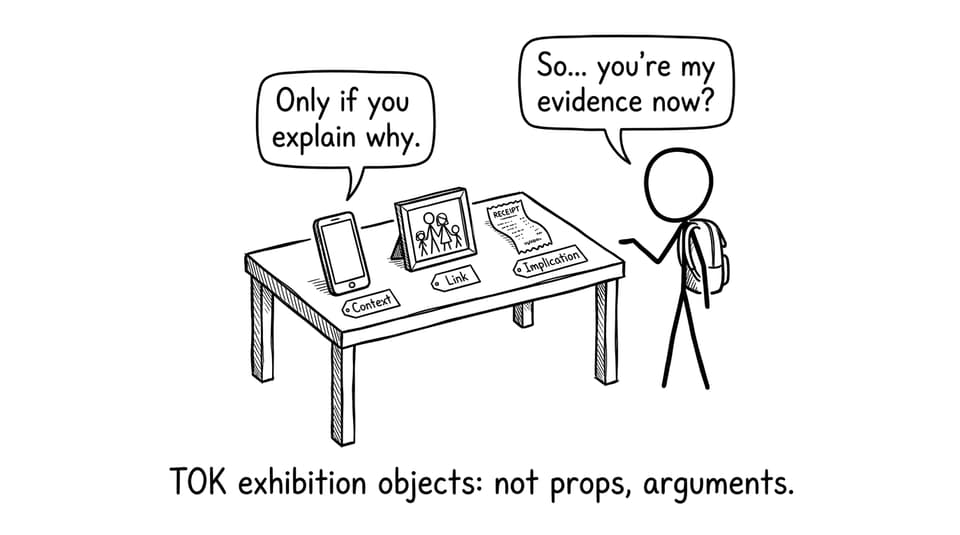
Many students lose marks in TOK because their exhibition objects are “nice” but not usable.
A usable object is not symbolic. It is situated. It has a specific origin and a specific reason it helps answer the prompt.
If you are still choosing a prompt, see What are the TOK Exhibition Prompts?. Then use these guides to turn the prompt into a plan:
Object ideas that tend to work (because they have context)
You do not need “rare” objects. You need objects you can justify.
-
Personal artifact: a family heirloom, certificate, or letter (knowledge, memory, authority)
-
Everyday technology: phone screenshot, app interface, or notification (bias, access, reliability)
-
Educational tool: textbook page with annotations, marked test, formula sheet (methods, credibility)
-
Cultural object: festival item, recipe card, instrument (shared knowledge, interpretation)
-
Historical document: newspaper clipping, map, archive photo (evidence, perspective, selection)
If you want rubric-aligned feedback, use the IB TOK Exhibition Grader to see whether your commentary is actually doing TOK thinking.
How TOK and EE create your bonus points (and what “passing” changes)
Your TOK grade pairs with your EE grade to create up to 3 bonus points toward your total IB score.
That is why TOK feels small until results day, and then suddenly feels structural.
A D in TOK can still contribute to bonus points depending on your EE grade, but an E in TOK wipes out the diploma requirement entirely. For the scenario-based explanation, read What Happens If You Fail TOK in the IB Diploma?.
Closing: pass TOK by making your thinking visible
The minimum grade to pass TOK is a D. But the more useful goal is simpler: stay comfortably away from an E by writing in a way an examiner can reward.
TOK is not a contest to sound profound. It is a skill of making reasoning visible: context, link, justification, implication.
If you want a clear path through both assessments, use RevisionDojo’s TOK resources for the TOK Exhibition and the TOK Essay, then sharpen your draft with How to Hit the Top Mark Bands.
Get clear, get specific, and let TOK work the way it was designed to work: as the quiet set of points that you do not have to panic about on results day.