


If you have ever stared at a random object and thought, “How on earth is this supposed to become TOK?”, you are not alone. The TOK Exhibition feels simple on paper: three objects, one prompt, one commentary. In real life, it is where vague symbolism goes to die, and precise thinking finally gets rewarded.
The good news is that the TOK Exhibition is a controlled task with clear rules. Once you understand what is assessed (and what is not), your confidence goes up and your stress goes down.
TOK Exhibition basics (what you are actually doing)
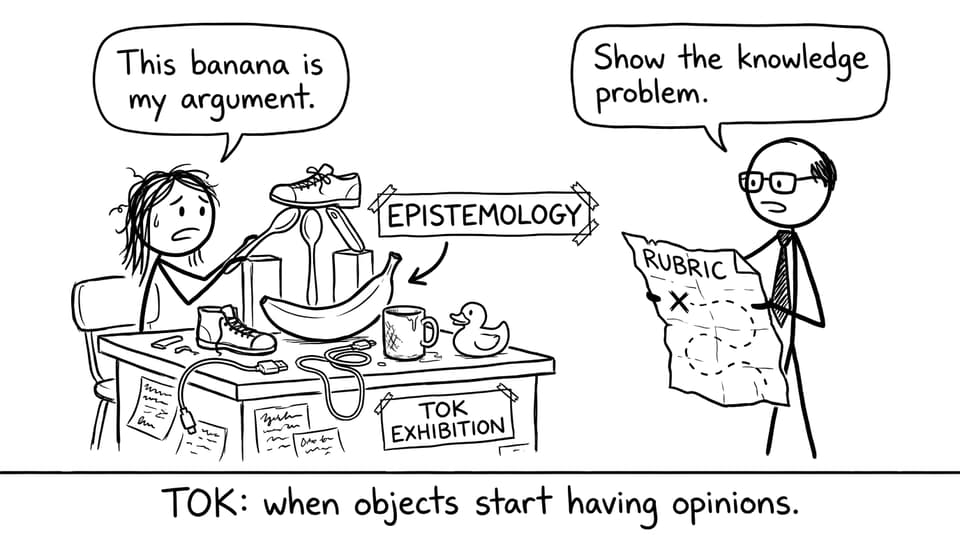
The TOK Exhibition is an internal assessment worth 33% of your final TOK result. You choose one of the IB prescribed prompts, select three specific real-world objects (or images of them), and write a single commentary of up to 950 words total.
Two details matter more than students expect:
-
Only the written commentary is assessed.
-
Your work is marked by your teacher and externally moderated, so clarity beats cleverness.
If you want the bigger picture of the course, keep IB Theory of Knowledge Resources open while you work.
A quick TOK checklist before you pick objects
Use this checklist to keep your TOK thinking sharp:
-
Prompt: Can you rewrite the TOK prompt in your own words without changing the meaning?
-
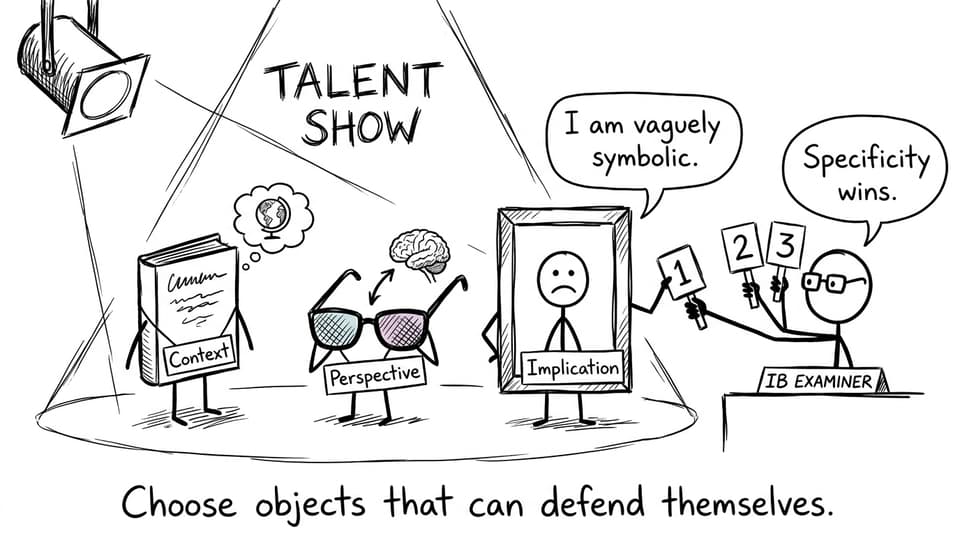
Objects: Are your objects specific and real (not “a painting” but this painting in this context)?
-
Different angles: Do your three objects push three different perspectives, not the same point three times?
-
Knowledge focus: Can you name the knowledge idea (evidence, authority, bias, interpretation, certainty, values)?
-
Explainable: Can you explain each object’s context in one sentence?
For deeper object strategy, see Selecting TOK Exhibition Objects That Score.
How to write a TOK Exhibition commentary that earns marks
A strong TOK Exhibition commentary does three quiet things.
It makes the prompt visible in every paragraph
Do not “mention the prompt once” and hope the examiner remembers it. In TOK, your link has to be explicit: this object shows X about the prompt because… If you need help unpacking what prompts are asking, use TOK Knowledge Questions: Examples and Writing Tips.
It stays analytical, not descriptive
Description is what the object is. Analysis is what the object shows about knowledge. A fast way to level up TOK analysis is to add a different point of view that genuinely pressures your claim. See TOK: Using Different Points of View That Score.
It treats each object as a mini-argument
For each object, aim for: contexttolink to prompttoknowledge insighttoimplication. If you are unsure how close you are to the marking standard, compare against How Is the TOK Exhibition Graded? and use the IB TOK Exhibition Grader to spot gaps quickly.
How RevisionDojo helps your TOK Exhibition feel manageable
The fastest way to improve TOK is to stop guessing and start iterating.
-
Use Study Notes for clean explanations of the exhibition requirements: IB Theory of Knowledge 4.1 the TOK Exhibition.
-
Use Flashcards to lock in terms like justification, perspective, evidence, and bias: Theory of Knowledge (TOK) Flashcards and Flashcards for 4.1 The TOK Exhibition.
-
Use the Coursework Library to see what strong work looks like: IB TOK Exhibition SL Examples and IB TOK Exhibition Exemplars.
-
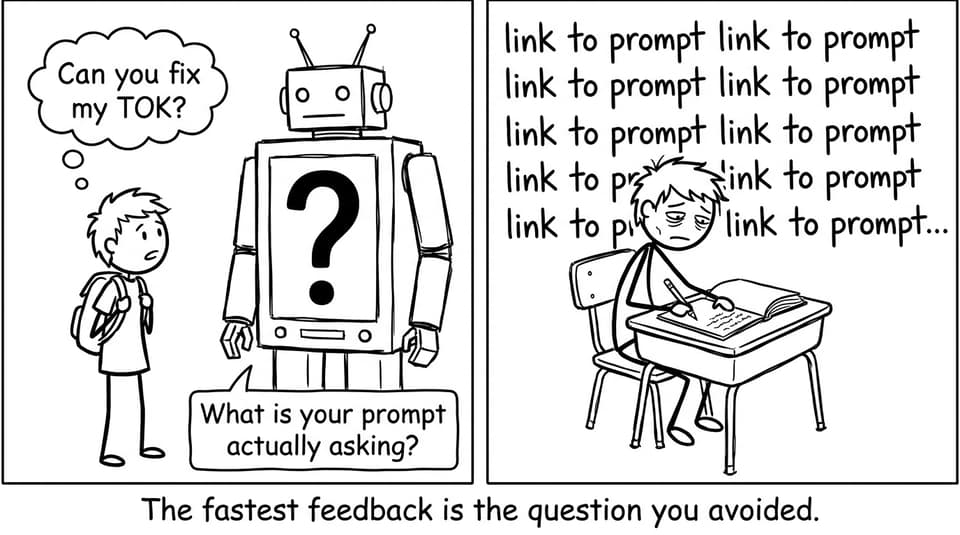
Use AI Chat to ask focused questions (like “What assumption am I making about evidence here?”), then verify with the rubric using Grading tools.
-
When you want practice habits that transfer to every subject, add a short weekly set from the Questionbank: Questionbank.
FAQ about the TOK Exhibition
How long should my TOK Exhibition be?
The display or “presentation” element varies by school, so your teacher may set a time expectation. The part that matters for marks is the TOK Exhibition commentary, which is capped at 950 words total across all three objects. That limit forces you to write with control, not just enthusiasm. It also means you cannot afford long scene-setting paragraphs. Spend your words where TOK marks live: the link to the prompt, the knowledge issue, and what the object reveals about how knowledge works.
Can my TOK Exhibition objects be digital?
Yes, your TOK Exhibition can include images of objects, screenshots, or digital artifacts. The key is specificity: it should be this post, this dataset, this meme, this photograph, in a named context. A generic image pulled from a search engine often reads like a placeholder, not a real-world object with a traceable story. Digital objects can actually strengthen your TOK analysis because they naturally raise questions about authenticity, manipulation, and authority. Just make sure you explain where it came from and why that context matters.
Is collaboration allowed for the TOK Exhibition?
The TOK Exhibition is an individual assessment, so the final choices and writing need to be your own. That said, discussing prompts in class is normal, and teachers often encourage brainstorming because TOK grows through conversation. The risk is accidental sameness: if your objects and points mirror a friend’s, your personal engagement becomes harder to see. Use discussion to generate options, then go private and get specific with your own context. If you want a calibration check, use RevisionDojo exemplars to see how top responses make their thinking unmistakably individual.
The calm way to finish your TOK Exhibition
A strong TOK Exhibition is not about finding “deep” objects. It is about taking ordinary objects and showing extraordinary precision in how you connect them to a prompt. Choose three objects that can carry three different angles, write links that an examiner cannot miss, and keep your focus on knowledge, not decoration.
When you are ready to turn your draft into something you can defend, use RevisionDojo’s Study Notes, Flashcards, AI Chat, Questionbank, Coursework Library, Grading tools, plus Predicted Papers, Mock Exams, and Tutors to build momentum without guessing. Your TOK Exhibition can be one of the most satisfying pieces of the IB core, because it is the moment your thinking becomes visible.