The night before results day has a particular kind of silence.
You can feel your brain doing math it doesn’t fully trust: If I got a 4 there… and a 3 there… does that add up to the diploma? In the IB, that anxious arithmetic often circles one number: 24.
The “24-point rule” sounds simple, but it isn’t a single rule. It’s the doorway. And the IB adds a few quiet locks on the door that students only notice when it’s too late. This guide breaks the whole system down so you know what counts, what doesn’t, and how to protect your diploma.
IB scoring in one minute
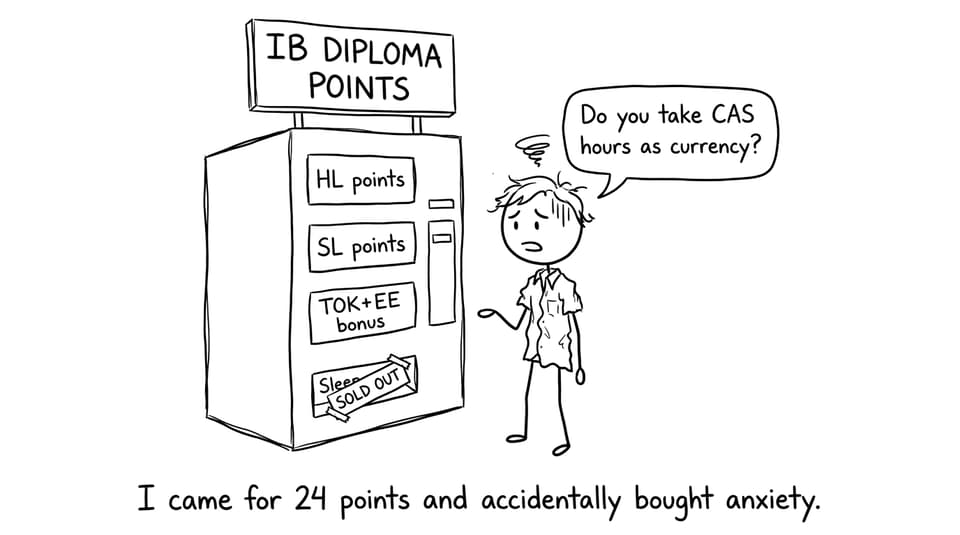
In the IB Diploma Programme, your final score is out of 45 points.
Here’s the big picture:
-
6 subjects, each graded 1 to 7 (maximum 42 points)
-
3 Higher Level (HL) and 3 Standard Level (SL)
-
Up to 3 bonus points from TOK + EE
-
CAS is compulsory, but worth 0 points
If you want a clean explanation of the whole points system, keep this open while you revise: How do IB points work? A simple guide.
Quick checklist: what you need to “pass” the IB Diploma
Use this as a reality check:
-
24+ total points (out of 45)
-
Finished CAS requirements
-
Completed TOK and the Extended Essay
-
Met the extra IB pass conditions (especially HL/SL minimums and grade restrictions)
That last bullet is where most confusion lives.
What is the 24-point rule in the IB?
The IB 24-point rule is the minimum total score typically required to be awarded the full IB Diploma.
But think of it like a minimum bank balance, not a guarantee. In the IB, you can technically reach 24 and still fail the diploma if you break certain conditions (like weak HL performance or failing the core). The point of the rule is to ensure you’ve shown baseline competence across the six subjects plus the core.
How your 24 points are calculated
Subject points (up to 42)
Each of your six subjects contributes 1 to 7 points. Those points come from a mix of:
-
Final exams
-
Internal Assessments (IAs)
-
Coursework components (subject-dependent)
A student aiming to pass the IB should treat IAs like insurance. They don’t remove exam pressure, but they can stop a bad day from becoming a bad result.
Core points: TOK + EE (0 to 3)
Theory of Knowledge (TOK) and the Extended Essay (EE) together can add 0 to 3 bonus points.
If you feel shaky on what the core actually includes, this article clarifies the moving parts: What is the core requirement in IB? TOK, EE, and CAS explained.
Here’s the emotional reality: students often ignore TOK and EE until the final stretch, then realize those points can decide the diploma.
Example: a simple 24-point pass
One possible (and very common) pass profile in the IB:
-
HL English: 5
-
HL Biology: 4
-
HL History: 4
-
SL Math: 4
-
SL Spanish: 3
-
SL Visual Arts: 3
-
TOK/EE bonus: 1
Total = 24.
The part nobody tells you: 24 points is not always enough
The IB includes additional diploma requirements to prevent “lopsided” passes (for example, strong SL grades but collapsing HL results).
Common pass conditions include:
-
Minimum combined points across your three HL subjects
-
Minimum combined points across your three SL subjects
-
Restrictions on how many very low grades you can have
-
Completing TOK, EE, and CAS
These conditions are why students can feel blindsided: the total looks fine, but the distribution fails.
A painful example: total above 24, but still no diploma
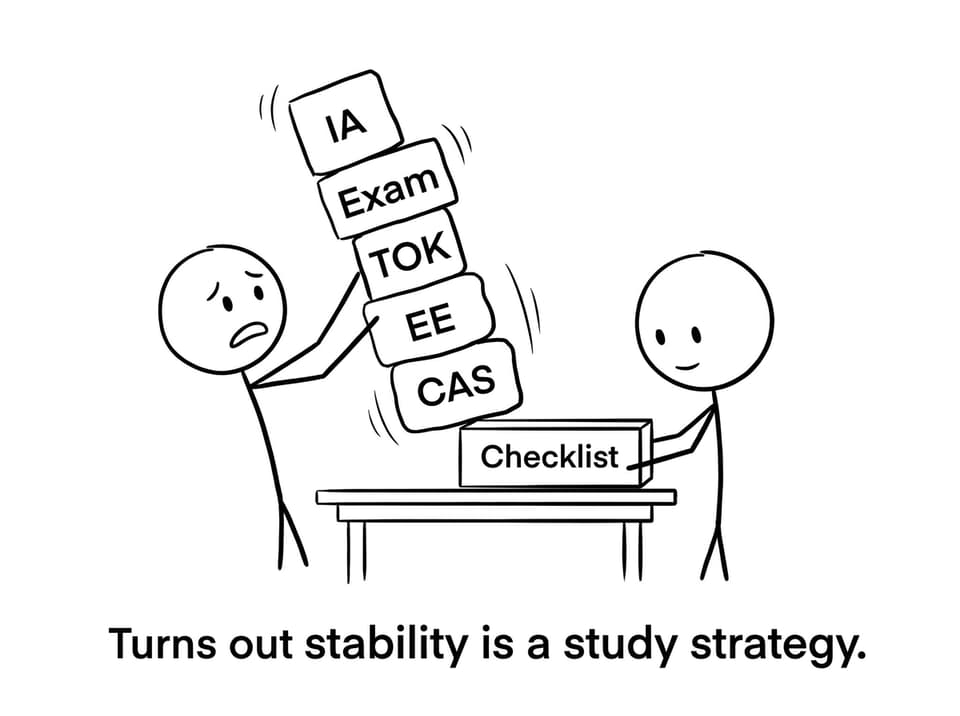
Imagine you earn 25 points overall, but your HL results include a serious low grade. In many situations, that can block the diploma.
If you’re specifically worried about a low HL grade, read this carefully because it addresses the rule directly: Can you get a 2 on an IB HL test and still get your diploma?.
The takeaway for the IB is simple: don’t just chase points. Protect your HL floor.
Can TOK + EE bonus points save your IB Diploma?
Sometimes, yes.
TOK and EE bonus points can lift you from the danger zone (like 22 or 23 from subjects) to the 24-point line. They are often the difference between “I finished the programme” and “I have the diploma.”
But bonus points don’t magically erase failing conditions. If your profile breaks a core pass rule (for example, a critical HL issue), those extra points may not rescue the result.
If you want to strengthen EE performance in a way that also improves TOK thinking, this is useful: How to use TOK to enhance your Extended Essay.
What happens if you score below 24 in the IB?
If your final total is below 24:
-
You do not receive the full IB Diploma
-
You may still receive certificates for individual subjects (depending on outcomes)
-
You may be able to retake exams in a later session (timelines depend on your school and regulations)
-
Some university offers may change if they require the diploma specifically
This is why it helps to treat the IB diploma as a system: your goal is not “ace one subject,” but “avoid critical failure anywhere.”
How to protect your 24 points: practical exam strategy that works
The students who pass the IB with 24 to 28 points rarely feel like geniuses. They feel organized.
Here are the strategies that quietly raise the floor.
Make your revision measurable
Vague study creates vague results. Build a loop:
-
Learn fast with RevisionDojo app: The smarter way to prep for IB exams
-
Drill weaknesses with the Questionbank
-
Lock recall with Flashcards
-
Get unstuck with AI Chat
-
Rehearse timing with Mock Exams and Predicted Papers
-
Improve written responses using Grading tools
RevisionDojo works well here because it turns “I studied” into “I answered 40 exam-style questions, reviewed 12 errors, and fixed 3 recurring mistakes.” That’s the kind of data that protects an IB pass.
Prioritize the next marks, not the perfect topic
When you’re near the 24-point boundary, your job is to stop bleeding marks in predictable places:
-
Misreading command terms
-
Writing too much for low-mark questions
-
Leaving questions blank due to panic
Two articles to keep nearby in exam season:
Use short time horizons when you feel behind
If you’re overwhelmed, stop planning your whole life. Plan 14 days.
And if you’re in pure triage, this is surprisingly calming because it gives you a shape: IB last 24 hours study plan.
Closing thought: make the IB manageable by making it visible
The IB isn’t built for perfection. It’s built for follow-through: six subjects, a demanding core, and a scoring system that rewards balance.
Once you understand the IB 24-point rule as a threshold plus conditions, the goal becomes calmer and more practical: raise your floor, protect your HLs, and use TOK/EE as leverage rather than an afterthought.
If you want one place to run that entire plan, from Study Notes to Questionbank, Flashcards, AI Chat, Grading tools, Predicted Papers, Mock Exams, Coursework Library, and Tutors, start here: RevisionDojo: IB resources. Your 24 points aren’t a mystery. They’re a system you can train.


