
For IB students sitting exams in May 2028 (started DP1 in August 2026).
For medicine May 2028 IB applicants, the safest strategy is to protect strong predicted grades, choose HL sciences that preserve your options, and prepare early for each university’s admissions test and experience expectations. Build a university spreadsheet now, because subject rules, score expectations, tests and deadlines differ by institution, and many details for 2028 entry have not yet been published.
Medicine rewards early preparation, but not because every hour must be occupied. It rewards preparation because several separate clocks are running at once. Your IB coursework has one rhythm. Admissions testing has another. Applications may be due before you sit your final examinations.
The goal is not to predict every rule two years ahead. It is to create a plan that remains useful when those rules change.
Your medicine May 2028 IB checklist
- Identify the countries and medical courses you may apply to.
- Check each university’s official subject and grade requirements.
- Treat HL Chemistry and HL Biology as the broadest science combination, while confirming whether your target courses require something different.
- Set predicted-grade targets above the published minimum where realistically possible.
- Track admissions tests, application deadlines and interview formats separately.
- Begin sustained, accessible service or healthcare-related experience during DP1.
- Keep a short reflective record of what each experience teaches you.
- Plan coursework early enough to protect DP2 revision and application time.
- Recheck every requirement during 2027, when more information for 2028 entry should become available.
Choose subjects by working backwards from universities
For students considering direct-entry medicine in the UK and similar systems, HL Chemistry and HL Biology usually preserve the widest range of choices. Chemistry is explicitly required by some medical schools, while Biology may be required or strongly preferred elsewhere. Certain institutions accept Chemistry with Physics or Mathematics, but that flexibility is not universal.
Oxford’s currently published Medicine requirement, for example, is 39 points including core points, with 766 at HL. It also requires Chemistry and at least one of Biology, Physics or Mathematics at HL. That is a useful illustration, not a guaranteed 2028 rule. Requirements can change, so consult every university’s official course page before treating a combination as safe.
Mathematics choice also deserves attention. Some medical schools accept either Mathematics: Analysis and Approaches or Mathematics: Applications and Interpretation, while others may express a preference, impose a level requirement or make no mathematics requirement beyond the diploma. Do not choose HL Mathematics merely because it appears impressive if it is unnecessary and likely to weaken your overall profile. Equally, do not assume SL Mathematics will be accepted everywhere.
A sensible shortlist records:
| University or system | Details to verify |
|---|---|
| UK direct-entry medicine | Required HL subjects, total and HL scores, UCAT policy, application deadline and interview format |
| Australian or New Zealand medicine | Direct-entry eligibility, UCAT ANZ or other testing, prerequisites and international applicant rules |
| European or Asian programmes | Language rules, science prerequisites, local entrance examinations and qualification recognition |
| US or Canadian route | Undergraduate admission first, pre-med prerequisites and later medical-school requirements |
The US route is structurally different. Most students complete an undergraduate degree and the relevant pre-med coursework before applying to medical school. The MCAT normally belongs to that later stage, not to your May 2028 IB application calendar. Your immediate task is therefore to choose undergraduate institutions and programmes that fit your academic interests, finances and longer-term prerequisites.
For current IB science support, use the IB Biology notes guide and IB Chemistry HL success guide alongside the documents supplied by your school.
Know which IB syllabus applies in May 2028
As of October 2026, official IB materials identify the current Biology and Chemistry courses as first assessed in 2025. Students sitting in May 2028 should therefore be taught under those versions unless the IB announces a later change. Biology is organised through themes and levels of organisation, while Chemistry is structured around the concepts of structure and reactivity.
The revised Extended Essay is first assessed in May 2027, so it applies to the May 2028 cohort. The next Mathematics: Analysis and Approaches and Mathematics: Applications and Interpretation courses are scheduled for first teaching in August or September 2027 and first assessment in May 2029. That means May 2028 students should remain on the preceding mathematics courses, subject to confirmation from their IB coordinator.
The detailed May 2028 examination schedule is not yet published on the IB’s official examination schedule page. Final session-specific instructions, examination dates and any later subject notices must be checked when the IB releases them. Your coordinator remains the authoritative source for how official documents apply at your school.
This distinction matters because internet advice ages quietly. A resource can look polished while describing an older course. RevisionDojo’s syllabus-aligned Study Notes, Flashcards and Questionbank can help keep revision connected to the course you are actually taking, while the guide to using Biology revision notes explains how to turn content review into retrieval and application.
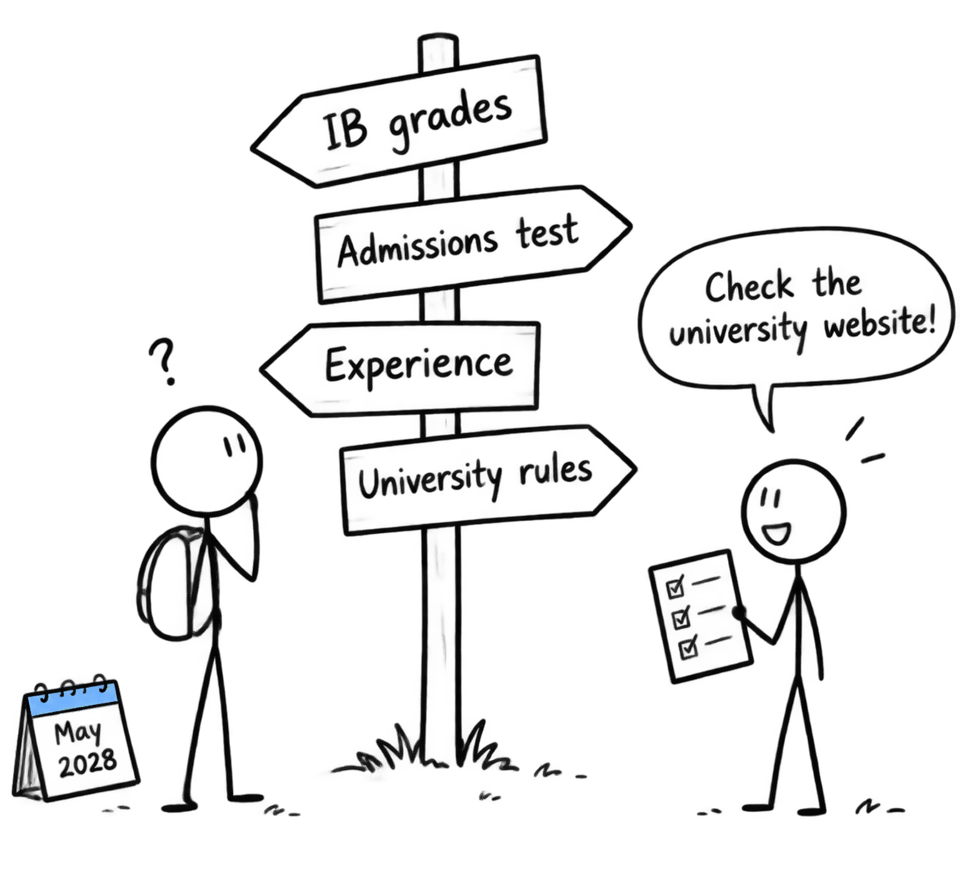
Treat grades as a system, not a last-minute target
Medical admissions can involve demanding academic thresholds, but there is no universal IB score for medicine. Universities may consider total points, specific HL grades, individual science results, predicted grades and contextual information in different combinations. Meeting a minimum can make you eligible without making an offer likely.
Your predicted grades may matter before your final grades exist. For UK applications, most medicine applicants apply during DP2 using school predictions because the deadline falls months before May examinations. Current UCAS information places the equal-consideration deadline for most medicine courses in mid-October, but the precise deadline for 2028 entry was not yet confirmed when this article was prepared. Check UCAS and each course page during 2027 rather than copying a previous cycle’s date.
The practical response is a weekly learning loop:
- Learn a narrow concept from class materials or Study Notes.
- Retrieve it without looking, using Flashcards or a blank page.
- Apply it through topic-specific Questionbank problems.
- Review why each error occurred.
- Revisit the weakness several days later.
The IB flashcard system for active recall and a balanced IB study schedule can help make that loop sustainable. RevisionDojo’s AI Chat can clarify a misconception, while Grading tools can expose weaknesses in an answer. Neither should replace your teacher, official criteria or your own judgement.
Build an admissions-test timeline without guessing dates
Admissions tests are easy to postpone because they feel separate from school. In reality, they often arrive when coursework and predicted-grade pressure are rising.
For UK medicine, many universities currently use the UCAT. The official UCAT site had published 2026 dates for 2027 entry, but dates for applicants seeking 2028 entry were not yet available. Do not assume that a previous registration, booking or testing window will repeat exactly. Monitor the UCAT website and your shortlisted universities during 2027.
A calm provisional plan looks like this:
- August-December 2026: investigate countries, courses and current testing policies.
- January-June 2027: protect school performance and learn the structure of any likely admissions test.
- Summer 2027: complete focused preparation and sit the required test if the official 2028-entry cycle places it there.
- Early DP2: finalise choices, references and application materials before the confirmed deadline.
- Late 2027-early 2028: prepare for interviews if invited, while maintaining IB performance.
- May 2028: sit IB examinations according to the official schedule once published.
Admissions-test practice should be timed and diagnostic. Record whether errors come from reasoning, comprehension, timing or unfamiliarity. More questions are not automatically better if the same mistake survives every session.
Choose experience for insight, not prestige
A week in a famous hospital is not automatically more useful than months of reliable service in an ordinary community setting. What matters is what you observed, how responsibly you participated and what you learned about people, teamwork, communication and the realities of care.
Depending on local access and safeguarding rules, useful experience might include volunteering in a care home, supporting a disability organisation, helping a community service, observing healthcare where formally permitted or taking a sustained role that involves working with people. The Medical Schools Council currently notes that unequal access affects healthcare work experience, and many schools do not simply demand a particular clinical placement.
Keep a private reflection log after each session. Record what happened without identifying patients or disclosing confidential information. Then ask:
- What did I learn about listening or communication?
- What assumption changed?
- What did effective teamwork look like?
- What was emotionally or ethically difficult?
- How did this affect my understanding of medicine?
Reflection is not about manufacturing a heroic story. It is about noticing complexity. Always check individual universities because experience expectations and acceptable evidence vary.
Protect DP2 from avoidable congestion
The dangerous plan is the one in which the Extended Essay, internal assessments, admissions testing and application writing all become urgent together. Start coursework steadily in DP1 and follow your school’s deadlines. Use the new Extended Essay criteria that apply to your cohort rather than an older checklist.
RevisionDojo’s Coursework Library can help you study structure and standards without copying another student’s work. Coursework Grading tools can provide another layer of feedback, but your supervisor’s guidance and the IB’s academic integrity rules remain decisive. Predicted Papers and Mock Exams become more useful later, once you have enough syllabus coverage to interpret the results. Tutors can provide targeted human support when a persistent weakness is not resolving through independent practice.
The month-by-month IB revision plan is useful for seeing workload before it becomes a crisis. The deeper principle is simple: finishable work done early has more value than ambitious work permanently waiting for the perfect weekend.
Build a plan that can change
IB medicine 2028 planning contains genuine uncertainty. The detailed May 2028 examination timetable, 2028-entry UCAT dates, final UCAS deadline and many university-specific policies were not yet published as of October 2026. Australian, European, Asian and North American institutions will publish information on their own schedules.
Create a tracker with columns for subjects, grades, test, deadline, experience expectations, interview, fees, residency status and the date you last checked the official page. Review it once each month. RevisionDojo can then become the academic engine behind that plan, bringing together Questionbank practice, Study Notes, Flashcards, AI Chat, Grading tools, Predicted Papers, Mock Exams, the Coursework Library and Tutors in one IB-focused system.
Your specific next step is to open a free RevisionDojo account, create a May 2028 plan for all six subjects, and record this week’s baseline topic and progress target for Biology, Chemistry and your weakest subject.