
For IB students sitting exams in May 2028 (started DP1 in August 2026).
The best May 2028 IB geography study advice is to build syllabus-mapped notes, retrieve case-study evidence from memory, and practise applying geographical knowledge every week. Start with short, open-book questions in DP1, then progress toward closed-book, timed responses once the revised assessment requirements are clear.
That last qualification matters. The May 2028 cohort is studying a revised Geography course, not simply continuing with an older syllabus. A good revision system must therefore be both disciplined and adaptable: precise enough to build strong knowledge now, but careful enough not to assume an assessment format that the IB has not publicly confirmed.
What May 2028 students should do now
Use this checklist as the foundation of your Geography routine:
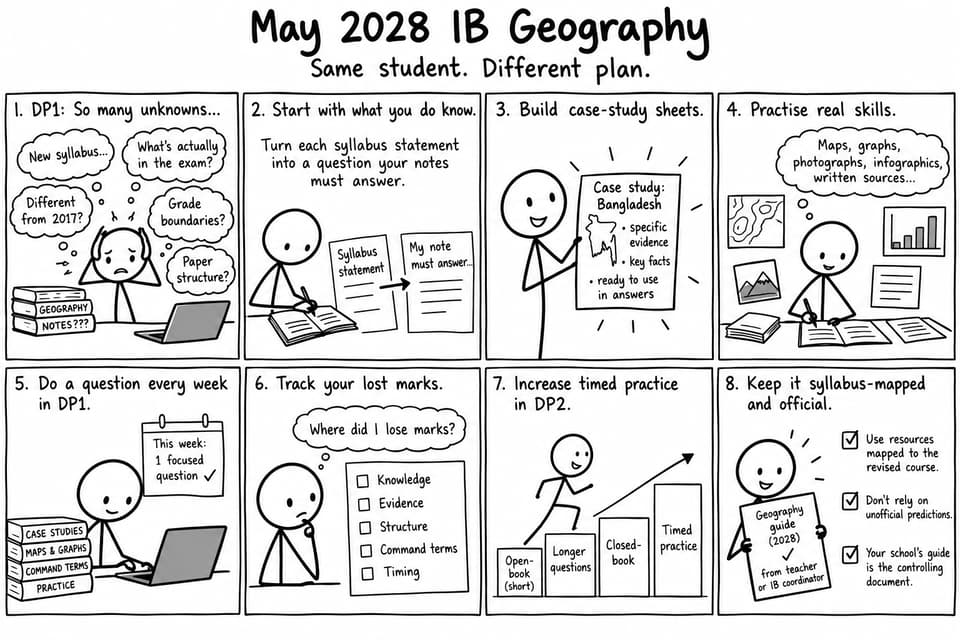
- Obtain the Geography guide for first assessment in 2028 from your teacher or IB coordinator.
- Turn each syllabus statement into a question your notes must answer.
- Build compact case-study sheets containing specific, usable evidence.
- Practise interpreting maps, graphs, photographs, infographics, and written sources.
- Complete one focused question every week in DP1.
- Track whether lost marks came from knowledge, evidence, structure, command terms, or timing.
- Increase timed practice gradually during DP2.
- Use only resources that are explicitly mapped to the revised course.
The IB Geography resource hub brings together Study Notes, Flashcards, Questionbank practice, and other Geography resources. Before relying on any individual resource, check that its topic label corresponds with the guide used by your school.
What is confirmed about IB Geography 2028
Official IB curriculum update information identifies the revised Geography course as first taught in August or September 2026 and first assessed in May 2028. This means students beginning DP1 in August 2026 belong to the first examination cohort for the revision.
However, the publicly accessible IB Geography subject page found during research still linked to the older 2017 subject brief. The exact revised syllabus content, paper structure, mark allocations, specimen assessment details, and component weightings could not all be verified from publicly available official documentation reviewed for this article.
The final May 2028 grade boundaries are not published in advance because they are determined through the assessment process. An exact May 2028 examination timetable was also not available in the official material reviewed. Do not build a revision plan around unofficial paper predictions, recycled assessment structures, or assumed grade boundaries.
Your school may have access to official programme documentation that is not openly available on the public IB website. Treat the course guide supplied by your teacher or coordinator as the controlling document, and record its publication date and first-assessment year at the top of your syllabus checklist.
How to make Geography notes that remain useful
Geography notes become ineffective when they resemble a shortened textbook. Their purpose is not to preserve everything you encountered. Their purpose is to make relevant knowledge easy to retrieve and apply.
For every syllabus statement, create a one-page note with five parts:
- Core idea: Explain the process, pattern, or relationship in two or three sentences.
- Key vocabulary: Define only terms you could use accurately in an answer.
- Causal chain: Show how one factor leads to another, including feedback or uncertainty where relevant.
- Evidence: Add one or two located examples with dates, places, measurements, or stakeholder perspectives when verified.
- Application prompt: Write a question that forces you to use the knowledge rather than repeat it.
A topic such as migration, hazards, resource use, or urban change should not end as a list of facts. It should become a network of relationships. Ask what changed, where it changed, why it changed, who benefited, who faced costs, and how outcomes differed across scales.
The guide to choosing useful Geography case studies explains why examples should function as evidence rather than decoration. For a deeper method, use the comprehensive IB Geography case-study guide to organise each example around context, process, impacts, responses, and evaluation.
Keep the factual burden manageable. A small collection of flexible, well-understood examples is usually more useful than dozens of examples remembered vaguely. The easiest Geography case studies to use effectively can help you think about selection, but every example must still match your 2028 syllabus statement.
What to practise and how often
Reading feels productive because recognition is easy. An examination asks for something harder: retrieval, selection, interpretation, and communication under constraints.
A sustainable DP1 routine could look like this:
| Frequency | Geography practice |
|---|---|
| After each lesson | Spend 10-15 minutes reducing the lesson to one syllabus-mapped page. |
| Twice each week | Retrieve definitions, processes, and case-study evidence without notes. |
| Once each week | Answer one focused question and review it against available guidance. |
| Every two weeks | Interpret an unfamiliar map, graph, image, or short data source. |
| Once each month | Complete a cumulative review covering earlier and current topics. |
In DP2, keep the retrieval sessions but add more extended and timed work. The precise duration should follow the revised assessment structure once your school confirms it. Timing yourself against an older paper format may train the wrong pacing.
Use the RevisionDojo Questionbank to isolate a skill or topic, then use Grading tools to identify weaknesses in explanation, evidence, and structure. Flashcards are helpful for definitions and case-study cues, while AI Chat can challenge you with follow-up questions. The tools serve different purposes, and the strongest routine combines them rather than treating any single feature as complete revision.
Which practice materials match the revised syllabus
The safest resource hierarchy begins with official information:
- The revised course guide provided by your school, clearly marked for first assessment in 2028.
- Official specimen material for the revised assessment, when your school or the IB makes it available.
- Teacher-created tasks mapped directly to named 2028 syllabus statements.
- RevisionDojo questions and notes explicitly aligned with the revised course.
- Older questions used selectively for transferable skills, only after checking topic and format relevance.
Older questions can still train data interpretation, explanation, evaluation, and geographical writing. They should not be treated as proof of what the May 2028 papers will contain.
The best IB Geography resources for self-study offers a framework for comparing guides, notes, data sources, and question practice. When using RevisionDojo Predicted Papers or Mock Exams later in the course, verify that each is labelled for the May 2028 syllabus before relying on its coverage or structure.
RevisionDojo’s Coursework Library can help you understand how geographical investigations are communicated, but it should never become a template to copy. Your teacher’s instructions and the revised official criteria control your own work. If a concept remains unclear after notes, questions, and feedback, a RevisionDojo Tutor can help diagnose the specific misunderstanding.
Common habits that lose Geography marks
Describing when the question asks for explanation
A description identifies what happened. An explanation connects causes, processes, and outcomes. Underline the command term and ask what intellectual job it requires before planning your answer.
Naming a place without using it as evidence
A place name alone is not a developed example. Add relevant evidence and explain how it supports the argument. If a statistic cannot be verified, use accurate qualitative evidence rather than inventing precision.
Treating every source as neutral
Maps and graphs are constructed representations. Check units, dates, scale, categories, anomalies, and source limitations. A strong response interprets what the material shows without claiming more than the evidence permits.
Writing first and deciding the argument later
Before an extended response, write a one-sentence position and select the evidence for each paragraph. This prevents the conclusion from contradicting the body of the answer.
Memorising one rigid case-study paragraph
Questions rarely arrive in the exact form used during revision. Learn evidence in flexible units that can support different claims. The article on leveraging Geography case studies in assessment shows how selection and application matter as much as recall.
HL and SL need different planning
Both HL and SL students need accurate concepts, relevant evidence, source interpretation, and clear geographical reasoning. The difference is workload management. HL students should expect to organise the additional content, depth, or assessment demands specified in the revised guide used by their school, rather than assuming that older HL requirements remain unchanged.
Create a syllabus tracker with separate columns for shared material, SL-only requirements if any are specified, and HL-only requirements. Attach every note and practice question to an exact syllabus line. This prevents HL students from revising only familiar shared content and stops SL students spending valuable time on material outside their course.
HL students will usually benefit from more frequent synthesis practice because additional material creates more possible connections. SL students should not interpret a smaller course allocation as permission to remain descriptive. Quality of reasoning, evidence, and evaluation still requires deliberate practice.
If you work with classmates, the guide to building an effective IB Geography study group offers a useful structure: retrieve first, compare reasoning second, and consult notes last. A study group should expose gaps, not distribute summaries nobody tests.
Build a system that can survive uncertainty
The first cohort of a revised course faces an unusual problem. There may be fewer familiar reference points, and some public materials may lag behind what schools receive. The sensible response is not to guess harder. It is to build transferable skills while keeping every resource tied to the correct guide.
RevisionDojo works best as the centre of that system: Study Notes for clarity, Flashcards for retrieval, AI Chat for questioning, Grading tools for feedback, and syllabus-matched Questionbank practice for application. Predicted Papers and Mock Exams become useful later, once their alignment with the revised assessment is explicit. The Coursework Library and Tutors provide additional support when independent study reaches its limit.
Your specific next step is to open the RevisionDojo IB Geography Questionbank, choose one topic already taught under your 2028 guide, answer one question without notes, and record the single reason you lost the most marks.