

Joining a course late creates a peculiar kind of anxiety. Everyone else appears to know where the classroom is, what the abbreviations mean, and why each homework task matters. You are still learning the map while they seem to be running the race.
If you joined IB late, do not try to recreate every lesson you missed. Identify the gaps that affect current learning, close them in a sensible order, and understand how your school runs the Diploma Programme. A few missed weeks in IB DP1 are recoverable when vague worry becomes a written catch-up plan.
Your late-start catch-up checklist
Begin with these actions during your first two school days:
- Confirm your six subjects and whether each is at Higher Level or Standard Level.
- Ask every teacher which topics, assessments, practical activities, and class texts you missed.
- Obtain the current unit plan, course outline, deadlines, and required materials.
- Ask whether missed work must be submitted or can be replaced by a shorter diagnostic task.
- Check access to school platforms, textbooks, calculators, laboratories, and shared folders.
- Meet your DP coordinator to discuss Theory of Knowledge, the Extended Essay, and Creativity, Activity, Service.
- Divide your catch-up list into urgent, foundational, and useful-later tasks.
- Schedule short review blocks alongside current work rather than pausing current learning.
The distinction between current and missed work matters. If you spend two weeks looking backward, the class keeps moving. A workable plan helps you remain present while repairing the foundations beneath you.
First, find out what you actually missed
A missed lesson is not automatically a serious knowledge gap. One class may have covered procedures. Another may have introduced notation that will appear throughout the course. Treating both as equally important wastes time.
Ask each teacher four precise questions:
- Which missed concept is required for the topic we are studying now?
- Which task will be formally assessed?
- Is there a model response, mark scheme, or worked example I should examine?
- What can I safely postpone until the weekend or next school break?
Then classify each item:
- Urgent: needed for tomorrow's lesson or an approaching deadline.
- Foundational: used repeatedly, such as algebraic manipulation, command terms, source evaluation, or laboratory conventions.
- Administrative: platform access, folders, forms, materials, and calendar entries.
- Optional review: useful context that will not block current progress.
This turns “I am behind in six subjects” into something specific, such as “I need to learn one Chemistry calculation, read two chapters, and understand how my History teacher structures essays.” Specific problems are usually smaller than the feelings surrounding them.
Bridge MYP to DP instead of starting again
The transition from MYP to DP is not a complete reset. The IB describes the MYP as a programme that develops inquiry, reflection, communication, research, and interdisciplinary understanding. Those abilities remain useful in DP.
What changes is how consistently you must apply them. DP courses often demand greater subject depth, more independent consolidation, and closer attention to assessment language. RevisionDojo's guide to the MYP to DP transition explains this wider change in expectations.
Use previous learning as a bridge:
- Sciences: carry forward experimental design, graphing, uncertainty awareness, and evidence-based conclusions. Review terminology and mathematics used in the opening unit.
- Mathematics: retain algebra, functions, graphs, geometry, and statistical reasoning. Identify notation or calculator methods your DP class already uses.
- Language and literature: keep annotation and interpretation skills, but practise sustained arguments supported by precise evidence.
- Individuals and societies: transfer source analysis, research, and evaluation while learning subject-specific response structures.
- Language acquisition: maintain regular reading, listening, speaking, and vocabulary practice.
If you did not study the MYP, do not assume you are automatically disadvantaged. Many students enter DP from other systems. Map existing knowledge against current units, then focus on differences in terminology, task structure, and assessment expectations.
Review foundations subject by subject
Catching up works best when review ends with a small test. Reading may make an unfamiliar idea feel comfortable without proving that you can use it.
For each subject, follow a three-step loop.
Learn the minimum useful theory
Read the relevant textbook section or focused Study Notes. Record only the definitions, relationships, methods, and examples needed for the current unit. Avoid copying pages of notes merely because classmates have fuller folders.
Retrieve without looking
Close the source and explain the concept aloud, draw the process, solve a basic example, or answer several Flashcards. If you cannot reconstruct the idea, return to the exact point that failed rather than rereading everything.
RevisionDojo's guide to using flashcards effectively can help you convert missed content into concise retrieval prompts.
Apply it through IB-style questions
Complete several topic-specific questions and inspect where marks are awarded. The RevisionDojo Questionbank can filter practice by subject and topic, which is more useful for catch-up than attempting a complete assessment before covering enough material.
Each mistake reveals whether the gap concerns knowledge, method, interpretation, or communication. That distinction tells you what to review next.
Build a realistic first-week plan
Your catch-up timetable should be deliberately modest. An ambitious plan that collapses by Wednesday creates another problem: you stop trusting your schedule.
Try this structure for your first seven days:
- Before school: review 5-10 Flashcards or one formula set.
- During lessons: mark unfamiliar references with a question mark, then keep listening.
- After school: complete current homework first unless a missing foundation blocks it.
- Catch-up block: spend 30-45 focused minutes on one named gap.
- End of day: record what is secure and choose tomorrow's priority.
- Weekend: complete one longer reading, essay plan, problem set, or laboratory review.
Leave space for meals, sleep, travel, CAS activities, and adjustment to a new environment. The guide to studying outside class in DP1 offers a sustainable framework without imposing an arbitrary hourly total.
Learn the IB DP1 system, not just the content
The Diploma Programme combines six subjects with a core consisting of Theory of Knowledge, the Extended Essay, and Creativity, Activity, Service. Your school's sequence and internal deadlines determine when each component becomes important.
During your first week, ask your coordinator:
- How are deadlines communicated?
- Has the class started TOK or discussed the Extended Essay?
- What does the school expect for CAS planning and reflection?
- Are internal assessments or practical records underway?
- Who approves subject or level changes?
You do not need to master the entire core immediately. You do need to know whether the school has completed an orientation, assigned a reflection, or established a process you must follow.
Learn the command terms and response conventions used in each course too. “Describe,” “explain,” and “evaluate” require different thinking. A student can understand a topic and still lose marks by answering a different question from the one set.
If a subject choice appears unsuitable, speak to your coordinator early. RevisionDojo's guide to changing subjects during DP1 outlines the questions to consider.
Use support without surrendering your judgement
A late start makes quick answers attractive. Yet catching up is not simply collecting explanations. You need a cycle that helps you understand, remember, apply, and receive feedback.
RevisionDojo connects that cycle through Study Notes, Flashcards, the Questionbank, AI Chat, and Grading tools. You can use Jojo AI as an IB study assistant to clarify an unfamiliar term or break a concept into steps. Verify important course requirements with your teacher, then apply the idea independently.
Later in DP1, the Coursework Library and Tutors can help you understand task conventions and obtain focused support. Predicted Papers and Mock Exams become more valuable after you have covered enough content to interpret the results. A full timed assessment during your first week may mostly measure material you have not been taught.
If your late start follows a move, the guide to catching up after switching schools provides a broader plan for records, communication, and continuity.
When the gap feels bigger than expected
You may also be adapting to a new language of instruction, unfamiliar equipment, different mathematics prerequisites, or a school whose topic order differs from your previous course.
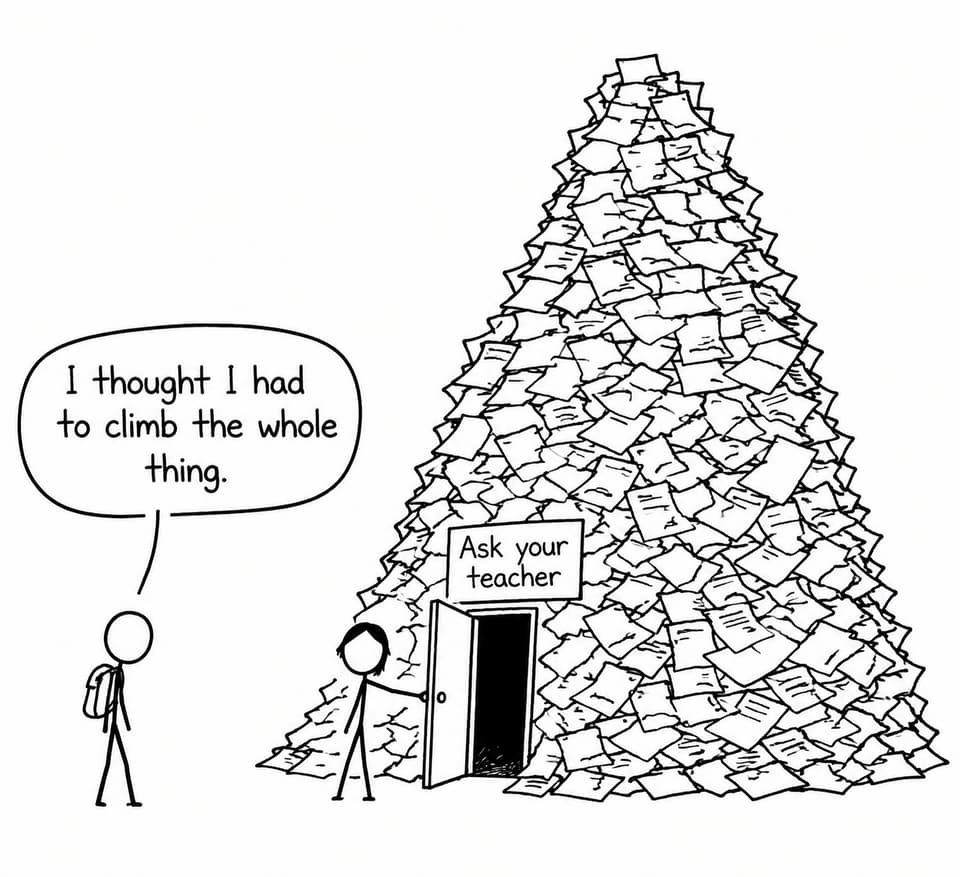
Ask for a diagnostic conversation rather than requesting “all the work.” Bring one attempted question, a marked paragraph, or a list of concepts you cannot explain. Teachers and Tutors can respond more precisely when they see where your reasoning breaks down.
The RevisionDojo DP1 student guide can help you establish a cycle of learning, practice, marking, and reattempting. If a gap remains after two focused attempts, ask a teacher, use AI Chat to clarify the steps, or arrange targeted tutoring.
A late beginning need not become a lasting gap
Students often imagine everyone else began DP1 with a perfect system. Usually, they did not. Being present from the first day and being academically secure are not the same thing.
Your advantage is a reason to become intentional early. Map missing work. Protect current lessons. Review foundations in small blocks. Test each topic instead of trusting recognition. Ask for help while the questions remain narrow.
Open the RevisionDojo IB Questionbank, choose the topic your class is studying, and try 10 free questions. Do not treat the score as a verdict. Use it as a map of what to review next, because that is how a few weeks behind gradually becomes caught up.