


If you have ever looked at your IB schedule and thought, “There is no room for one more demanding subject”… that is usually the exact moment IB Visual Arts starts to look both terrifying and strangely tempting.
Because it is not just another class. IB Visual Arts can feel like a second life: sketchbook on the bus, artist research at lunch, photos of “interesting textures” taking over your camera roll, and a constant low hum of “Is this good enough?”
So is IB Visual Arts worth taking? For many students, yes. But only when the reason you choose it matches the reality of how it is assessed.
IB Visual Arts in one quick checklist
Before you commit to IB Visual Arts, run this fast reality-check:
-
Do you enjoy making art even when it is not “inspiration time”?
-
Can you document process (messy drafts, failures, decisions) consistently?
-
Are you willing to write and reflect, not just create?
-
Can you handle long projects alongside other IB deadlines?
-
Do you want a subject where your growth and intention matter as much as polish?
If you answered “yes” to most of these, IB Visual Arts is more likely to feel meaningful than miserable.
What makes IB Visual Arts genuinely valuable
The best part of IB Visual Arts is not that it rewards “talent.” It rewards attention. The student who learns to notice patterns in their own thinking often outperforms the student who only produces pretty outcomes.
You build the rare skill of visible thinking
In many IB subjects, your thinking stays invisible until exam day. In IB Visual Arts, your thinking is the product: experimentation, annotation, reflection, refinement.
That is why the course can sharpen skills that universities and careers actually care about: creative problem solving, independent planning, visual communication, and analytical writing about culture and context.
If you want to understand what the course includes (and what you will actually submit), keep this open: What is IB Visual Arts?
It can strengthen university applications (when you curate well)
A coherent body of work and a clear artistic voice can stand out, especially for art, design, architecture, media, and related fields. Even for non-art degrees, IB Visual Arts can signal discipline and originality when your portfolio shows intentional development.
If you are wondering how the subject connects to different futures, this is a helpful read: Career Pathways for IB Visual Arts Graduates
The hard parts of IB Visual Arts (and how to make them easier)
Most students do not struggle because they “lack creativity.” They struggle because the workload is elastic. IB Visual Arts expands to fill whatever time you give it.
Time commitment is the real price
Your exhibition pieces take longer than planned. Your process pages take longer than planned. Photographing and presenting work takes longer than planned.
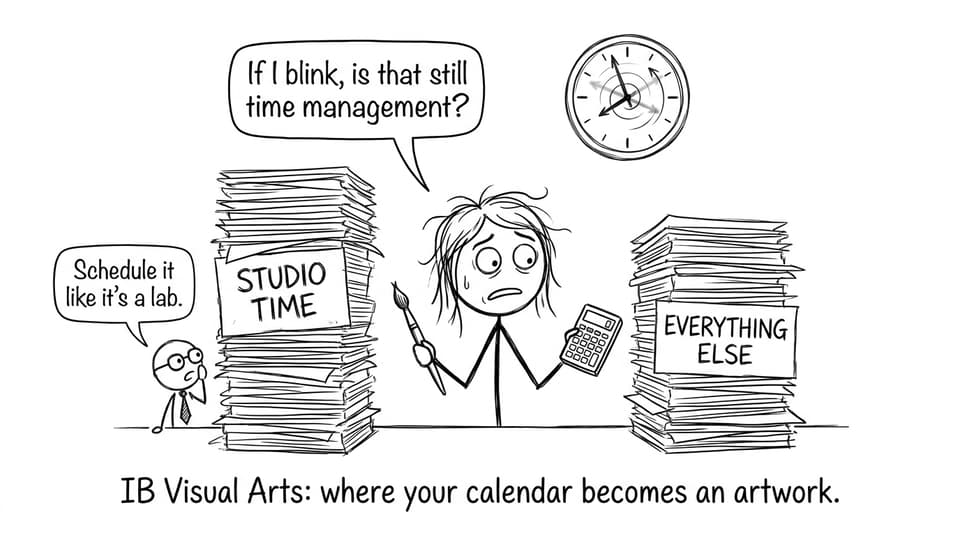
A practical fix: treat studio time like a science lab. Put it on your calendar. Defend it.
For a grounded approach to routine, see: How to Study IB Visual Arts Effectively
Assessment can feel subjective (but the criteria are not)
Yes, art is subjective. But IB Visual Arts marking is anchored to criteria: coherence, technical competence, investigation, reflection, and communication.
Start here to make the rubric feel concrete: IB Visual Arts Assessment Criteria Explained Simply
Then deepen it with: Understanding the Marking Criteria for IB Visual Arts
Materials and space can be a hidden stressor
Supplies can add up, and not everyone has a quiet workspace. One smart strategy is to lean into mixed media and digital documentation, and to plan experiments that are small, repeatable, and easy to photograph.
Also, protect academic integrity. In IB Visual Arts, authentic authorship matters, and your documentation should show honest development. This guide helps: Integrity and Originality in IB Visual Arts: Creating Authentic Work
How to score higher in IB Visual Arts without burning out
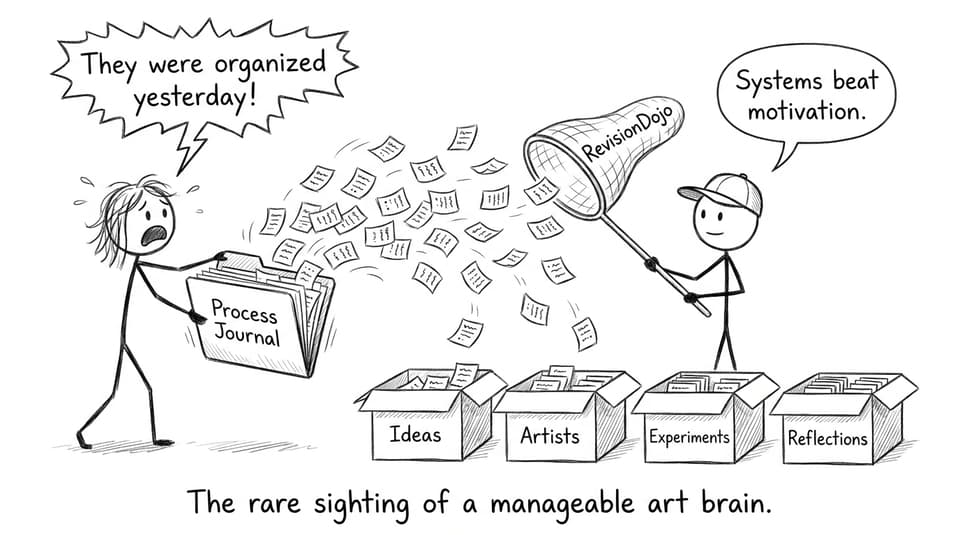
High marks in IB Visual Arts tend to come from systems, not late-night heroics.
Build around the three components
Your work sits inside three major pieces: Comparative Study, Process Portfolio, and Exhibition. Each one rewards clarity.
If you want your submission to feel “examiner-readable,” these two are worth bookmarking:
Avoid the mistakes that quietly cost marks
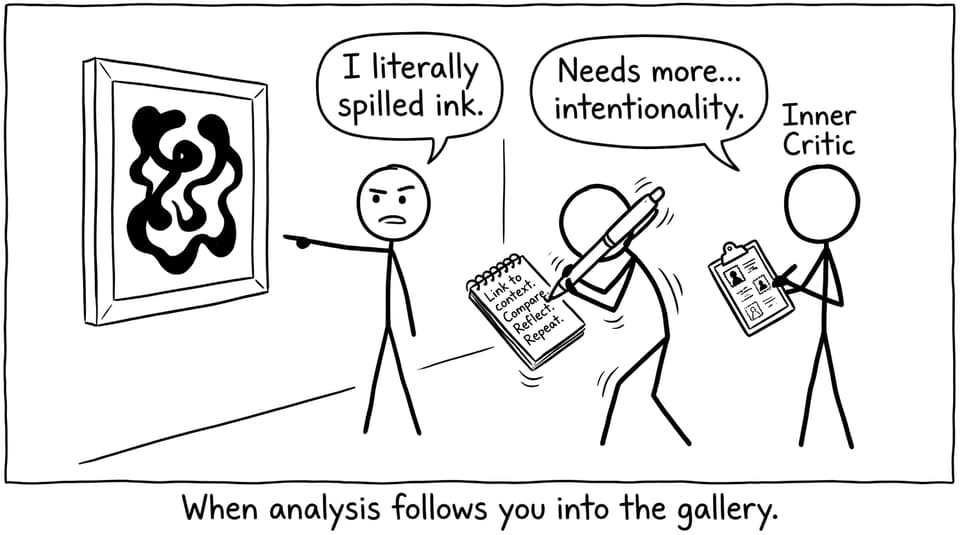
A lot of students lose marks in IB Visual Arts for reasons that are fixable: thin reflection, unlinked artist research, random experimentation, weak curatorial rationale.
Use this as a pre-submission checklist: Most Common Mistakes in IB Visual Arts
Use RevisionDojo to turn effort into targeted improvement
RevisionDojo is built for IB students who want momentum without chaos. When IB Visual Arts starts to sprawl, it helps to have a single home base:
-
Use Study Notes to clarify the assessment language and expectations fast
-
Use Flashcards to keep key terms, artists, and criteria sharp
-
Use AI Chat when you are stuck on analysis, reflection phrasing, or curatorial rationale structure
-
Use Grading tools to get rubric-aware feedback on written components
-
Use the Coursework Library to see what strong submissions look like
-
Use Tutors when you want human, targeted critique
-
And for your other IB subjects, pair the Questionbank, Mock Exams, and Predicted Papers to keep exam prep moving in parallel
If you want the full workflow explained clearly, start here: RevisionDojo App: The Smarter Way to Prep for IB Exams
So, is IB Visual Arts worth it?
IB Visual Arts is worth it when you want a course that rewards depth, patience, and self-directed growth. It is not worth it if you want a low-maintenance subject or if you only enjoy art when it is effortless.
If you decide to take IB Visual Arts, choose it with your eyes open: build systems early, use the criteria as your compass, and keep your process honest. And when you want a calmer, smarter way to manage the whole IB workload, use RevisionDojo as your home base for Study Notes, Flashcards, AI Chat, Grading tools, a Coursework Library, Tutors, plus exam support through Questionbank, Mock Exams, and Predicted Papers.
For more guides focused on IB Visual Arts, browse: All IB Visual Arts posts