


The first term IB Visual Arts experience is usually less about producing a perfect masterpiece and more about learning how an artist investigates. You will experiment with materials, research other artists, document decisions, discuss unfinished work, and begin finding questions that could sustain deeper inquiry.
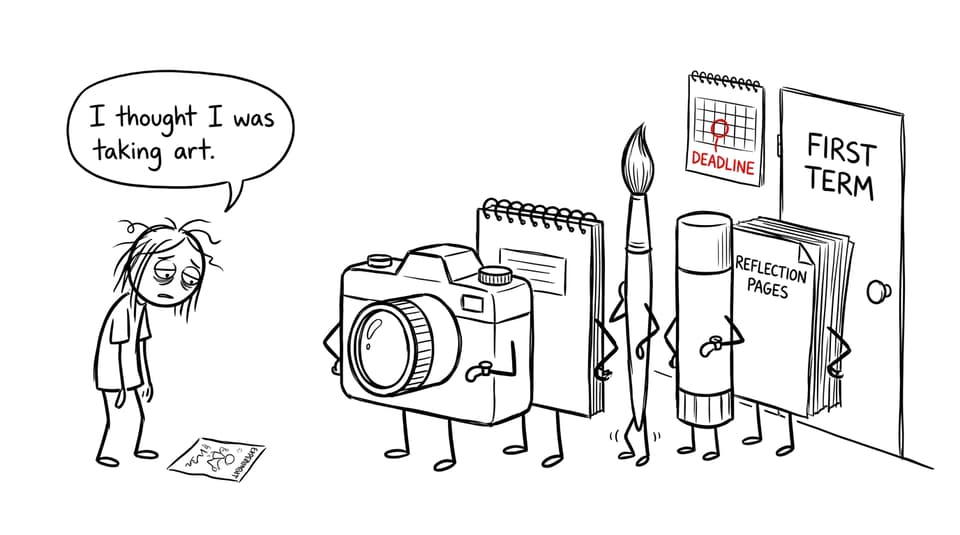
Many students arrive expecting an advanced studio class. Making remains central, but IB Visual Arts also asks you to connect artwork with context and explain your decisions through journal pages, photographs, annotations, conversations, and revisions.
The exact calendar depends on your school and teacher. Still, most first terms follow a recognizable arc: orientation, experimentation, artist research, an emerging line of inquiry, critique, and reflection.
Your first-term overview
By the end of the term, you should ideally have:
- A visual arts journal or reliable digital documentation system
- Experiments across several materials, processes, or creative strategies
- Research into artists and artworks from relevant contexts
- Photographs showing stages of development, not only final outcomes
- Short reflections explaining intentions, results, and next steps
- A clearer sense of the questions, themes, or methods you want to explore
Students assessed from 2027 onward follow the revised IB Visual Arts course. It is organized around create, connect, and communicate, with art-making as inquiry at its center. The assessed structure includes an art-making inquiries portfolio, an SL connections study or HL artist project, and a coherent body of five resolved artworks.
For a current breakdown of the course, use RevisionDojo's IB Visual Arts self-study resource guide.
What the first term usually looks like
| Stage | What you may be doing | What you are really learning |
|---|---|---|
| Opening weeks | Setting up a journal, making diagnostic work, discussing course expectations | How artistic evidence is recorded and evaluated |
| Early exploration | Testing media, surfaces, tools, scale, and creative strategies | How experimentation produces information |
| Middle of term | Researching artists and responding through practical studies | How context and other practices can influence your choices |
| Later development | Selecting a promising question and extending an artwork | How intentions develop through revision |
| End of term | Critiquing, refining, photographing, and reflecting | How to communicate a visible chain of decisions |
The opening weeks feel broad on purpose
Your teacher may begin with short exercises rather than asking for a personal theme immediately. You might draw an object using unfamiliar constraints, test photography, work with found materials, change scale, or respond to an artist's process.
Start documenting from the first lesson. A photograph of an awkward experiment, followed by one precise sentence about what it revealed, may become more useful than a polished page reconstructed months later. RevisionDojo's guide to showing experimentation in IB Visual Arts explains how multiple attempts can create a readable trail of development.
Research begins to affect your making
Artist research is rarely meant to remain a biography beside a downloaded image. Stronger research identifies a specific choice, such as composition, material, audience relationship, symbolism, or process, and then tests that choice in practice.
The habit is simple: observe, investigate, test, evaluate. The IB Visual Arts portfolio essentials can help you distinguish meaningful influence from decorative research.
A line of inquiry starts to emerge
Around the middle of the term, scattered interests often begin forming a question. You do not need a permanent two-year theme by week four. Choosing one too quickly can trap you inside an idea that has not earned your curiosity. A useful inquiry is focused enough to guide the next experiment but open enough to change when the work teaches you something unexpected.
This is where a sketchbook becomes more than storage. RevisionDojo's IB Visual Arts sketchbook ideas show how questions, thumbnails, material tests, and reflections can live together without turning every page into a decorative spread.
The workload is steady rather than dramatic
IB Visual Arts can seem manageable until documentation accumulates. A studio session may create another hour of work later: selecting photographs, recording materials, citing research, and explaining the next decision.
As a planning estimate, protect 2-4 hours outside class in an ordinary week, with more before critiques or school deadlines. HL usually requires broader, more sustained work, but regular sessions help at both levels.
A workable weekly rhythm is:
- One or two focused making sessions
- One short documentation session
- One artist or contextual research block
- A five-minute reflection after each practical session
- One weekly review of unfinished tasks and materials
For each experiment, write three lines: I intended, I observed, and next I will. This is faster and more valuable than writing a long reflection after you have forgotten what happened. The RevisionDojo guide to studying IB Visual Arts effectively offers a sustainable version of this cycle.
What surprises new students most
Unsuccessful work can become strong evidence
A failed print, unstable sculpture, or overworked painting is not automatically wasted time. If you can identify why it failed and make an informed adjustment, it demonstrates inquiry. The catch is that failure without reflection remains only failure. Photograph it, diagnose it, and decide what to test next.
Writing is part of the subject
You will write about intention, process, formal qualities, cultural significance, and audience. The best writing is not inflated. It is specific. Instead of saying a color is powerful, explain where it appears, what contrast it creates, and how that supports meaning.
RevisionDojo's Study Notes and Flashcards can sharpen your visual vocabulary, while AI Chat can help you test whether a reflection is clear. Your ideas should remain yours. The tool's role is to question and clarify them.
Critique is about the work, not your worth
Early critique can feel personal because the artwork may come from personal material. Useful critique separates intention from effect. You might intend intimacy, while viewers experience distance. That gap is information, not a verdict.
Ask focused questions such as, “Where does your attention go first?” or “Which material feels inconsistent with the idea?” If balancing technical control with experimentation feels difficult, read RevisionDojo's guide to technique and creativity in IB Visual Arts.
Organization quietly determines how hard the course feels
Create folders for dates, experiments, artist research, process photographs, reflections, and sources. Photograph work in consistent light and save original files. Record citations when you find a source, not at the end of the year.
RevisionDojo's Coursework Library provides models, Grading tools help you examine evidence against criteria, and Tutors offer targeted human feedback. The Questionbank, Predicted Papers, and Mock Exams can also keep your other IB subjects moving during a long studio weekend.
Finish the term with evidence, not perfection
Your first term is successful if your thinking has become more visible. Your experiments should reveal preferences, limitations, and possibilities. Your journal should show movement rather than a collection of attractive pages.
That is the real first-term shift. You stop treating art as something that appears at the end of inspiration and begin treating it as a process you can examine, challenge, and continue.
RevisionDojo is the ultimate IB resource for keeping that process understandable. Use its IB Visual Arts Coursework Library, study tools, AI support, grading feedback, and tutors to turn a crowded term of experiments into a clear artistic journey.