
The night before a deadline, most IB Visual Arts students do the same strange thing: they start questioning whether their work is “good enough” in a way that feels personal, not academic. You stare at a piece you’ve lived with for months and wonder if an examiner will understand what you meant.
Here’s the calmer truth: IB Visual Arts is not graded on taste. It’s graded on evidence. The marking criteria reward work that shows clear skill, clear thinking, and a process an outsider can follow. When you understand that, the course becomes less mystical and more manageable.
If you want a wider overview of the whole course (not just marking), start with What is IB Visual Arts?.
IB Visual Arts marking criteria: the fast checklist
Use this quick scan before you export anything for IB Visual Arts:
-
Have I shown experimentation, not just finished outcomes?
-
Can an examiner see development over time in my decisions?
-
Did artist research actually change what I made next?
-
Are my reflections specific (what, why, so what, what next)?
-
Does the final selection feel curated, not random?
For a plain-language version of the criteria across the course, keep IB Visual Arts Assessment Criteria Explained Simply open while you work.
Process Portfolio marking criteria in IB Visual Arts
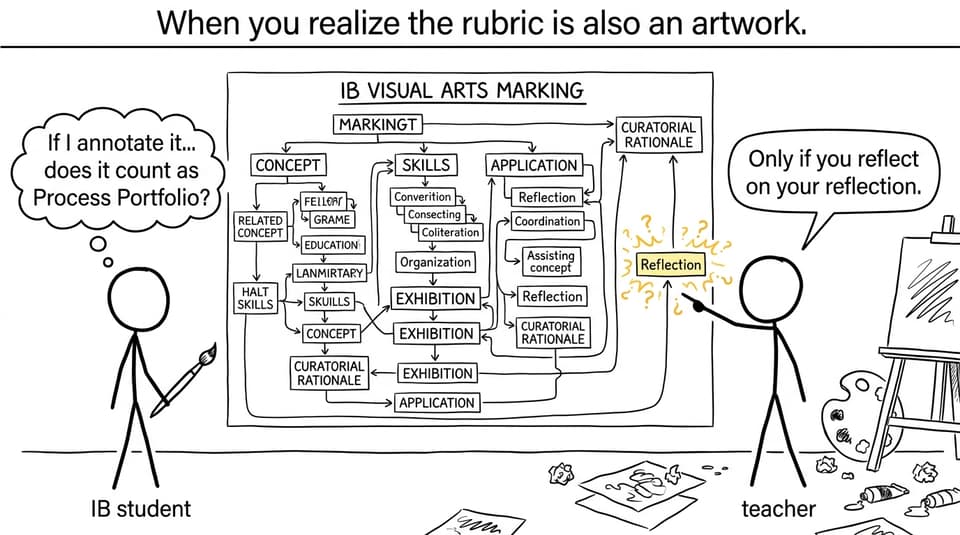
The Process Portfolio is where IB Visual Arts becomes legible. It’s not a scrapbook. It’s a curated record of how your ideas moved from curiosity to choices.
If you’re building from scratch, use IB Visual Arts Process Portfolio Structure (High-Scoring) as your framework.
Skills, techniques, and processes (12 marks)
This strand rewards technical control and versatility. Not “I tried watercolor once,” but “I tested three ways of controlling watercolor blooms to match a concept of fading memory.”
What tends to score well in IB Visual Arts:
-
A range of media, tools, and methods (used intentionally)
-
Visible refinement: early attempts vs improved versions
-
Purposeful risk-taking, documented clearly
Critical investigation (6 marks)
This is where your artist research proves it wasn’t decorative. Examiners look for investigation into artists and cultural contexts, then links to your own making.
Strong signals:
-
Analysis that goes beyond biography (materials, choices, context, meaning)
-
Clear influence statements (what you borrowed, adapted, rejected)
-
Cultural awareness that changes interpretation
If your comparisons feel thin, IB Visual Arts Comparative Study Structure (Step-by-Step) can help you practise deeper visual analysis and context.
Communication and reflection (6 marks)
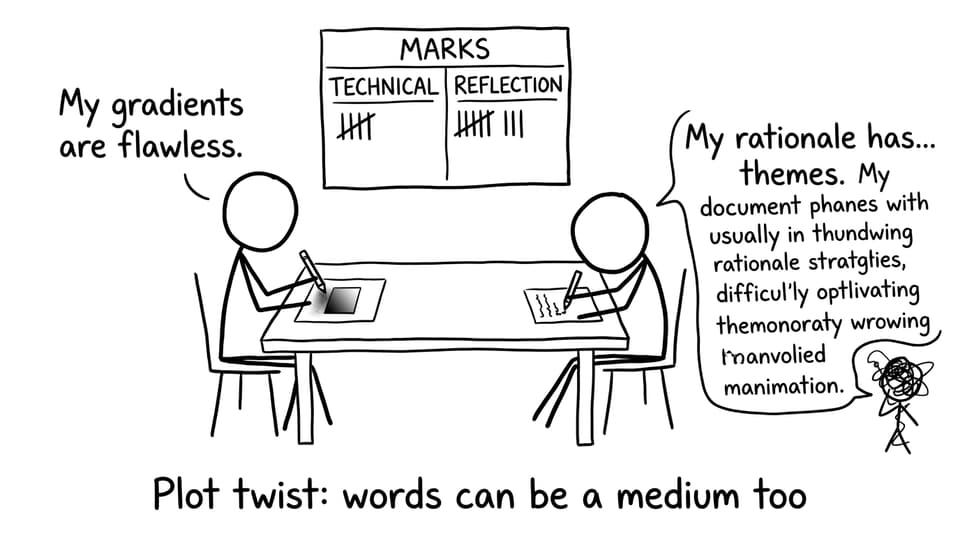
In IB Visual Arts, reflection is a medium. It’s how an examiner “hears” you think.
Aim for reflections that are:
-
Specific (name the decision)
-
Analytical (why it worked or didn’t)
-
Forward-looking (what you changed next)
A useful mindset: write like you’re leaving notes for your future self, not writing an artist statement for strangers.
Presentation (6 marks)
Presentation is not about making it pretty. It’s about making it readable.
High-mark presentation usually includes:
-
Consistent layout hierarchy (titles, short annotations, images that lead)
-
Screens that each have one job (experiment, research link, development)
-
Clear documentation (process photos, close-ups, iterations)
If you’re unsure about required screen counts, check IB Visual Arts Portfolio Screen Requirements Explained.
Exhibition marking criteria in IB Visual Arts
The Exhibition is graded like a story told through objects. Each artwork is a paragraph; your curatorial choices are the punctuation.
To understand what examiners reward most consistently, read How Examiners Grade the IB Visual Arts Exhibition.
Coherent body of works (9 marks)
Coherence doesn’t mean everything looks the same. It means your work feels intentionally connected: a shared question, visual logic, theme, or tension.
Try this test: can you explain your exhibition’s “through-line” in one sentence without using vague words like society or identity alone?
Technical competence (9 marks)
This is about control of chosen media. Examiners don’t need you to master everything, but they do want the technique to match the intention.
Practical approach:
-
Choose a few media you can refine deeply
-
Show craftsmanship in finishing and presentation
-
Avoid last-minute materials that you can’t control
Conceptual qualities (9 marks)
Concept is the difference between “nice” and “meaningful.” In IB Visual Arts, conceptual strength shows up when your choices feel motivated.
Examiners tend to reward:
-
Original angles on familiar themes
-
Layered meaning (personal + cultural + formal)
-
Visual decisions that carry the idea, not just captions
Curatorial practice (SL: 3 marks, HL: 6 marks)
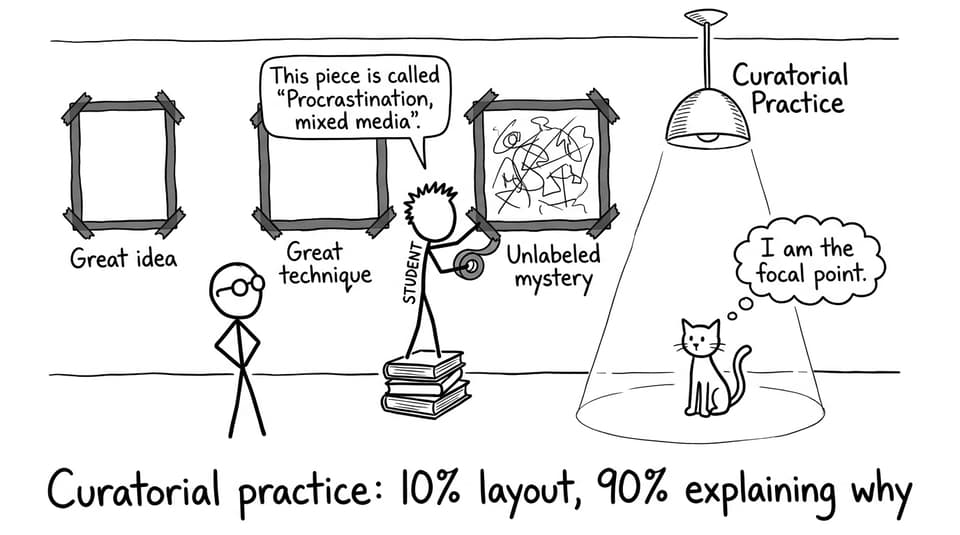
Curatorial practice is both the physical installation and the written rationale. It’s where you explain why these works belong together and why they’re arranged this way.
To avoid losing easy marks, review Mistakes to Avoid in IB Visual Arts Exhibition Layout and Common Exhibition Mistakes That Cost IB Visual Arts Students Marks.
Also confirm the required number of pieces in IB Visual Arts: How Many Artworks for the Exhibition?.
How to turn the criteria into weekly habits (not panic)
The easiest way to raise marks in IB Visual Arts is to stop treating the rubric like a document you read once, and start treating it like a weekly filter.
Try this simple cycle:
-
Make one experiment (small is fine)
-
Document it with photos and close-ups
-
Reflect in 4 sentences: intention, method, result, next step
-
Link one artist reference that influenced a choice
-
Curate the screen so the examiner can “see” the logic in 10 seconds
RevisionDojo is built to support exactly this routine. Students use the Questionbank to check understanding of course expectations, Study Notes to clarify criteria language, Flashcards to memorise key art terms, and AI Chat to pressure-test whether a reflection is specific enough. When it’s time to submit, Grading tools can break feedback down by rubric strands, while Mock Exams and Predicted Papers (used as timed practice prompts and planning drills) help you rehearse decision-making under pressure. If you need examples for structuring research and writing, the Coursework Library and Tutors can help you level up without guessing.
Closing: make the criteria your ally
The marking criteria for IB Visual Arts aren’t there to trap you. They’re there to translate something subjective into something assessable. Once you treat the criteria like a map, you stop guessing what “good” means and start building evidence on purpose.
If you want a structured way to do that, use RevisionDojo alongside your studio practice: organise your process with clear screens, check your understanding with Study Notes, refine reflections with AI Chat, and sanity-check your submission with Grading tools. IB Visual Arts rewards the student who can make their thinking visible. You can be that student.