



If you have ever stared at a wall of your own work and thought, “Is this a series… or just my year in chaos?” you are already close to the real task.
The IB Visual Arts Exhibition is not the moment you prove you can make art. It is the moment you prove you can curate meaning: select, refine, and present a small body of resolved works that reads like an intentional story. In exam season, when everything feels like a spreadsheet, the Exhibition is strangely human: it rewards clarity, restraint, and the courage to choose.
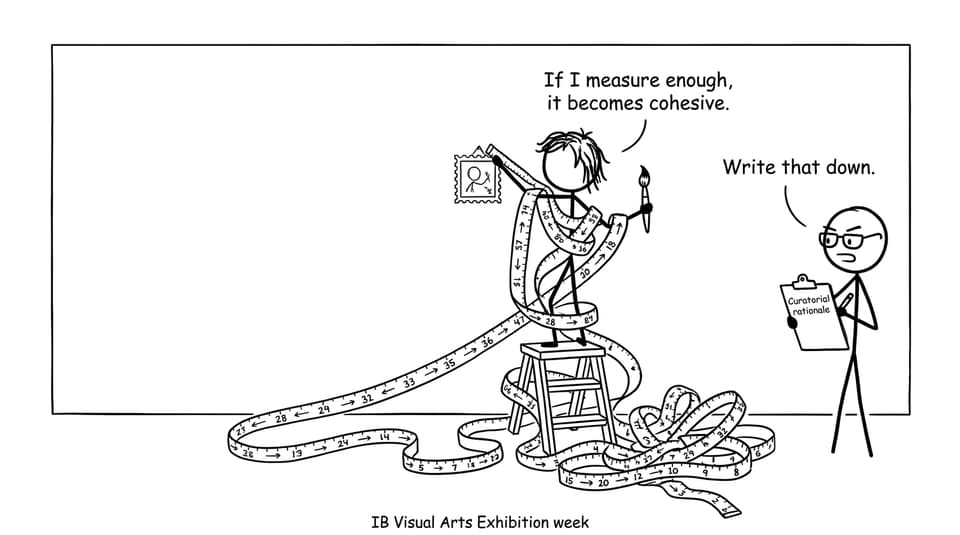
IB Visual Arts Exhibition overview (fast checklist)
Use this as your calm, last-minute anchor for IB Visual Arts:
-
Confirm your level requirements (SL vs HL) before you select anything.
-
Build coherence first: one sharp theme or guiding question.
-
Choose resolved works only (not “almost finished”).
-
Write a curatorial rationale that explains decisions, not just descriptions.
-
Present professionally: layout, labels, spacing, and documentation.
-
Cross-check against assessment criteria, then refine.
For a broader map of what examiners reward across the course, keep IB Visual Arts Assessment Criteria Explained Simply nearby while you edit.
What the Exhibition is really testing in IB Visual Arts
In IB Visual Arts, the Exhibition is where your process becomes legible to a stranger. Examiners cannot hear your internal monologue. They see objects, arrangement, and a short text. That is why the Exhibition quietly rewards students who think like editors.
You are being assessed on whether your final selection shows:
-
A coherent body of work (it feels like one exhibition, not multiple unrelated projects)
-
Technical competence (control of materials that fits your intention)
-
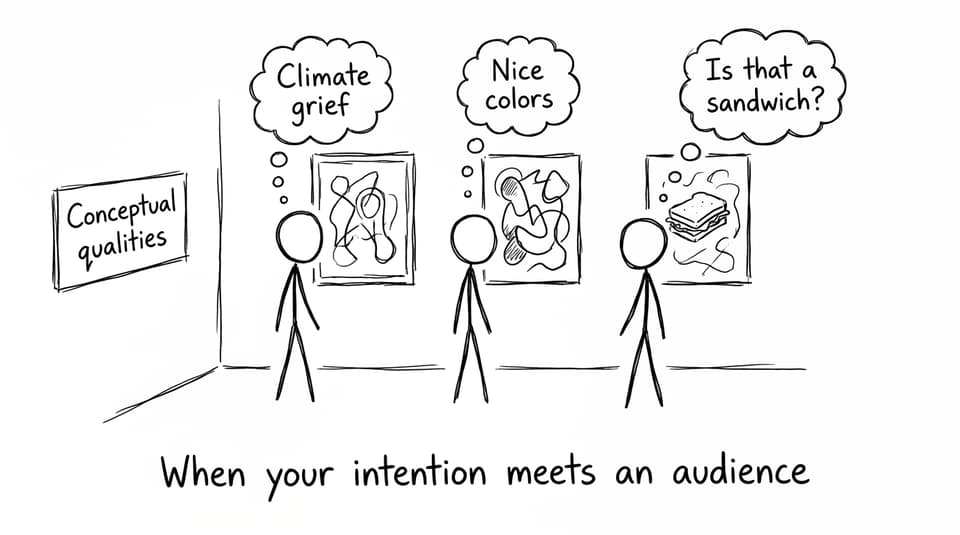
Conceptual qualities (ideas with depth, not just decoration)
-
Curatorial practice (presentation choices that support meaning)
If you want a deeper breakdown of how the Exhibition is marked, read How Examiners Grade the IB Visual Arts Exhibition.
IB Visual Arts Exhibition requirements (SL vs HL)
Before you perfect anything, lock the boundaries. In IB Visual Arts, the limits shape the strategy.
-
SL: 4-7 artworks + curatorial rationale up to 400 words
-
HL: 8-11 artworks + curatorial rationale up to 700 words
Those numbers matter because selection is part of the assessment story. A smaller set demands tighter coherence. A larger set demands control so the exhibition does not drift.
For a clear guide to planning the exact number, see How Many Artworks Do You Need for the IB Visual Arts Exhibition? and How to Succeed in the IB Visual Arts Exhibition at SL vs HL.
Choosing resolved artworks that feel cohesive
A helpful mindset for IB Visual Arts is this: your exhibition is an argument, and each artwork is a piece of evidence.
When you select, avoid the common trap of choosing only your “prettiest” pieces. Instead, choose the works that best demonstrate:
-
A consistent thread (theme, question, symbol system, or visual logic)
-
Growth (risk-taking, refinement, and learning)
-
Variety that still feels intentional (media changes with a reason)
Try this simple test: write one sentence that explains what your exhibition is about. Then write one sentence for each artwork that explains what it contributes. If any piece cannot earn a sentence, it usually cannot earn wall space.
If you want to avoid last-minute selection regret, skim Common Exhibition Mistakes That Cost IB Visual Arts Students Marks.
The curatorial rationale in IB Visual Arts (what to write, not waffle)
The curatorial rationale is where many IB Visual Arts students accidentally hide their best thinking behind vague language. You do not need poetic fog. You need clear cause-and-effect.
A strong rationale usually does four jobs:
-
States your theme or guiding idea in one clean line
-
Explains why these works belong together (connections, progression, contrasts)
-
Justifies presentation choices (order, spacing, grouping, lighting, placement)
-
Reflects on development (what changed, what you learned, what you resolved)
For a full structure and sentence-level guidance, use IB Visual Arts Curatorial Rationale: A Clear Guide. It pairs well with Understanding the Marking Criteria for IB Visual Arts when you are tightening drafts.
Presentation matters more than you think
In IB Visual Arts, presentation is not “extra.” It is part of curatorial practice. Your layout is how a viewer reads the work.
A few high-impact details:
-
Flow: arrange works so the viewer’s eye moves with intention
-
Breathing room: spacing helps the exhibition feel confident
-
Consistency: labels, mounting, and formatting should match across works
-
Digital work: test screens, prints, and playback in the real space
If you are including digital pieces, IB Visual Arts: Showcasing Digital Art in Your Exhibition is a practical guide. For setup details that win marks, see IB Visual Arts Exhibition Setup Tips for High Marks.
How RevisionDojo helps you prepare for the IB Visual Arts Exhibition
Exhibition prep is emotional because it feels like you are grading your own growth. That is exactly why structure helps.
RevisionDojo gives IB Visual Arts students practical support across the whole course:
-
Use Study Notes to clarify criteria language and avoid guesswork.
-
Use Flashcards to drill key terms (coherence, conceptual qualities, curatorial practice) until they become second nature.
-
Use AI Chat to stress-test your theme sentence and refine your curatorial rationale for clarity.
-
Use Grading tools to self-check your Process Portfolio and rubric alignment (so your Exhibition is supported by evidence).
-
Use the Coursework Library to learn from strong examples and avoid common pitfalls.
-
Use Mock Exams and Predicted Papers for wider exam confidence in IB subjects, so art deadlines do not collide with everything else.
-
If you want direct guidance, RevisionDojo Tutors can help you edit rationale drafts and curate your final selection.
-
And for other subjects, the Questionbank keeps the rest of your revision efficient, so your studio time stays protected.
If you want more targeted reading, browse All IB Visual Arts posts.
Closing: make the Exhibition feel like a choice, not a scramble
The best IB Visual Arts Exhibitions feel quiet in a specific way. Not because the themes are small, but because the decisions are clear. You can sense that the student chose, refined, and presented their work with intention.
If you want that feeling, treat the Exhibition like a short story: fewer scenes, stronger edits, and one thread the reader can follow.
When you are ready to curate with confidence, use RevisionDojo to keep your criteria clear, your planning structured, and your studio time protected, with Study Notes, Flashcards, AI Chat, Grading tools, Coursework Library examples, and Tutors built for IB Visual Arts success.