

An IB student once told me they were stuck because their interdisciplinary EE felt “unfair.”
Not unfair to the reader. Unfair to the subjects.
They had a World Studies topic they genuinely cared about, a clean research question, and enough sources to build something sharp. But they were haunted by a simple fear: If I don’t split it 50/50, will I lose marks?
Here’s the calm, exam-ready truth: your EE does not need an evenly balanced combination of both subjects. The balance depends on your topic and the emphasis of your research question. What matters is that the essay clearly demonstrates that integrating both subjects enabled an effective response to the research question.
That single sentence is the difference between writing an interdisciplinary EE that feels like two mini-essays taped together, and writing one that reads like a coherent investigation.
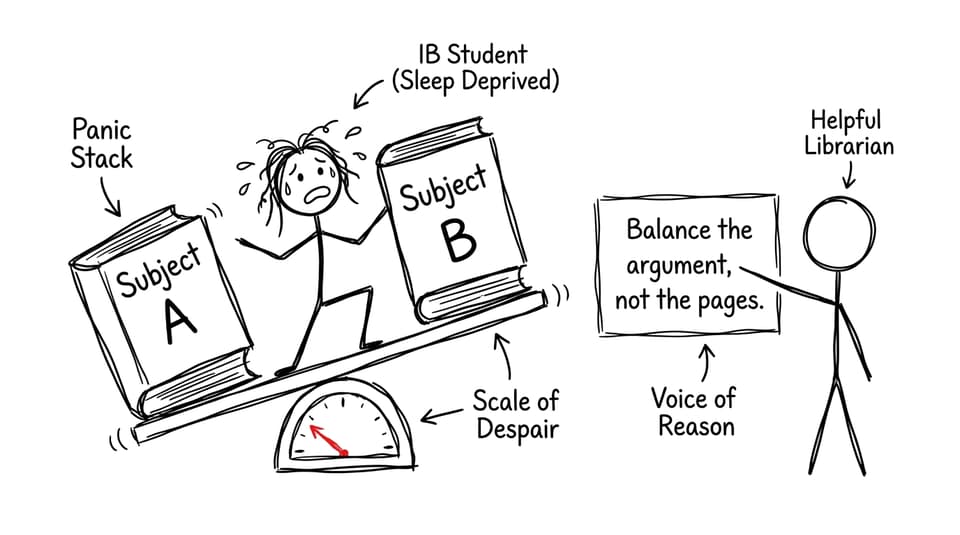
The quick answer: No, your interdisciplinary EE does not need 50/50
A 50/50 split is tempting because it feels measurable. You can count pages. You can count citations. You can reassure yourself you were “fair.”
But an examiner is not grading your ability to share airtime. They’re grading how well your EE answers a focused research question using an interdisciplinary approach.
In an interdisciplinary EE, one subject often becomes the engine and the other becomes the steering. Sometimes the steering needs fewer words, but without it, you crash.
If you want a broader primer on how World Studies works, start with What is a World Studies EE? and keep it open while you plan.
A checklist to test whether your EE is integrated (not just “two subjects”)
Use this as a fast diagnostic before you rewrite half your draft.
- Your EE research question cannot be answered well using only one subject.
- Each body section shows interaction between lenses (not separate “Subject A chapter” then “Subject B chapter”).
- Key terms from both subjects are defined and used in analysis.
- Evidence is interpreted through both perspectives, even if one dominates.
- Your conclusion synthesizes insights from both subjects into one final answer.
If you’re still designing your question, How to Craft the Perfect IB Extended Essay Research Question will help you stress-test whether you’ve built a question that requires integration.
What “balanced” actually means in an interdisciplinary EE
“Balanced” is not a word-count rule. It’s a logic rule.
Balanced means:
- the reader can see what each subject contributes,
- the contribution is essential (not decorative), and
- the integration improves your ability to answer the research question.
A useful way to think about your EE is this: you’re not running two parallel races. You’re building one bridge.
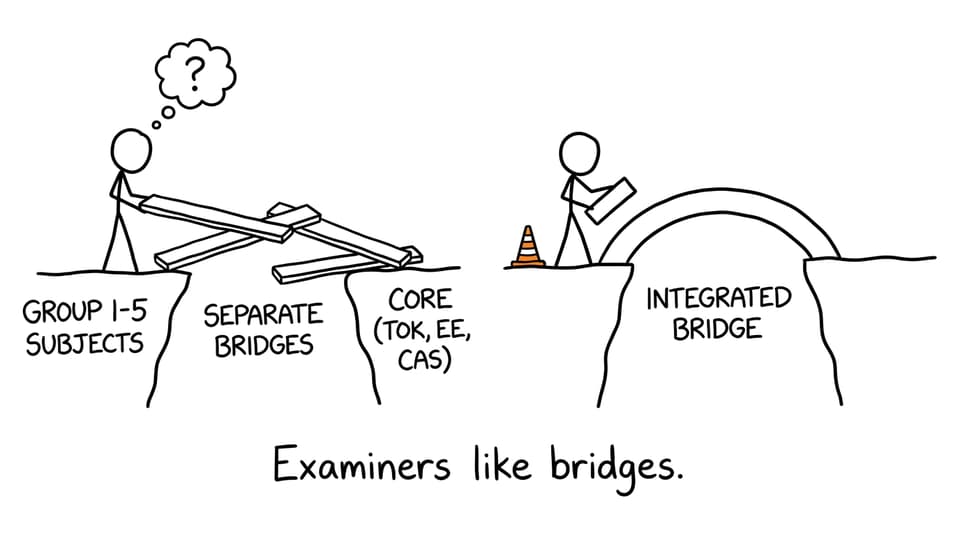
If you want to align this with marking language, RevisionDojo’s IB World Studies EE Grader is a practical way to check whether your integration reads as “methodologically justified” rather than “randomly combined.”
When an uneven split is not only okay, but smarter
Most strong interdisciplinary EE topics have an uneven center of gravity.
Your research question leans naturally toward one method
If your question requires heavy data analysis (say, economics-style modeling) but uses a second subject to frame meaning (say, global politics or geography), your EE might be 70/30 in method. That’s normal.
The danger isn’t leaning. The danger is leaning without showing why the second subject was necessary.
Your evidence base is asymmetric
Sometimes one subject provides abundant high-quality sources and the other provides fewer but more conceptually powerful ones.
Example pattern:
- Subject A: many sources, many data points.
- Subject B: fewer sources, but they change your interpretation.
Your EE can be shorter on Subject B content, as long as Subject B changes the shape of your argument.
One subject supplies the conceptual framework
Frameworks often take fewer paragraphs to explain than to apply. You might introduce a conceptual lens from Subject B briefly, then use it throughout to interpret Subject A evidence.
That’s integration. That’s not imbalance.
For more on building analysis instead of summary, How to Make Your IB Extended Essay Analytical, Not Descriptive is a strong companion guide.
The most common “50/50” trap (and how to avoid it)
The trap looks like this:
- Section 1: Subject A theory dump
- Section 2: Subject B theory dump
- Section 3: A short conclusion saying “both matter”
This usually reads like two separate EEs forced into one.
A better structure for an interdisciplinary EE
Try a rhythm that forces integration repeatedly:
- Introduction: establish global issue, define both subject lenses, state why both are needed for the EE.
- Body Section A: claim + evidence + analysis through Subject A, then challenge or refine through Subject B.
- Body Section B: repeat, but with a different angle or case.
- Synthesis section: explicitly compare what each lens explains well vs poorly.
- Conclusion: one answer, one line of reasoning, two integrated lenses.
If you need help with flow, use How to Create an Effective EE Outline for a Logical Flow and build sections that force cross-subject interpretation.
How to prove integration (even if one subject is “smaller”)
Integration is something you show on the page, not something you promise in the intro.
Use “handoff sentences” between lenses
A handoff sentence is when you deliberately pass the same evidence through a second lens.
Example templates:
- “Economically, this suggests __. However, from a politics perspective, the same pattern indicates __.”
- “While the data supports __, the ethical lens complicates this because __.”
You can do this in 1-2 sentences at the end of a paragraph. It’s small, but it signals true interdisciplinary thinking in your EE.
Build one shared key term list
Instead of separate definitions, create a unified vocabulary. If you define “development,” for instance, define it in a way that explicitly notes how each subject treats it.
Make limitations interdisciplinary
A strong EE acknowledges limitations. In an interdisciplinary EE, your limitations should include what each subject cannot capture alone.
This naturally leads to synthesis, which tends to score well because it demonstrates judgement.
To tighten your overall EE structure, RevisionDojo’s How to Structure an Extended Essay (EE) is a useful reference point.
How RevisionDojo helps you execute an interdisciplinary EE (without guessing)
When students struggle with their EE, it’s rarely a motivation problem. It’s usually a feedback and clarity problem: What exactly is the examiner looking for, and where am I drifting?
RevisionDojo is built for that moment.
- Use the Coursework Library to see what strong interdisciplinary writing looks like, then borrow structure (not content).
- Use the Grading tools like the IB World Studies EE Grader to self-check integration against rubric language.
- Use Study Notes to quickly refresh subject-specific terminology so your EE sounds academically anchored.
- Use Flashcards to drill your key concepts (especially the ones that connect both subjects).
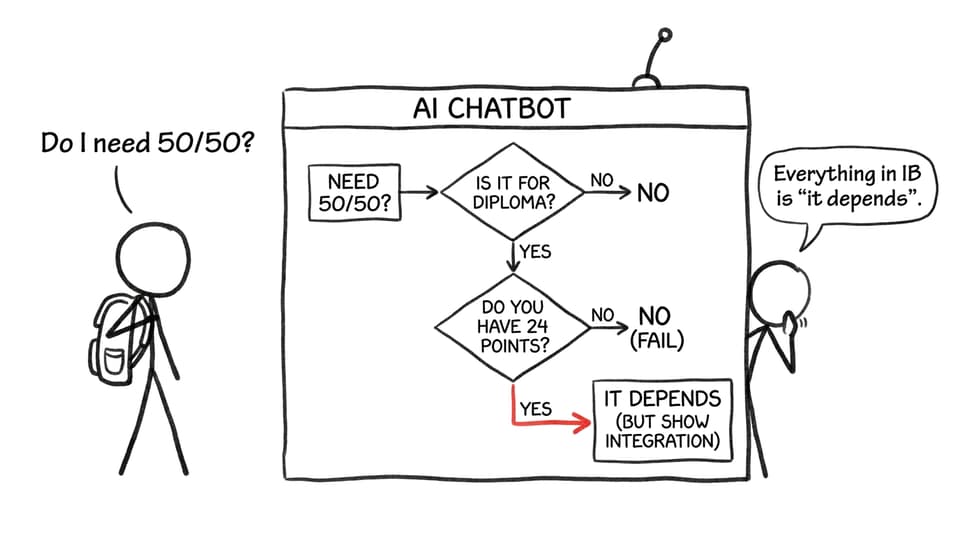
- Use AI Chat to pressure-test whether your research question truly requires both subjects, and to generate counterarguments you can address.
- Use Tutors if you need human guidance on whether your balance is justified and your synthesis is convincing.
Even if you’re currently in exam mode, an EE still competes for your attention. The point is to make your EE time efficient, not endless.
If you’re planning the full process, Mastering IB Extended Essays: How to Research, Write, and Revise is a good roadmap.
Closing: Aim for necessity, not symmetry, in your EE
An interdisciplinary EE is not a peace treaty between two subjects. It’s a tool for answering a research question that is too real, too complex, or too layered for a single lens.
So no, you do not need to balance both subjects equally in your EE.
But you do need to make your integration obvious, repeated, and necessary. Make the reader feel that each subject changes what you can claim, how confidently you can claim it, and what your final answer means.
If you want to turn that principle into a plan, use RevisionDojo’s Questionbank to stay sharp for exams while your EE simmers in the background, lean on Study Notes and Flashcards to keep concepts precise, and use AI Chat plus the Grading tools to check whether your EE is integrated enough to score well. Add Mock Exams and Predicted Papers to your revision routine, and you’ll keep your exam momentum without letting your EE drift.
Your EE doesn’t need to be 50/50. It needs to be convincing.