

A funny thing happens the first time you read an examiner’s comments closely: you realize they weren’t “grading your effort.” They were grading the quality signals in your writing.
That’s why IB English markbands are so powerful. They’re not just a scoring sheet you see after the fact. Used early, they become a mirror: honest, sometimes uncomfortable, and incredibly useful. If you want a clearer path to higher marks, the fastest shift is learning to self-assess like the markbands do.
The markbands mindset in IB English
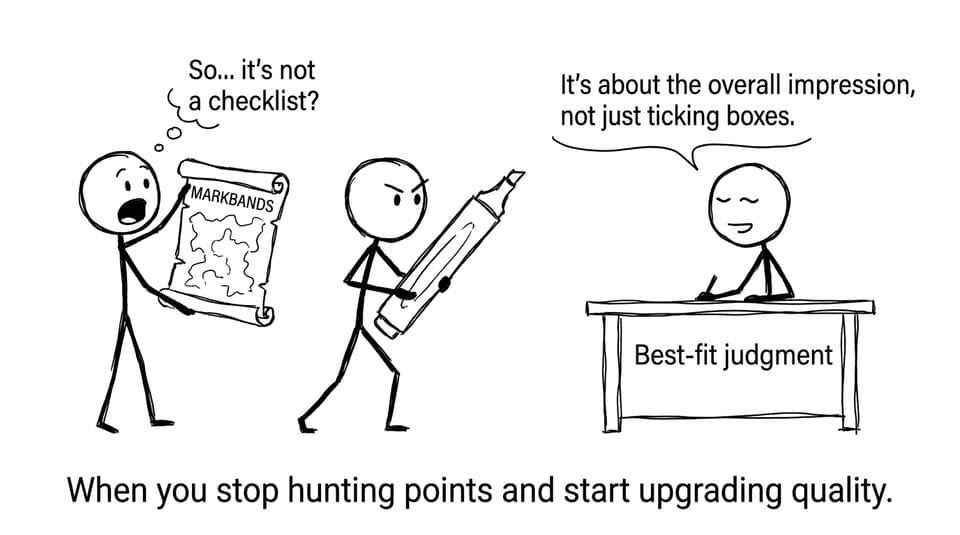
In IB English, markbands reward “best-fit” quality. That means examiners don’t count how many techniques you named. They judge how well your response works overall across the criteria.
So self-assessment isn’t you pretending to be your teacher. It’s you learning to notice what the markbands notice:
-
Does the essay show real interpretation, not retelling?
-
Does analysis explain how choices create meaning?
-
Does the line of argument stay focused and develop?
-
Is the language clear, controlled, and purposeful?
If you want a rubric-focused breakdown written for students, keep this open while you practice: How to Understand and Apply the IB English Assessment Rubrics.
A quick self-assessment checklist (save this)
Before you rewrite a single paragraph, run this five-minute IB English check:
-
Circle your thesis. Does it answer the task directly and interpretively?
-
Underline topic sentences. Do they argue (not announce)?
-
Highlight “analysis verbs” (suggests, implies, exposes, contrasts). Is there enough?
-
Mark every quote. Does each one earn its place by proving a claim?
-
Read your intro and conclusion back-to-back. Do they match?
Then choose two priorities only. Markbands reward the biggest upgrades, not the most edits.
Criterion A in IB English: interpretation beats summary
Criterion A is where many IB English drafts quietly lose marks because they sound knowledgeable but stay safe.
A practical self-check is this: Could my paragraph exist without this specific text? If yes, you’re drifting into general commentary.
Try these upgrades:
-
Replace plot recap with authorial choice: “Instead of showing X, the writer frames X through…”
-
Make your thesis “arguable”: it should take a stance, not state a theme.
-
Use micro-evidence: short, targeted quotations that you can actually unpack.
To build stronger interpretation habits for Paper 1 practice, pair your drafting with a method-focused guide like IB English Paper 1 Revision: A Step-by-Step Guide.
Criterion B in IB English: give every quote a job
Criterion B is the engine room of IB English. It’s where you prove you understand how texts create meaning.
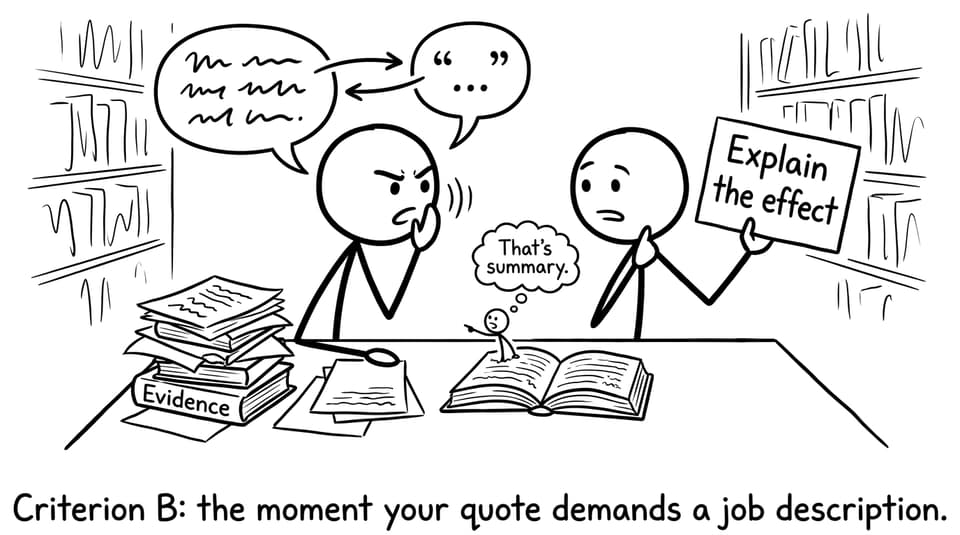
Here’s the simplest self-assessment trick: after every quotation, write “This matters because…” If you can’t finish the sentence, you probably placed evidence without analysis.
Common high-impact upgrades:
-
Move from naming to explaining: not “metaphor,” but “the metaphor compresses fear into…”
-
Track effects on the reader: tension, irony, intimacy, distrust, urgency.
-
Link technique to purpose: how does this choice shape the text’s message?
If you need more unseen-specific technique help, this is a strong companion: IB English: Analyze Language and Style in Paper 1 Unseens.
Criterion C in IB English: your structure is your argument
In IB English, organization isn’t decoration. It’s the shape of your thinking.
Self-assess Criterion C by checking whether your paragraphs form a chain:
-
Paragraph 1 makes Claim A.
-
Paragraph 2 deepens it or complicates it.
-
Paragraph 3 extends it to a bigger implication.
Quick fixes that often move you up a band:
-
Rewrite topic sentences as mini-theses.
-
Add signposting that clarifies your line of inquiry (“This shift matters because…”).
-
Cut the paragraph that repeats the previous one with different words.
When you’re under time pressure, structure becomes even more important. This guide helps keep your planning practical: IB English Time Management for Assessments That Matter.
Criterion D in IB English: clarity is a scoring strategy
Criterion D isn’t “use fancy vocabulary.” It’s control.
A strong IB English self-assessment routine for language:
-
Read one paragraph aloud. If you run out of breath, split the sentence.
-
Swap vague verbs (“shows,” “says”) for precise ones (“undermines,” “frames,” “amplifies”).
-
Remove repeated filler (“clearly,” “in order to,” “very”).
-
Check tense consistency and quotation punctuation.
Polishing matters most after you’ve upgraded A, B, and C. Clean language can’t rescue unclear thinking, but it can absolutely elevate strong thinking.
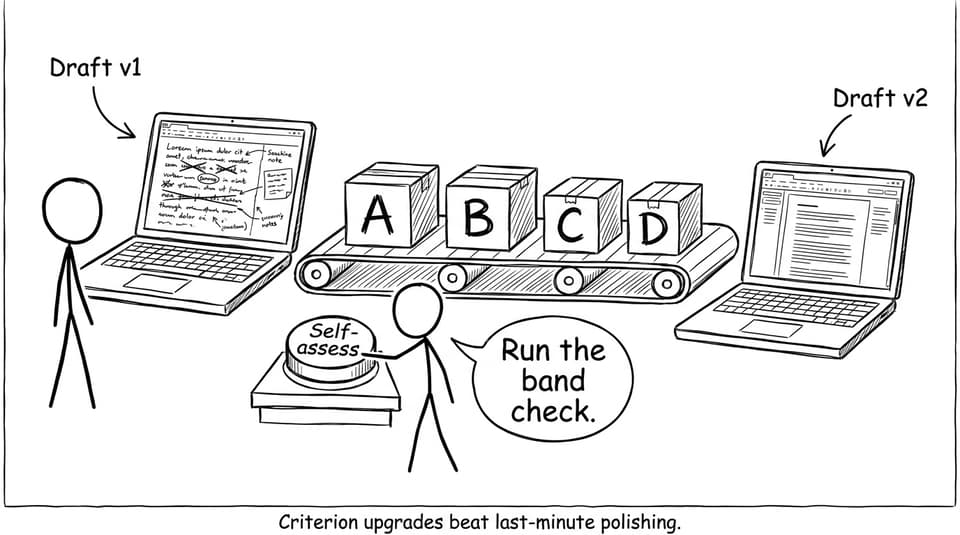
A simple 5-step self-assessment method (built for markbands)
Mark your draft by criterion
Color-code A, B, C, D in your draft margins. You’re looking for imbalance: many students have lots of “C” (structure) but not enough “B” (analysis).
Score with brutal honesty
Pick the band descriptor that fits overall. In IB English, “best-fit” means you don’t need perfection, but you do need consistency.
Choose two upgrades
One content upgrade (A or B), one communication upgrade (C or D). This keeps revision focused.
Revise like an examiner
Rewrite the thesis, re-plan body paragraphs, then rewrite your strongest paragraph last. That order prevents you from polishing weak logic.
Re-score and track patterns
Keep a tiny tracker: “A: thesis too broad” or “B: quote dumped.” Patterns are gold because they tell you what to practice next.
If you want a broader framework for markbands beyond English tasks, this companion article is useful: Understanding the IB Markbands for IAs and EEs.
How RevisionDojo makes IB English self-assessment easier
Self-assessment works best when it’s fast, repeatable, and grounded in real criteria. RevisionDojo is built around that loop.
-
Use the Study Notes and Cheatsheets to sharpen terminology and analysis moves: English A Lang & Lit Cheatsheets.
-
Train with targeted prompts in the Questionbank: IB English A Lang & Lit Questionbank and the English Paper 2 Questionbank.
-
Get criterion-based feedback using Grading tools like the IB English A: Language and Literature Grader and task-specific tools like the IB Language A: HL Essay Grader.
-
Lock in recall with Flashcards, pressure-test with Mock Exams, and sanity-check progress with Predicted Papers.
-
When you’re stuck, use AI Chat to ask: “Which criterion is weakest in this paragraph and why?”
-
If you want human calibration, RevisionDojo’s Tutors can help you match your self-scoring to examiner expectations.
FAQ: Implementing the markbands for IB English self-assessment
How often should I self-assess in IB English?
In IB English, self-assessing every full essay can be unrealistic during busy weeks, but you should self-assess something every time you practice. A good rhythm is one full markband self-score per week, plus a quick criterion check after smaller tasks like a single body paragraph. The goal is repetition, not perfection. Markbands become useful when you can predict your likely band before anyone else tells you. Over time, you’ll notice recurring issues (often thesis clarity or thin analysis) and fix them earlier. That’s when your practice starts compounding.
What if I don’t understand a markband descriptor?
Treat the descriptor like a translation problem, not a personal failure. In IB English, words like “effective,” “insightful,” and “convincing” have specific behaviors attached to them. Rewrite the descriptor into a concrete action you can take, such as “each paragraph must explain effect on the reader” or “my thesis must argue a perspective, not a theme.” Then test it on one paragraph and see if it changes your writing. If it still feels vague, compare two sample paragraphs and ask which one better fits the descriptor and why. Using a grader tool can also clarify what the criteria look like in practice because feedback is anchored to the rubric language.
Can peer assessment help with IB English markbands?
Yes, if it’s structured. In IB English, unstructured peer feedback often turns into “this is good” or line edits that don’t change the band. Instead, give your partner only two tasks: (1) identify the thesis and restate it, and (2) label one paragraph as strongest for Criterion B and explain why. This forces attention onto interpretation and analysis, not vibes. Then swap and repeat with Criterion C: ask whether the argument develops or just repeats. Peer assessment works best when you both use the same markband language and aim for best-fit judgments. It becomes even stronger if you both practice on the same kind of prompt under timed conditions.
Conclusion: use IB English markbands as a compass, not a verdict
If you want to improve faster in IB English, stop waiting for the markbands to arrive after grading. Bring them into the room while you draft.
Score honestly. Pick two upgrades. Revise with purpose. Repeat.
And when you want that process to feel simpler (and less lonely), build your routine on RevisionDojo: train with the Questionbank, sharpen skills with Study Notes and Flashcards, get rubric-aligned feedback with Grading tools, and use AI Chat or Tutors to calibrate your self-assessment. The markbands don’t have to be a mystery. In IB English, they can be your strategy.